


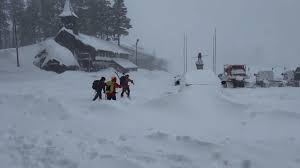
Eight of nine skiers buried in an avalanche near Lake Tahoe in northern California’s Sierra Nevada mountains have died, according to the Nevada County Sheriff’s Office.
One is still missing, Nevada County Sheriff Shannan Moon said.
Six skiers participating in the three‑day backcountry trip had previously been rescued with “various injuries,” the sheriff’s office said. A group of skiers on the final stretch of a three‑day backcountry trip near Lake Tahoe in Northern California was returning to the trailhead Tuesday morning when a wave of ice, rocks and debris came crashing down on them.
In the avalanche’s wake, survivors were left scrambling to try to find the rest of their group — and to improvise shelter as they awaited rescue.
The disaster at Castle Peak set off a dangerous, hourslong rescue effort hampered by heavy snow and strong winds from the winter storm roaring through the rugged Sierra Nevada mountains.
Emergency crews received reports of the avalanche around 11:30 a.m. and “highly skilled rescue ski teams” immediately began racing to the scene — 46 emergency first-responders in all, the Nevada County Sheriff’s Office said.
Eleven hours later, six survivors had been rescued with “various injuries,” according to the sheriff’s office, noting two had to be transported to the hospital for treatment. Nine are still missing.
“The search is ongoing, pending weather conditions,” the sheriff’s office said late Tuesday.
The area was under the second highest level, a 4 of 5, of avalanche threat Tuesday, which continued into the early hours of Wednesday.
“Natural avalanches are likely, and human-triggered avalanches large enough to bury or injure people are very likely,” the National Weather Service warned. “Traveling in, near, or below backcountry avalanche terrain is not recommended during high avalanche danger.”
Blackbird Mountain Guides, the company leading the trip, recognized the danger as well, posting a reel on Facebook two days before that avalanche about the condition of the snow, “This weak layer could lead to some unpredictable avalanches!” It added, “Pay close attention to places where faceting has been particularly strong – avalanches could behave abnormally, and the hazard could last longer than normal … use extra caution this week!”
An avalanche warning remains in effect for the greater Lake Tahoe area through 5 a.m. Thursday, according to the Sierra Avalanche Center. Fresh snow – though still below normal levels – means there’s high danger in the backcountry for large avalanches.
Remote, undeveloped and isolated areas of wilderness are often called “backcountry.”
As they continue to search, rescue crews will face additional rounds of snow, gusty winds and more avalanche danger this week that could hinder efforts.
Snow blankets the roads, ground and treetops in video of the area released by the California Highway Patrol. The video warns drivers not to be fooled by the clear sky – the roads remain “covered in ice, cold, and slick.”
Blackbird Mountain Guides updated the number in the group to 11 clients and four guides after initially saying there were 16 people who had been staying at the Frog Lake huts since Sunday. Only 11 of the 12 planned guests were on the trip, Nevada County Sheriff Shannan Moon said Wednesday – one had backed out at the last minute.
“Our primary focus and entire team are currently dedicated to the search and rescue efforts in the the Castle Peak area. We are in constant communication with the Nevada County Sheriff’s Office and local Search and Rescue teams as they continue their work. … Our thoughts are with the missing individuals, their families, and first responders in the field,” the tour company said.
On its website, the company advertises the ski trip to the Frog Lake huts for those with an intermediate to advanced skill level. Skiers spend their days navigating the mountain off-trail through steep terrain with the aid of guides, before returning to the huts for dinner, the company says.
The huts are near Donner Summit in “truly rugged, wild terrain” – an area that before 2020 was closed to the public for nearly a century.
Following the first call for help Tuesday, dozens of first responders approached the scene from multiple directions: Search and rescue teams staged at Boreal Mountain Ski Resort and Tahoe Donner’s Alder Creek Adventure Center, where they were dispatched along with rescue crews from surrounding counties.
The rescuers approached the scene on skis and snowcats, with snowmobiles on standby, as they battled the harsh weather in the region, where snow was falling at a rate of 3 to 4 inches an hour Tuesday.
According to the Utah Avalanche Center, 93% of avalanche victims live if pulled out within 15 minutes. After 45 minutes, only 20% to 30% of victims survive, and after two hours of being buried in the snow, most people don’t make it.
As the time ticked by, the survivors were told to “shelter in place as best they can in the conditions,” the sheriff’s office said.
The stranded skiers were communicating with rescuers through emergency beacons, including some with the ability to send text messages, Capt. Russell Greene of the Nevada County Sheriff’s Office told CNN affiliate KCRA.
The group crafted a makeshift shelter from a tarp, “doing everything they can to survive,” Greene said.
For safety, everyone in the backcountry should wear emergency beacons or receivers, according to Mike Duffy, an avalanche instructor at Silverton Avalanche School in Colorado.
“You’re sending a signal. When someone gets buried, you switch it to search. You can also pick up that signal and pinpoint the person,” Duffy said. “Having a GPS satellite communicator makes a big difference. You can get a message out and get the rescue teams in there. It takes rescue a long time to get in there.”
By CNN
Email your news TIPS to Editor@Kahawatungu.com — this is our only official communication channel
