


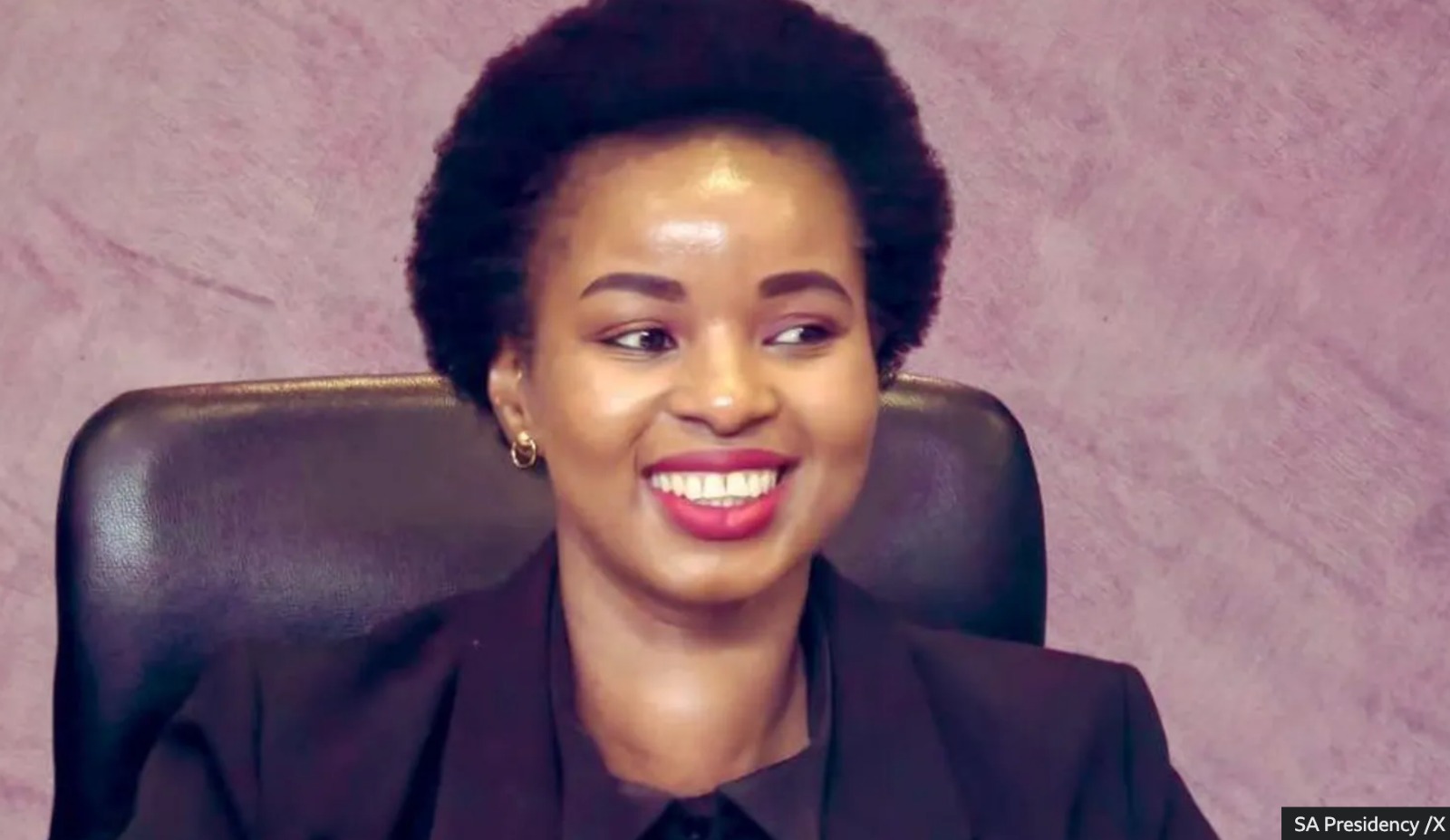
South Africa’s first black female nuclear scientist, Senamile Masango, a trailblazer who set out to inspire young women, has died aged 37, the government has confirmed.
Ms Masango, dubbed “the queen of science” by some in South Africa, passed away on Sunday. The cause of her death is unknown.
Headstrong and ambitious, she “was a beacon of hope for many young people, especially women”, a statement from Deputy President Paul Mashatile said.
Despite her success she said she faced discrimination as a black woman as she constantly had to prove that she knew what she was talking about.
Nevertheless, her unwavering determination earned her deep respect in her field.
Ms Masango was the first African woman to join an African-led team conducting experiments at the European Organisation for Nuclear Research (Cern), which is the world’s largest particle physics laboratory.
“Masango’s tireless efforts to promote science education and empowerment, particularly among women and disadvantaged communities, will be deeply missed,” a statement from South Africa’s Department of Science, Technology and Innovation said.
Born in 1987 in the rural village of Nongoma, KwaZulu-Natal, the historical seat of the Zulu monarchy, Ms Masango’s mother was a princess in the royal family, and her father was a prominent figure.
She grew up in a polygamous family, with her mother being the youngest of three wives.
It was a challenging family set-up, she told local newspaper Sowetan Live, but she learned how to stand up for herself.
Her parents quickly recognised her early passion for learning and encouraged her to read extensively.
At 11, her geography teacher spoke about astronauts, sparking a lifelong interest in science.
“I was so fascinated to learn that there are people who travel to space – leave this dimension – and go to the moon,” she told Global Citizen, an organisation dedicated to ending extreme poverty.
“That’s when I fell in love with science.”
Ms Masango enrolled at the University of Zululand at 16 to study physics, but after becoming pregnant and failing some modules, she had to drop out.
With her family’s support, she returned to complete her degree and later earned an MSc in nuclear physics at the University of the Western Cape, graduating with distinction.
Tragically, her daughter died in a car crash aged seven.
Beyond her academic accomplishments, Ms Masango established a foundation dedicated to encouraging young women to pursue science.
“Girls are discouraged at an early age from taking science subjects; it is the root cause of the lack of women in the nuclear space,” she said.
Her remarkable achievements included being named one of South Africa’s most successful black women scientists under 35 in 2019 and earning a spot on the Mail & Guardian’s 200 Young South Africans in Science and Technology list.
In 2022, she received the prestigious International Women in Science Award, recognising her profound impact on the scientific community.
But throughout her career, Ms Masango faced misogynoir – the discrimination black women face because of their race and gender.
“The biggest challenge in my career is my skin colour. If you look like me, no-one believes in you; you must prove that you know your job and that you can think!”
“There are still very few black women scientists. This means women like me have to work twice as hard to prove their worth,” she said.
Yet, she persevered, using her journey to help inspire a new generation to pursue science fearlessly and boldly.
By BBC News

Email your news TIPS to Editor@Kahawatungu.com — this is our only official communication channel
