


For as long as many residents of Nairobi can remember, the Kenyan capital has been awash with red every 14 February.
On Valentine’s Day, people are dressed in red, the colour of love and romance, or are carrying red roses.
Traders are quick to cash in, selling fresh blooms from local farms, as Kenya is one of the world’s top producers of cut flowers.
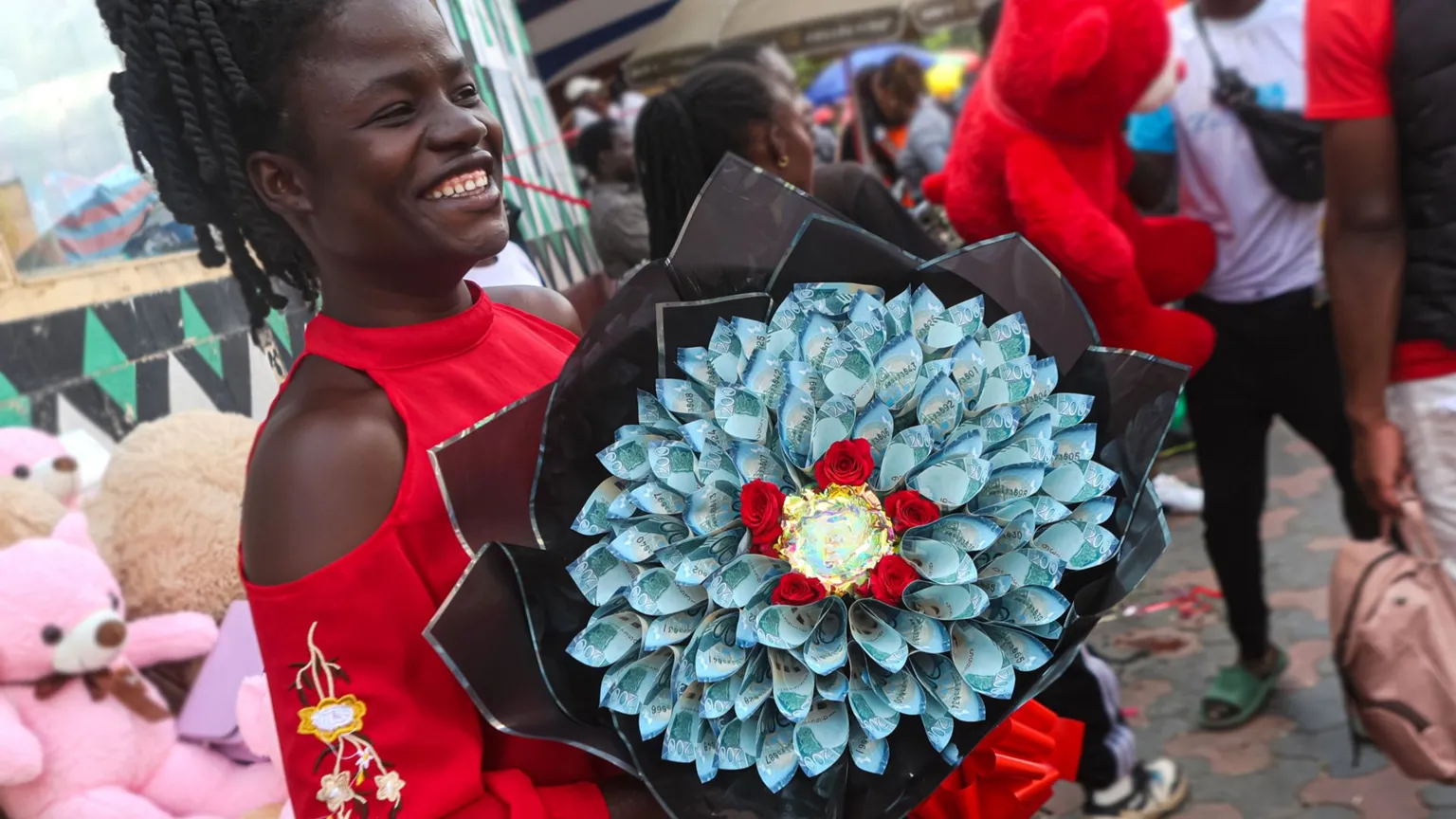
Recently though, instead of the soft red petals, some people have been opting for the brown, blue or purple of crisp banknotes, folded, rolled or fastened together into floral-like bouquets.
The trend has spread to other African countries and has become so pervasive that it has drawn the concern of central banks in Kenya, Uganda, Rwanda, Botswana and Namibia.
They have all issued public warnings against damaging or defacing banknotes when making these bouquets of cash.
The Central Bank of Kenya (CBK) says that in many instances, banknotes are “glued, taped, stapled, pinned or otherwise affixed”.
Damaged notes can then be rejected by automated teller machines (ATMs) and cash‑sorting equipment, meaning they have to be withdrawn from circulation, at a cost to the taxpayer.
In its notice, the CBK said it was not opposed to the use of cash gifts – only to practices that damaged notes – an offence that could lead to creators of money bouquets being jailed for up to seven years.
Cash bouquets have been popularised by celebrities and online influencers, who often share videos of themselves presenting such gifts.
The celebrations are not limited to Valentine’s Day – they extend to birthdays and other special occasions, meaning money bouquets are in demand throughout the year.
The bouquets come in various designs, with creators arranging the banknotes to suit the taste and budget of each customer.
The wads of cash used in such bouquets vary widely – they can amount to as little as 1,000 shillings ($8; £6) or as much as a million shillings, says Angela Muthoni, a florist at the Gift and Flowers shop in central Nairobi.
While many are created in floral designs, or a mix of flowers and money with elegant wrappings, they can also be part of cake designs or be given in gift boxes.
Muthoni says money bouquets have become popular in the last two years. In the run-up to Valentine’s Day, she has been receiving orders of between 15 and 20 bouquets every day, despite the CBK’s warning.
“Everyone loves money,” she tells the BBC, adding that gifting people cash takes away the stress of choosing a present.
Some Kenyans, however, argue that it just shows that people are becoming more materialistic, seeking to buy love with money, rather than romance.
“It’s some form of peer pressure,” 24-year-old Haskell Austin tells the BBC.
He prefers giving flowers, describing the idea of gifting money as “materialistic”.
But if cash must be given, he prefers a straightforward transfer instead of folding or decorating it into bouquets.
A woman who identifies herself only as Lynn is disappointed by the timing of the CBK’s caution against making cash bouquets, coming just ahead of Valentine’s Day, as she was looking forward to receiving one.
“People are still excited about the trend,” she tells the BBC at Koinange Street, a popular spot for buying flowers in Nairobi.
“I would prefer cash,” Nicole Rono tells the BBC. “Who doesn’t love money? Flowers are OK, yes, but now with what the CBK has said, you can still give cash without damaging it,” she says.
For university student Benjamin Nambwaya, the fact that women are usually the recipients is based on social expectations.
He tells the BBC that the culture of giving money bouquets is a “bad thing” and can end up “destroying relationships”, especially when it creates an expectation even when one cannot afford to give money.
He would prefer to give flowers.
“I think flowers are cool, because this is a small celebration or something just to show how how much you really adore this person,” he says.
Economic expert Odhiambo Ramogi says it is all about “our capitalistic approach to life”.
“Capitalistic societies are driven by advertising, by marketing and special days like Valentine’s are a very good opportunity.”
For Muthoni, the florist, it comes down to how someone wants to express their love.
“Love people the way they want to be loved,” she says, although she concedes that ultimately money is at the heart of it.
“You can buy a lot of things with money. You might not know what someone likes, but money is the solution.”
Discussions about money bouquets have been widespread on social media since the CBK’s warning, drawing both praise and derision.
It has sparked some humour as well, such as memes of bouquets made from rolled chapati bread.
Speaking about the trend on TikTok, Kenyan Scott Ian Obaro said it may also have encouraged a culture of “showing off”.
Ramogi argues that the idea of giving flowers is largely a foreign concept in Africa, which he says helps explain why the culture of gifting money is more readily embraced.
“The African hardly gave flowers,” he says, adding that the practice is a Western tradition and that many Kenyans would prefer money “to take care of a need” rather than a flower given purely for sentimental reasons.
“But now it’s combined with the fact that we are more materialistic. The natural flower has been replaced with the currency flower,” he says.
The intervention by Kenya’s regulator, along with those in other countries, may slow the culture of giving money bouquets.
Muthoni fears the move could lead to a loss of income for people who have built livelihoods around the bouquets, though she believes there is room for innovation.
She says she has designed bouquets with transparent pockets that can hold money without it getting damaged and is considering other ideas such as digital bouquets.
Some have switched to using US dollars, which would not be affected by the warning from Kenya’s central bank.
So the money bouquet culture is unlikely to be nipped in the bud any time soon.
By BBC News
Email your news TIPS to Editor@Kahawatungu.com — this is our only official communication channel
