


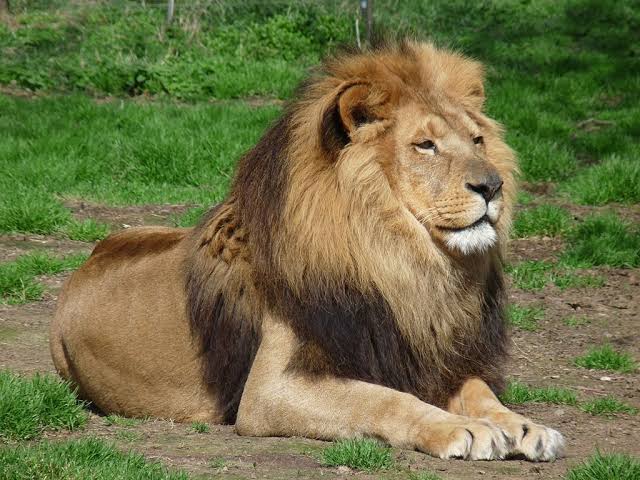
Lion DNA has been used to successfully prosecute poachers for the first time in the world, it has emerged.
Wildlife crime experts have only just revealed how they were able to identify the individual animal from body parts found in a suspect’s village, as they matched a profile on Zimbabwe’s lion database.
A blood sample had previously been taken from the male lion, which was being tracked by authorities in Hwange National Park – using a radio collar.
Two poachers were convicted for the 2024 incident and sent to prison in what is thought to be the first prosecution of its kind.
The details of the convictions and the role the DNA database played have been previously unknown.
Non-governmental organisation (NGO) Traffic, which works to combat the illegal trade in wildlife, has shared the detail with us.
In May 2024, authorities in Hwange National Park became suspicious after a radio collar worn by a male lion stopped working.
Investigators and police traced its last known position and found a snare with lion fur attached to it.
After collecting forensic evidence they questioned two men in a nearby village and discovered three sacks of meat, 16 lion claws and four teeth. These body parts would later be tested against the database, with the DNA from all matching the profile of that missing lion.
But possessing lion parts is not necessarily a crime in Zimbabwe.
Having them can be explained away as old, traditional ornaments or as coming from an animal that died of natural causes.
This has been an obstacle to prosecutions in the past.
But thanks to a breakthrough in DNA profiling, that’s now changed.
The lab generated a DNA profile from the recovered body parts and compared this to the profile previously generated from a blood sample of the lion with the radio collar.
The two profiles matched and scientists were able to identify the specific missing animal.
Over the last eight years the Victoria Falls Wildlife Trust (VFWT) has received about £250,000 from the People’s Postcode Lottery in the UK to build up the DNA database of lions in Zimbabwe.
The scientist at the trust, who made the discovery, asked to remain anonymous for his own safety, but said:
“Before we had access to this technology, we were only able to do species identification, but sometimes that’s not enough.
“We can essentially match those claws or those products to the lion of interest that we are looking for.”
Within 10 days of the killing, the DNA evidence was presented in court.
Two men pleaded guilty and were given 24 month prison sentences.
The hearing was told the value of the lion was about $20,000.
Richard Scobey, Traffic’s executive director, said “countries now have the forensic capability to bring, solid science-based evidence to court” and that it will have global impact.
This is understood to be the first time that DNA from an individual lion has been identified and used to prosecute poachers.
Professor Rob Ogden has been closely involved in setting up the project and is co- founder of the organisation Trace, which promotes the use of forensic science in wildlife law enforcement.
He says the prosecution gives “a message of hope” and shows what can be done using a combination of training, research and development and forensic casework.
Recent figures suggest an increase in the number of lions being killed for their body parts which are then sold both as cultural objects in Africa and for traditional Chinese medicine.
It is thought the rise may be down to organised crime gangs also involved in the illegal trade in Rhino horn and ivory trafficking.
In Mozambique between 2010 and 2023, 426 lions were killed as a result of contact with humans with a quarter linked to deliberate poaching.
A measure of the scale of the trade is also the number of seizures by the authorities in recent years.
That includes 17 lion skulls found in Lusaka in 2021, reportedly en-route from South Africa, and a 2023 seizure in Maputo of more than 300kg of lion body parts.
Which is why this breakthrough on DNA identification is seen as sending an important message to would-be poachers.
By BBC News
Email your news TIPS to Editor@Kahawatungu.com — this is our only official communication channel
