


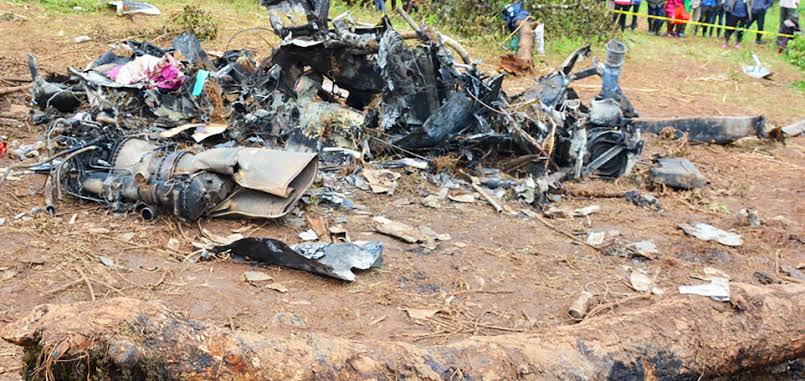
A preliminary investigation into the helicopter crash that killed Emurua Dikirr MP Johana Ng’eno and five others identified deteriorating weather conditions and reduced visibility as the primary factors behind the February 28, 2026 accident.
The report, released by the Aircraft Accident Investigation Department (AAID) under the Ministry of Roads and Transport, confirms that the Airbus AS350B3 Ecureuil (5Y-DSB) was conducting a commercial charter flight when it encountered adverse weather.
While the aircraft had completed several flights earlier that day, it encountered fog, light rain, and severely reduced visibility en-route to Emurua Dikirr.
There was a sudden shift in atmospheric conditions. While the Kenya Meteorological Department had predicted moderate afternoon rain, eyewitnesses at the Chepkiep crash site described a much grimmer reality: thick fog that reduced visibility to less than 20 meters.
“Eyewitness accounts indicated that at the time of the accident, there was moderate rainfall and the presence of heavy fog with reduced visibility of less than 20m. Low cloud cover up to 1,000 ft above ground level was also reported,” the report reads.
According to investigators, these conditions forced the pilot to make a precautionary landing in an open field at Tabolwa, Nandi County, at 4:20 pm.
The crew waited for the weather to clear, but the pause lasted only five minutes. Believing a sufficient window had opened, the pilot attempted to resume the flight to Nairobi at 4:25 pm.
Tragedy struck just sixty seconds later. At 4:26 pm, the helicopter collided with “rising terrain” in the Chepkiep area of Mosop Sub-county, merely 200 meters from its takeoff point.
Operating under Visual Flight Rules (VFR), which strictly require a pilot to keep the ground in sight, the crew faced impossible navigation.
Satellite imagery and weather radar further confirmed a “deep presence” of cumulonimbus clouds and low cloud cover up to 1,000 feet above ground level at the time of the accident.
The investigation into the helicopter’s technical history revealed no mechanical anomalies. The aircraft held a current Certificate of Airworthiness valid until July 2026. Records from the Approved Maintenance Organisation (AMO), Lady Lori Engineering Ltd, showed the most recent maintenance checks were completed on December 19, 2025.
Furthermore, fuel records showed the aircraft had topped up 410 litres in Eldoret shortly before the crash, and its “mass and centre of gravity” were well within safety limits, ruling out overloading as a factor.
“The aircraft’s technical logbook indicated no Accepted Deferred Defects. Fuel records indicated that 410 litres of fuel were topped up at HKED, bringing the total fuel capacity to 550 litres. The Mass and centre of gravity were within the prescribed limits,” the report reads.
The AAID has issued an interim safety recommendation to the Kenya Civil Aviation Authority (KCAA), urging for strengthened operational guidelines.
They pointed to potential gaps in operational risk management across Kenya’s helicopter sector.
KCAA was urged to compel all helicopter operators—both commercial and private—to adopt and enforce comprehensive, risk-based operational minima tailored to the complexity of their missions.
The recommendations highlight the need for stricter controls across several critical areas, including weather limitations, terrain and environmental risks, aircraft performance, and operational decision-making.
According to the preliminary findings, operators should clearly define meteorological thresholds for all phases of flight, factoring in visibility, cloud cover, and adverse weather conditions that may compromise safety.
The advisory also stresses the importance of accounting for environmental challenges such as confined landing zones, obstacles, hostile terrain, and high-density altitude operations—conditions that significantly affect helicopter performance.
Investigators further note that aircraft-related limitations, including weight and balance, as well as single-engine capability, must be rigorously assessed before and during flights.
Mission-specific risks such as multi-leg operations, pilot fatigue, fuel management, and payload control were also flagged as key safety considerations.
To strengthen decision-making, operators are being encouraged to formalize pre-flight planning procedures, including clear go/no-go criteria and diversion protocols in case conditions deteriorate.
The recommendations call for these safety measures to be embedded in operators’ manuals, standard operating procedures, and safety management systems, backed by continuous crew training and subject to strict regulatory oversight and periodic review by the KCAA.
“The objective is to reduce accidents linked to weather, terrain, performance limitations, and human decision-making,” part of the advisory notes.
The ongoing investigation is expected to analyse all available evidence before issuing a final report detailing the findings, probable cause of the crash, and any additional safety recommendations.
Email your news TIPS to Editor@Kahawatungu.com — this is our only official communication channel
