


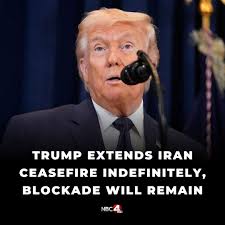
U.S. President Donald Trump has announced an extension of the ceasefire with Iran, delaying a planned military strike to allow Tehran more time to present a unified proposal to end the ongoing conflict.
In a statement shared on social media, Trump said he had instructed the U.S. military to maintain its current posture — including the naval blockade — while remaining prepared for action if negotiations fail.
“I have therefore directed our Military to continue the Blockade and… extend the Ceasefire until such time as their proposal is submitted, and discussions are concluded, one way or the other,” Trump stated.
The decision follows mediation efforts by Pakistan, with Prime Minister Shehbaz Sharif welcoming the move and expressing hope for a lasting resolution.
Sharif confirmed that talks are scheduled to continue in Islamabad, adding that Pakistan will keep pushing for a comprehensive peace agreement.
Iran has yet to formally respond to the ceasefire extension. However, officials have strongly criticized the ongoing U.S. naval blockade, calling it a violation of the truce.
Foreign Minister Abbas Araghchi described the blockade as an “act of war,” signaling that Tehran may reconsider its participation in upcoming negotiations.
Despite Trump’s claims that Iran’s leadership is divided, reports from Tehran suggest otherwise. According to regional analysts and journalists, the leadership remains cohesive following the death of former Supreme Leader Ali Khamenei.
His successor, Mojtaba Khamenei, has yet to appear publicly but is believed to be working closely with an established inner circle.
The ceasefire, originally agreed upon on April 8, has been fragile from the start. Major sticking points include:
- Control of the Strait of Hormuz
- The scope of Iran’s nuclear program
- Limits on missile development
- Iran’s regional alliances, including Hezbollah and Hamas
The U.S. is pushing for a complete shutdown of Iran’s nuclear activities and removal of enriched uranium stockpiles. Iran, however, insists on its right to maintain a civilian nuclear program and refuses to export its uranium.
Analysts suggest that the ceasefire extension may reflect shifting dynamics rather than progress. Iran’s control over key maritime routes has strengthened its bargaining position, complicating U.S. strategy.
With no clear deadline attached to the truce, uncertainty remains high. The coming talks in Pakistan could determine whether diplomacy prevails — or whether the conflict escalates further.
Email your news TIPS to Editor@Kahawatungu.com — this is our only official communication channel
