

A plane crashed into a tower in Beijing but China is not saying what happened

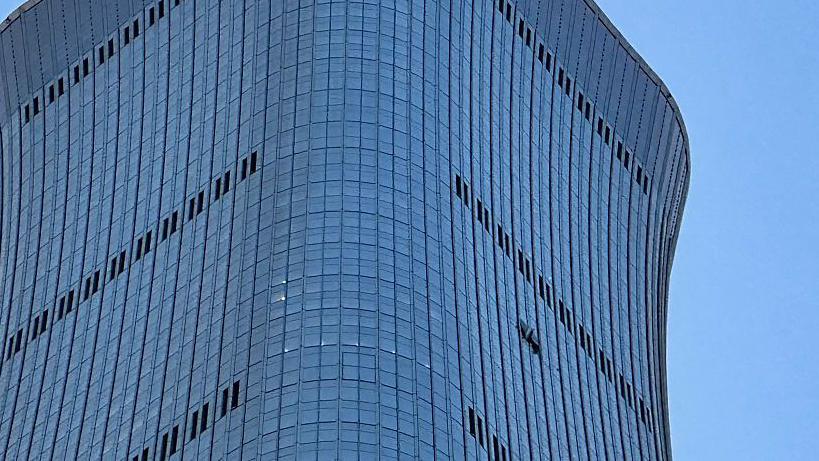
It has been four days since a small plane slammed into Beijing’s tallest skyscraper, killing the pilot – the only person on board – and wounding 13 others, but it’s still unclear why, and how, that happened.
A 60-word report detailing the basic facts in state-owned Beijing Daily is the only official statement China has published so far on the crash, which happened just a few kilometres from Zhongnanhai, the Communist Party’s headquarters.
Friday’s collision left holes on the side of the 109-storey CITIC Tower, which have since been boarded up. Dramatic footage of the incident has been scrubbed off the internet. At least three aviation firms tell the BBC they’ve been told to suspend light aircraft operations but declined to elaborate, saying they had been instructed not to discuss it.
Amid the information vacuum, speculation is mounting as to how the aircraft managed to penetrate a city which has some of the world’s strictest airspace controls.
China is no stranger to censorship. Criticism of the party, the country’s leaders or the government is rare, and any discussions that seem critical, have political implications or touch upon sensitive issues quickly disappear.
But this time it has gone well beyond the obvious targets. Photographs and memes of the skyscraper, which are unrelated to Friday’s incident, have also been removed from Chinese social media platforms.
Shaped like a Chinese wine vessel, the building is a local crowd-puller. Many see it as a lucky charm and young people wishing for good fortune, from exam results to jobs, either stop by or share photos of it online, along with a quick prayer.
The censorship machinery kicked in so quickly and thoroughly this time possibly because Beijing’s leadership is “still not exactly sure what happened”, says Manya Koetse, who runs the Eye on Digital China newsletter.
“This is a highly unusual incident,” she says, adding that it calls into question government competence and threatens “important party narratives”.
Even those aviation firms that confirmed to the BBC that authorities have grounded light aircraft operations since the incident did not wish to say more.
“We were told to not speak about it. Please ask others,” said a lady at a flight training institute in Beijing.
Another firm in Chengdu declined to specify which authority the instruction came from, and promptly ended the call.
Beijing enforces a permanent no-fly zone of roughly 100 sq km (39 sq miles) over its political core covering Tiananmen Square and Zhongnanhai, the heavily guarded compound where the country’s top leaders live and work.
Describing the incident as a “massive security breach”, China analyst Bill Bishop wrote on X: “Not many more seconds of flying and [the crash] could have been at Zhongnanhai… [That would have been] an earthquake in Beijing’s security system.”
Beijing also recently tightened regulations on drones, citing security concerns – drones now have to be registered before they can be brought in and out of the capital city.
“The fact that a small plane, considerably larger than most drones, was able to fly across much of the city and get quite close to Zhongnanhai is both politically embarrassing and a major security lapse,” says Raymond Kuo, vice-president of research at the Chicago Council of Global Affairs.
It could have been a case of pilot error or a mechanical failure, Kuo says, but adds that it could also “potentially have been intentional”.
The plane was a two-seat, single-engine Aurora SA60L manufactured by Chinese company Sunward Aircraft, according to flight tracking service Flightradar24. At 6.9m long, with a wingspan of 8.6m, it is designed for touring, aerial photography and recreational aviation.
Outside China, Friday’s incident has recalled, for some, the moment they heard about the September 11 attacks in 2001, when suicide attackers crashed US passenger jets into two New York skyscrapers, killing thousands of people.
“This was exactly the same news alert I received when a plane hit the first tower during 9/11,” a user wrote on Reddit.
Chong Ja Ian, a non-resident scholar at Carnegie China, says a closer parallel was the incident in May 1987 toward the end of the Cold War, when German amateur pilot Mathias Rust landed his light aircraft in the Red Square in Moscow.
“His flight and landing highlighted serious gaps in the Soviet air defence system. That incident led to the removal of several high-ranking officers responsible for air defence and security,” Chong says.
Similarly, he adds, some officials may be removed from their posts over the Beijing crash.
“A small plane hitting CITIC Tower means that a drone or missile might be able to as well. This is a bit of an embarrassment to the security services responsible for Beijing.”
By BBC News

