

AI Video Is Everywhere — But Trust Is the New Currency

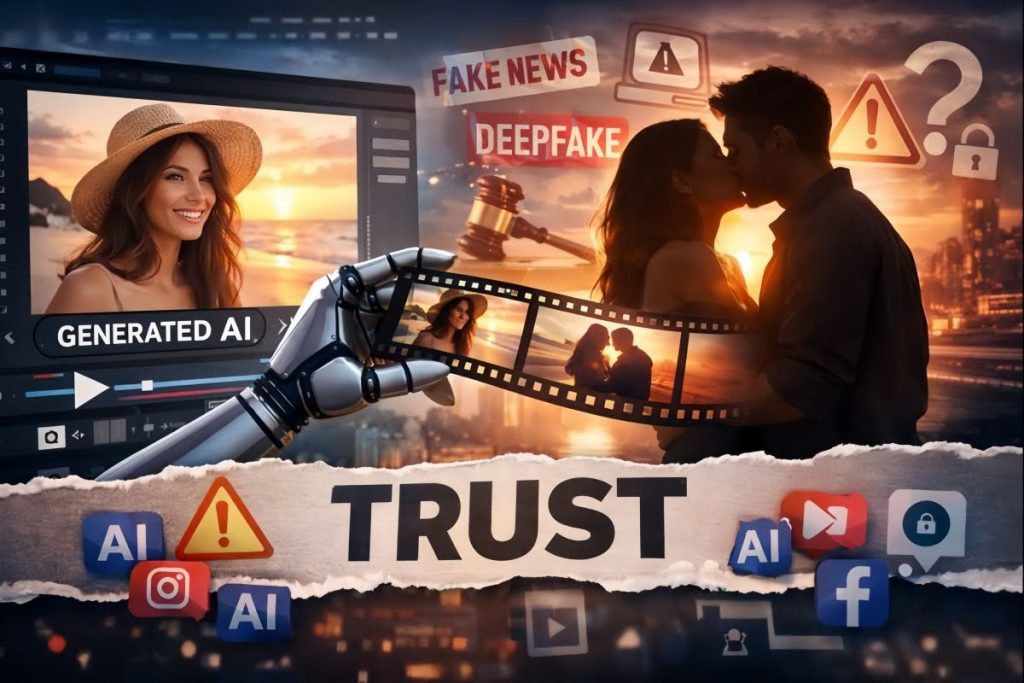
AI Video Is Everywhere
Scroll through TikTok, Instagram Reels, or X for five minutes and you’ll notice something: the “camera” no longer has to be real. A product shot can be generated. A background can be rebuilt. A person can “say” something they never said. And the clips that look like they were filmed on a set? Sometimes they weren’t.
That shift is now reaching a new stage — not just “cool tools,” but real-world rules. Platforms are moving to label AI-made videos, major creative companies are baking generative video into professional workflows, and publishers are wrestling with how AI changes traffic, licensing, and attribution.
So where does that leave everyday creators, small brands, and the average person who just wants to make content that looks good (and doesn’t get them into trouble)?
Let’s break it down in plain language.
Why AI Video Is Taking Off Right Now
AI used to be mostly about text and images. Video was the hard part: motion, lighting consistency, faces, hands, physics — all messy.
That’s changing fast. One signal is how quickly generative video is being pulled into “serious” creative stacks. Adobe, for example, announced a strategic partnership with Runway aimed at making generative video a dependable part of pro workflows — not just a toy for experiments.
For creators, this matters because it pushes AI video from “a trend” to “a workflow.” In practice, people are using AI video for:
- Social-first marketing (short promos, product loops, seasonal campaigns)
- Creator economy content (reaction clips, story visuals, meme formats)
- Fast localization (new backgrounds, different styles, quick iterations)
- Personal fun (photo animation, romantic effects, playful edits)
The upside is speed. The downside is… trust.
The trust problem: “Is this even real?”
The biggest change in 2026 isn’t only quality — it’s believability.
Once AI video crosses a certain realism threshold, the internet starts paying a price: confusion, scams, reputational harm, and deepfake abuse. That’s why labeling is becoming more mainstream. TikTok, for instance, has said it would automatically label AI-generated content from several platforms, a sign that platforms want clearer signals for viewers.
What this means for creators: if you’re publishing AI video, you should assume audiences (and platforms) will increasingly expect transparency. Not every clip needs a giant disclaimer — but hiding it can backfire.
Where the Money Breaks Down: Credit vs. Control
Behind the scenes, there’s another pressure point: who gets paid, and who gets scraped.
KahawaTungu has covered how authors pushed back on AI training and demanded compensation, reflecting a wider debate about using creative work to power AI systems.
Publishers have also been warning that AI-driven search experiences can reduce clicks to original sources, adding urgency to licensing talks, crawler blocking, and new distribution strategies.
- Why This Affects You, Even If You’re Just Posting Videos”:
- Platforms and regulators tend to respond when money, rights, and harm collide.
- The safest long-term approach is to create responsibly and use tools that respect consent and attribution.
A Creator-First Look at Using AI Video Safely
Here’s a simple way to think about it: AI video can be brilliant for transforming your own assets (your own photos, your own clips, your own product shots). It gets risky when it starts transforming other people.
A good “starter workflow” many creators use is turning still images into short motion clips — a clean way to make content without impersonation. If you want to explore that route, this is a direct example of an image to video AI free workflow (turning a single image into a shareable clip).
And yes — romantic or playful effects are also trending, especially for memes and couples’ content. The key is consent. If the people involved didn’t agree, don’t do it. If they did, keep it tasteful and clearly positioned as an effect. For that style, a tool like a free kissing video generator is typically used for fun, fictional edits — not deception.
Quick safety table (save this)
| What you’re trying to do | Safer approach | Red flags to avoid |
| Make content from a photo quickly | Animate your own image into short video | Using someone’s face without permission |
| Create a romantic/funny effect | Use consenting subjects + keep it clearly “edited” | Impersonation, harassment, or sneaky posting |
| Promote a product | Use your product images + stylized AI motion | Fake testimonials, fake “news” clips |
| Post on social | Label when appropriate; keep context clear | Trying to pass AI as real-world proof |
A simple checklist before you post
- Consent: Do you have permission from anyone recognizable in the content?
- Context: Would a viewer misunderstand it as real footage?
- Labeling: If a platform labels it, don’t fight it — work with it.
- Source materials: Use content you own or have rights to use.
- Common sense test: If it would be embarrassing in a group chat, don’t post it publicly.
Where this is headed next
AI video isn’t slowing down. The bigger shift is that platforms, publishers, and professional creative tools are building guardrails while also pushing adoption.
For creators and small brands, the win is simple: use AI to make content faster and better — but don’t use it to blur reality in a way that harms people. In a world where “seeing is believing” no longer works, trust becomes the real algorithm.

