

Alarm as Unlicensed Pollsters Flood Kenya with Fake Opinion Polls

Alarm as Unlicensed Pollsters Flood Kenya with Fake Opinion Polls
A dangerous trend is sweeping across our digital spaces. Fake opinion polls—dressed up as legitimate research—are being circulated daily on social media, WhatsApp groups, and even some news platforms. Their purpose? To deceive you, manipulate your perceptions, and distort our democratic process.
This is not speculation. This is a documented crisis. And it is time we called it out.
The Scale of the Problem
In recent months, fact-checking organizations have exposed dozens of fabricated polls attributed to legitimate research firms. The pattern is always the same: a glossy graphic with impressive numbers, a credible-sounding polling firm’s name, and a narrative designed to shape public opinion.
Politrack Africa, Swiss Poll International, Infotrak, TIFA, and Mizani Africa have all been victims of impersonation. Their names have been stolen and attached to polls they never conducted.
Recent Cases You Need to Know About
1. Politrack Africa: Forced to Issue “FAKE POLL ALERT”
On June 8, 2026, Politrack Africa was compelled to issue a public statement after a fabricated poll circulated on Facebook claiming that Nzioka Waita was leading the Machakos gubernatorial race with 61%. The firm’s response was unambiguous:
“FAKE POLL ALERT. Politrack Africa has NOT released any Machakos gubernatorial poll. The document circulating is fake. Ignore it completely. Only trust polls published on our official website and verified social media pages.”
But this was no isolated incident. Mombasa residents have publicly questioned the credibility of Politrack Africa polls, casting doubt on the accuracy of findings across multiple races. Critics have pointed to “possible manipulation” and raised concerns about inconsistencies in the data. In one instance, residents dismissed a poll outright, asking: “There’s no way undecided voters can be 1%”.
Kenyans online have openly questioned the credibility of Politrack polls after rankings produced results that defied common sense. When a little-known MP is suddenly ranked ahead of consistently top-performing parliamentarians, something is clearly wrong.
2. Swiss Poll International: Exposed and Flagged
Government Spokesperson Isaac Mwaura recently exposed fake opinion polls branded with “Swiss Poll Int” that were circulating online falsely bearing his name. The fabricated poll claimed to show voting intentions for the Kiambu senatorial race, complete with a fake sample size of 1,141 respondents and a fabricated 3.0% margin of error—all designed to lend false credibility.
Mwaura warned the public: “This page is a fraud. Be very careful. Someone is overworking.”
3. Infotrak: A Constant Target of Impersonation
Kenya’s leading research firm Infotrak has been repeatedly targeted by poll forgers. In August 2025, a phantom poll circulated claiming that Rigathi Gachagua was the most popular opposition figure. Infotrak confirmed they never conducted such a poll.
In January 2025, a ranking of Kenyan politicians purportedly from Infotrak was exposed as FAKE. In September 2025, another graphic claiming to show the ranking of top-performing Kenyan senators was also found to be fabricated. In December 2025, yet another poll ranking Baringo County senatorial candidates was debunked.
Infotrak’s regional research manager, Johvine Wanyingo, has repeatedly had to dismiss such claims, stating simply: “This is fake, we haven’t done that.”
4. TIFA and Mizani Africa: Also Victims
In October 2025, a poll circulating on Facebook claiming that Didmus Barasa was leading the Bungoma gubernatorial race was exposed as NOT from TIFA. In May 2025, another graphic claiming to show TIFA’s ranking of Kenya’s top-performing MPs was also found to be fake.
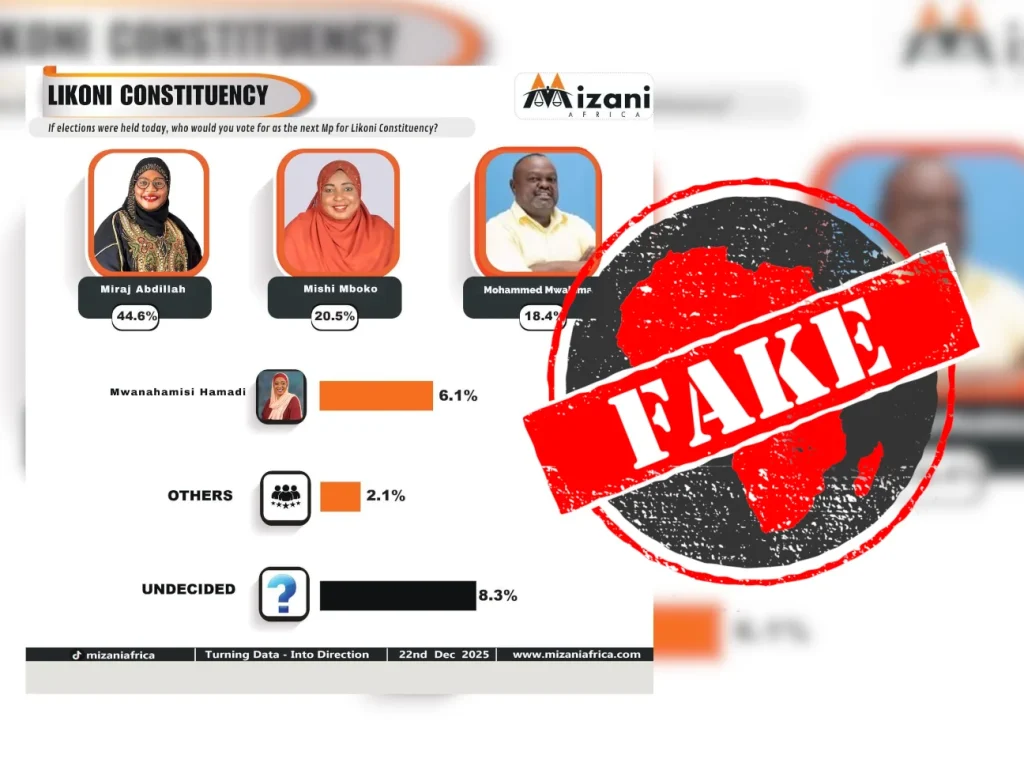
Mizani Africa has similarly had to distance itself from fabricated polls. In January 2026, although Mizani Africa had published a legitimate poll on the Likoni constituency race, the figures circulating widely online were found to be inaccurate and manipulated.
What the Law Says – and Why These Polls Are Illegal
Kenya has clear laws governing opinion polls. The Publication of Electoral Opinion Polls Act, 2012 applies to all persons who publish or cause the publication of results of an electoral opinion poll during an electoral period.
Any person who commits an offence under this Act is liable to a fine not exceeding one million shillings, or to imprisonment for a period not exceeding one year, or to both.
The law requires that any published poll must include:
- The commissioning party (who paid for it)
- The sample size and margin of error
- The methodology used
Ask yourself: Have you seen any of these required details from the polls circulating on your WhatsApp or Facebook? Or have you just seen a flashy graphic with a number and a narrative?
Official Warnings: “Voodoo Polls” Are Illegal
The Media Council of Kenya (MCK) has issued multiple stern warnings against what they call “voodoo polls” —unscientific and unauthorised election-related opinion polls.
In November 2025, MCK issued a stern advisory urging media outlets, journalists, and online platforms to immediately stop conducting or publishing unscientific and unauthorised election-related opinion polls. The Council stated:
“So-called ‘call-in’ or ‘instant polls’ are misleading because they fail to meet the legal and professional standards required by the Act and recognised ethical guidelines.”
The Council further clarified that instant social media polls, call-in votes, talk-show tallies, and similar informal surveys fall short of the legal and professional standards required for credible polling. These practices not only mislead the public but also undermine journalistic integrity.
MCK Chief Executive Officer David Omwoyo flagged these “voodoo polls” on social media, talk shows, and call-in programs, saying they are presenting a serious threat to responsible election reporting.
How These Fake Polls Operate – The Pattern
Based on documented cases, here is how the deception works:
- Impersonation: Forgers steal the name and branding of legitimate research firms like Politrack Africa, Infotrak, TIFA, or Mizani Africa.
- Fabrication: They create professional-looking graphics with fake sample sizes, margins of error, and confidence levels to appear credible.
- Viral Distribution: These fake polls are shared on Facebook, X (formerly Twitter), and WhatsApp groups.
- Narrative Control: The results are designed to create a false sense of momentum, discourage opponents’ supporters, or manufacture popularity for certain candidates.
- Lack of Transparency: None of these fake polls discloses who paid for them, their methodology, or their raw data—all legal requirements.
The Danger to Our Democracy
These fake polls are not harmless. They are weapons of manipulation designed to:
- Create false momentum for certain candidates
- Discourage voters who believe the race is already decided
- Manufacture consent and shape public perception
- Undermine trust in legitimate research and democratic processes
- Influence election outcomes through deception
As one Mombasa resident wisely observed: “Opinion polls can sometimes be shaped by those who fund them, and therefore may not always present a complete or accurate picture.”
What You Can Do – A Call to Action
When you see an opinion poll, do not just share it. Scrutinise it.
â ASK THESE QUESTIONS:
- Who paid for this poll? If this is not disclosed, it is illegal under Kenyan law.
- Where is the full methodology? Sample size, margin of error, sampling method, and fieldwork dates must be provided.
- Is the firm legitimate? Check if the polling firm is registered with IEBC and has a verifiable track record.
- Does the poll appear on the firm’s official website or verified social media? If not, it is almost certainly fake.
- Does the result make sense? If a poll shows results that defy common sense or contradict what you see on the ground, be suspicious.
ð« DO NOT:
- Share polls from unverified sources
- Assume that a professional-looking graphic is legitimate
- Believe polls that do not disclose their sponsor and methodology
- Let fake polls discourage you from participating in our democratic process
ð¢ REPORT:
- Report suspicious polls to PesaCheck, Africa Check, or other fact-checking organisations
- Report violations to the Media Council of Kenya (MCK)
- Report unlicensed pollsters to the Independent Electoral and Boundaries Commission (IEBC)
The Only Poll That Matters
Let us be clear: the only poll that matters is the one on Election Day.
No amount of fabricated numbers, glossy graphics, or viral WhatsApp messages can change the will of the people. These fake polls are designed to intimidate, discourage, and deceive. Do not let them succeed.
As Kenyans, we have been through too much—post-election violence, disputed results, and deep divisions—to allow our democratic process to be hijacked by manipulators with fabricated data.
The Media Council of Kenya has spoken clearly: “Media organisations and journalists must avoid any practice that could place them in breach of the law or undermine responsible journalism”. This applies to every Kenyan sharing content online.
Share this alert. Educate your friends and family. And when you see a fake poll, call it out.
Our democracy depends on informed citizens—not manipulated ones.
This is a public interest alert. Share widely.

