

Amnesty Kenya’s Houghton resigns from protest victims team

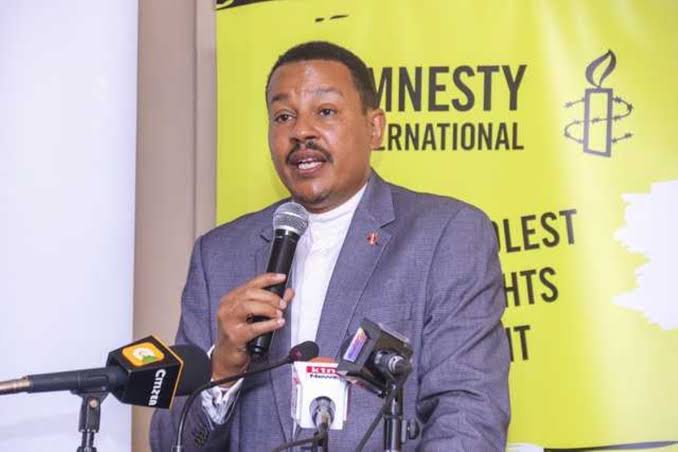
Amnesty International Kenya Executive Director Irungu Houghton formally resigned from President William Ruto’s Panel of Experts on Compensation of Victims of Protests and Riots with immediate effect.
He lamented what he described as a material alteration of the legal basis for the panel’s continued existence.
Houghton’s decision, communicated in a letter to Prof. Makau Mutua – chairperson of the panel – on Friday, followed Ruto’s January 5, 2026 extension of the panel’s mandate by 180 days.
This despite a December 4, 2025 ruling by the Kerugoya High Court that declared the panel unconstitutional and affirmed that compensation for human rights violations properly resides with the Kenya National Commission on Human Rights (KNCHR).
Houghton reflected the constitutional tension that has dogged the panel since its formation.
“I write to formally tender my resignation from the Panel of Experts with immediate effect. My decision follows the President’s 5 January 2026 extension of the Panel’s mandate for a further 180 days despite the 4 December 2025 ruling of the Kerugoya High Court,” he stated.
He argued that the High Court’s decision “materially alters both the legal basis and institutional legitimacy of the Panel’s continued existence. As a constitutionalist, I am obligated to respect judicial determinations and act in a manner that safeguards the integrity of independent institutions.”
Houghton’s resignation was the culmination of developments that began in September 2025, when he suspended his participation in the panel after the High Court temporarily halted its operations pending a legal challenge to its constitutional standing.
“For the avoidance of any public doubt, I immediately suspended my participation in the Panel of Experts … in accordance with Monday’s order by the High Court and my respect for the rule of law, constitution and judicial oversight.”
At the time of that suspension, Houghton made it clear that he had not participated in any panel meetings beyond the swearing-in and would refrain from duties until the court provided a pathway forward.
Houghton further disavowed an application filed on December 15, 2025, seeking to stay the High Court’s ruling, saying his name had been erroneously included without his consent or consultation.
“I was neither consulted nor do I support the December 15 application to stay the court ruling,” he wrote, adding that he “did not enter appearance when listed as an interested party.”
He also referenced his own public commentary from December 6, 2025 where he urged full compliance with the court’s determination that KNCHR, not a presidential panel, should lead compensation efforts.
Despite his departure, Houghton took pains to underscore his ongoing solidarity with victims of state violence.
“I remain grateful for the opportunity to explore this avenue for truth, justice and compensation for victims of state violence while expressing their constitutional right to assembly. The victims’ families’ cry for accountability, justice, and reparations has anchored my personal conscience throughout this journey,” he said.
He insisted that fidelity to the Constitution, the rule of law and institutional accountability must take precedence over expediency; a stance that, in his view, now lies outside the panel’s current legal footing.
Houghton concluded by urging all stakeholders to remain unwavering in pursuit of justice in coherence with the Constitution and the recent court judgment.
The panel was sworn in September 2025 to advise the Presidency on reparations for victims of protests and demonstrations, including police brutality incidents stretching back years.
However, its work was mired in constitutional challenges almost from inception. A High Court injunction the same month halted its operations, prompting Houghton’s initial suspension.
Then, in December 2025, the High Court went further, declaring the presidential panel unconstitutional and affirming that KNCHR is the statutory body mandated to handle investigations and redress for human rights violations under Article 59 of the Constitution.
President Ruto moved to extend the panel and, according to government statements, pursue compliance and legal clarity, even lodging an appeal while maintaining compensation efforts.
On Friday, Mutua said Ruto implemented the court’s decision through Special Gazette Notice No. 259 dated January 5, 2026, following a judgment delivered by the High Court in Kerugoya on December 4, 2025.
The ruling arose from Constitutional Petitions Nos. E10, E11 and E14 of 2025, in which the court affirmed the President’s unique constitutional role in protecting human rights and facilitating reparations for victims of rights violations.
According to the panel, the President’s action demonstrates a strong commitment to the rule of law, constitutionalism, and respect for the authority of the Judiciary.
Prof. Mutua said that, in line with the court’s directions, the necessary administrative and procedural steps are now underway to operationalise the judgment.
These measures are aimed at ensuring that the compensation process for victims of protests and public demonstrations is conducted in a transparent, fair, and accountable manner, guided by established legal and institutional frameworks.
At the same time, the panel confirmed that an appeal has been filed to seek clarification on broader legal issues arising from the judgment, citing the significant public interest involved.
However, Prof. Mutua emphasised that the appeal does not suspend, delay, or negate compliance with the existing court order.