


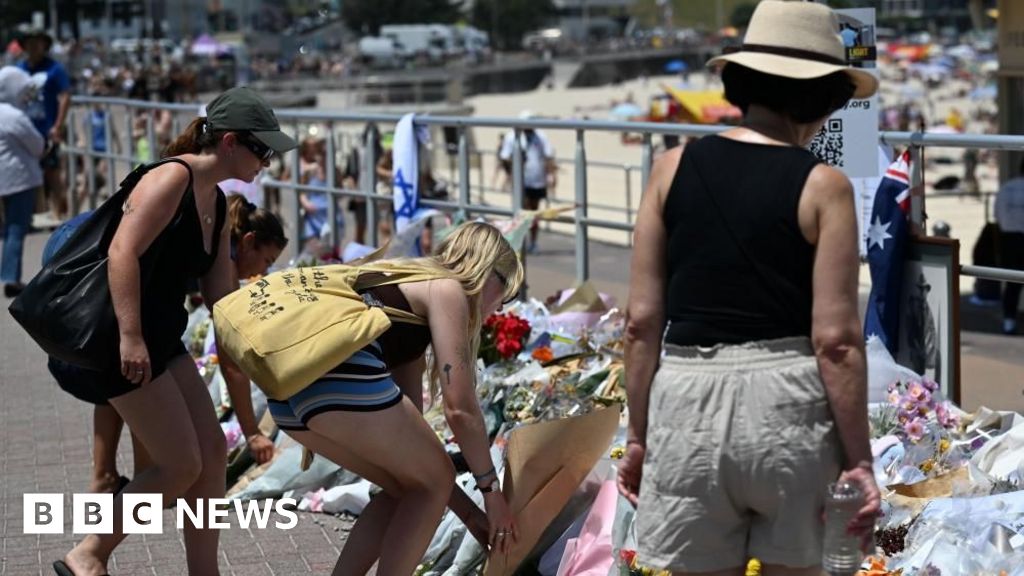
Australia’s Prime Minister Anthony Albanese announced a review into the police and national intelligence agencies after the Bondi Beach attack in Sydney.
“The ISIS-inspired atrocity last Sunday reinforces the rapidly changing security environment in our nation,” Albanese said, using an acronym for the Islamic State group. “Our security agencies must be in the best position to respond.”
The shooting, in which 15 people were killed after two gunmen opened fire at a Jewish festival, has been declared a terrorist incident. Police say the attackers were inspired by “Islamic State ideology”.
A national day of reflection is being held on Sunday.
A minute’s silence was observed at 18:47 (07:47 GMT) – the time when the attack began.
Albanese looked startled as he arrived at the event in Sydney as he was met with a loud chorus of boos and jeers.
At least one member of the crowd shouted “blood on your hands” while another was tackled by police after moving towards the prime minister.
Albanese was steered towards a VIP seating area and his wife Jodie Haydon grasped his arm in support.
The Jewish community in Australia has repeatedly said this attack was a shock, not a surprise. The overwhelming view is that more could and should have been done to prevent it from happening.
They have accused Albanese of siding with the Palestinians over supporting Israel and the relationship worsened when he moved to recognise the state of Palestine earlier this year.
Israeli Prime Minister Benjamin Netanyahu has accused Albanese – as well as the leaders of other countries that have recognised a Palestinian state – of rewarding Hamas, the group responsible for the deadliest attack on Israel on 7 October 2023.
After the Bondi Beach attack last Sunday, Netanyahu said Albanese’s government “did nothing to stop the spread of antisemitism in Australia”.
The Australian prime minister denies the accusation.
The prime minister earlier said the intelligence review, due by April 2026, would focus on ensuring authorities were equipped to tackle extremism.
He said: “The Department of Prime Minister and Cabinet will examine whether federal law enforcement and intelligence agencies have the right powers, structures, processes and sharing arrangements in place to keep Australians safe in the wake of the horrific antisemitic Bondi Beach terrorist attack.”
In the wake of Australia’s deadliest mass shooting in almost three decades, the government has also announced plans to tighten gun controls, while the New South Wales premier is pushing to crack down on hate speech.
Suspected gunman Naveed Akram, 24, has been charged with 59 offences, including 15 counts of murder and one of committing a terrorist act. His father Sajid was killed during the attack.
Earlier on Sunday, Governor-General Samantha Mostyn addressed a vigil held in Bondi, hosted by the National Council of Jewish Women Australia, where attendees largely wore white to symbolise peace.
“The entire Jewish community, whether it’s here in Bondi or across our nation, you are part of the belonging story and the success of this country,” she said.
Australians across the country are still reeling and there’s a sense of shock and disbelief that something like this could have happened.
But this weekend, normality returned in some ways. Bondi promenade was once again filled with surfers, runners and dog-walkers returning to their regular routine.
While a sombre mood lingers, children’s surf club activities – known locally as “nippers” – resumed on Sunday as a sign of the community showing resilience.
North Bondi’s Surf Life Saving president Steve Larnach told the BBC they had considered cancelling the regular nippers events.
“We were also aware of the sensitivity towards our Jewish community,” Larnach said.
“We did ask their opinion, they were very supportive of us going ahead but also extremely grateful for what we did.”
Lifeguard volunteers were among the first on the scene at the shooting last week providing first aid, Larnach added.
Some surf lifesavers have been hailed as heroes, including one who was photographed sprinting from a neighbouring beach with a red first aid kit slung over his shoulder.
Geraldine Nordfeldt, who brought her daughter to nippers, said “it was really important to return to whatever this new normal is as soon as we could”.
“You have to return, you can’t stay away, you can’t let fear win. The beach is the Australian way of life and we all love it,” she told the BBC.
By BBC News
Email your news TIPS to Editor@Kahawatungu.com — this is our only official communication channel
