


Bob Dylan, born Robert Allen Zimmerman on May 24, 1941, in Duluth, Minnesota, is an American singer-songwriter widely regarded as one of the most influential figures in modern music.
Raised in Hibbing, Minnesota, Dylan’s early exposure to blues, country, and rock and roll shaped his musical journey.
He adopted the stage name Bob Dylan in the early 1960s, inspired partly by the poet Dylan Thomas, and emerged as a pivotal figure in the folk music scene of New York City’s Greenwich Village.
Over a career spanning more than six decades, Dylan has continually reinvented himself, blending folk, rock, blues, and country with lyrics that weave political, social, and philosophical themes.
Siblings
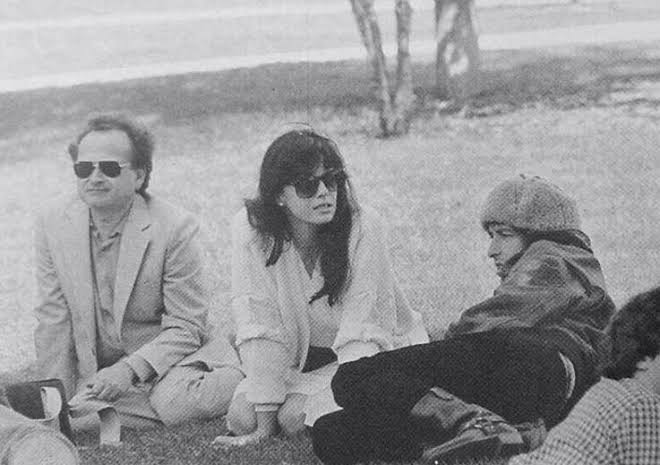
Bob has one sibling, a younger brother named David Zimmerman.
Born in 1946, David grew up alongside Bob in Hibbing, Minnesota, where their close-knit Jewish family fostered a sense of community.
While Bob pursued a path to global fame, David remained largely out of the public eye, leading a more private life.
David worked for many years with the Buffalo-Hanover-Montrose school board in Minnesota, indicating a career rooted in education and local governance.
Unlike his brother, David did not pursue a public career in music or the arts, though he was involved in the music industry to a limited extent.
In the early 1970s, David managed the band Skogie & the Flaming Pachucos under his company, Bernard Productions, securing their first recording contract and producing their debut album, The Butler Did It, at Sound 80 Studios in Minnesota.
Despite his brother’s towering fame, David has maintained a low profile, and little is known about his personal life beyond his professional endeavors and family ties.
Also Read: Chad Michael Murray Siblings: A Closer Look at the Actor’s Family Tree
Career
Dylan’s career began in earnest when he moved to New York City in 1961 to visit his idol, Woody Guthrie, and immerse himself in the Greenwich Village folk scene.
His self-titled debut album, released in 1962, featured traditional folk and blues covers, but it was his 1963 album, The Freewheelin’ Bob Dylan, with originals like “Blowin’ in the Wind” and “A Hard Rain’s a-Gonna Fall,” that established him as a voice of the counterculture.
Dylan’s shift to electric rock in 1965 with albums like Highway 61 Revisited and Blonde on Blonde revolutionized popular music, though it sparked controversy among folk purists.
Over the decades, he explored diverse genres, from country-infused Nashville Skyline to gospel-tinged Slow Train Coming, reflecting his spiritual and artistic evolution.
His relentless touring, often referred to as the “Never Ending Tour” since the late 1980s, has solidified his reputation as a tireless performer.
Dylan has released over 50 albums and written more than 600 songs, many covered by artists like Jimi Hendrix, Adele, and Guns N’ Roses.
Accolades
Dylan has won ten Grammy Awards, including Album of the Year for Time Out of Mind in 1998, and six of his recordings have been inducted into the Grammy Hall of Fame.
In 2016, he became the first musician to receive the Nobel Prize in Literature, awarded “for having created new poetic expressions within the great American song tradition.”
Dylan also received an Academy Award in 2001 for his song “Things Have Changed” from the film Wonder Boys.
His other accolades include the Presidential Medal of Freedom in 2012, the National Medal of Arts in 2009, and a Pulitzer Prize special citation in 2008 for his profound impact on music and culture.
Dylan has been inducted into the Rock and Roll Hall of Fame, the Nashville Songwriters Hall of Fame, and the Songwriters Hall of Fame, cementing his legacy as a transformative artist.
Email your news TIPS to Editor@Kahawatungu.com — this is our only official communication channel
