

Bolivian Congress allows deployment of troops to quell protests

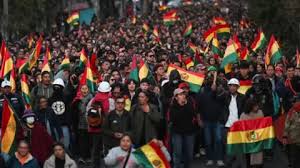
Bolivian Congress allows deployment of troops to quell protests
Congress in Bolivia passed a bill which will make it easier for the president to declare a state of emergency and deploy soldiers to quell protests.
The move comes after almost a month of road blocks and demonstrations by miners, farmers and indigenous groups, which are demanding President Rodrigo Paz resign.
On Monday, Paz said that he favoured dialogue over “armed confrontation” but the centre-right leader is coming under increasing pressure to end the protests, which have led to widespread shortages of water, fuel and medicines in the affected areas.
Paz has accused the left-wing former president, Evo Morales, of orchestrating the protests, which the ex-leader has denied.
On Tuesday, Bolivia’s Chamber of Deputies voted by more than a two-thirds majority to repeal a 2020 law which restricted the use of the military to quell protests to cases in which the police has been overwhelmed.
Lawmakers who backed the bill said that the 2020 law had restricted the constitutional powers of the president and that “violent” groups should not be able to dictate to the elected government.
But Sonia Siñani, who voted against the measure, warned that it could heighten social tensions, saying it was like “throwing fuel onto the flames”.
The protests started at the end of April and were originally triggered by a land reform proposed by Paz.
Some small-scale farmers were worried the measure would make it easier for large landowners to buy up small properties.
The government insisted any sale would have to be voluntary but powerful organisations representing small-scale farmers were not convinced and blocked the country’s main highways in protest.
Paz has since scrapped the reform, but by then the farmers had been joined by other sectors of society venting their grievances.
Drivers and transport workers took to the streets complaining that the quality of petrol had worsened since the government scrapped fuel subsidies.
The removal of the long-standing subsidy created shortages and prompted some petrol stations to sell adulterated fuel, which in turn caused damage to the motors of vehicles which used it.
Road blockades erected by angry protesters have further exacerbated the shortages, creating a vicious circle.
Proposed changes to the 2009 constitution – which was brought in by then-President Evo Morales – have also triggered a backlash.
Paz, a centre-right politician, campaigned on a promise to open up key parts of Bolivia’s economy to private investment.
Followers of Morales argue that these reforms could undermine the power of the state in managing these important economic sectors.
The former leader, who governed Bolivia from 2006 to 2019, remains an influential figure in the country, especially with indigenous groups.
The Paz government has blamed Morales for the unrest, arguing that he is fanning the flames of discontent to detract attention from an arrest warrant which was issued against him on 11 May.
A judge issued the warrant and declared Morales in contempt of court after he failed to appear at a hearing over allegations of statutory rape and human trafficking.
Prosecutors accuse Morales of impregnating a 15-year-old girl in 2015, and taking her on trips abroad.
Morales argues that the accusations are part of a right-wing vendetta against him and his followers have repeatedly threatened to paralyse the country should he be arrested.
Paz has tried to defuse the widespread protests by reshuffling his cabinet, slashing his salary and that of his ministers in half, and announcing the creation of a council to negotiate with sectors of society which feel isolated under his government.
By BBC News