

Bonar Law Siblings: All About the Law Siblings

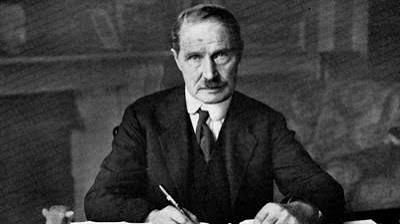
Bonar Law PHOTO/BBC
Andrew Bonar Law, commonly known simply as Bonar Law, was a British Conservative statesman who served as Prime Minister of the United Kingdom from October 1922 to May 1923.
Born on 16 September 1858 in Kingston (later known as Rexton), in what was then the Colony of New Brunswick, he remains notable as the only British prime minister born outside the British Isles.
Of Scottish and Ulster Scots ancestry, he was the son of the Reverend James Law, a minister of the Free Church of Scotland, and Eliza Kidston Law.
His early years were spent on a modest farm alongside his family in a remote setting, where he developed habits of hard work and simplicity.
After his mother’s death in 1861, his aunt Janet Kidston cared for the children until his father remarried in 1870, at which point the young Bonar Law moved to Helensburgh near Glasgow to live with his mother’s relatives.
Law died of throat cancer on 30 October 1923 in London and was buried in Westminster Abbey.
Siblings
Bonar grew up with three brothers and one sister.
His older brothers were Robert, William, and John, and his sister was Mary.
After their mother’s death, the family remained together under the care of their aunt until the father’s remarriage.
Mary later joined Bonar Law in Scotland and acted as his housekeeper when he established his own household in Helensburgh in 1888, before his marriage.
John also eventually moved to Scotland, where he worked for the same iron merchants firm, William Jacks & Co., that Bonar Law had joined, and later became chairman of the company.
Also Read: James Callaghan Siblings: All About Dorothy Gertrude Callaghan
Career
Law left school at sixteen to work as a clerk in the family firm of Kidston & Sons.
When the partners retired and the bank merged with the Clydesdale Bank in 1885, his relatives helped him purchase a partnership in the Glasgow iron merchants William Jacks & Co.
Through diligence and a remarkable memory for figures he prospered, becoming comparatively wealthy by his thirties and later able to devote himself to politics.
He entered the House of Commons in 1900 as the Conservative and Liberal Unionist Member for Glasgow Blackfriars.
Appointed Parliamentary Secretary to the Board of Trade in 1902, he lost his seat in the 1906 Liberal landslide but soon returned via a by-election for Dulwich.
He later represented Bootle and Glasgow Central.
In 1911, following Arthur Balfour’s resignation, Law was elected Leader of the Conservative Party as a compromise candidate.
He served as Leader of the Opposition until the First World War, when he entered the coalition government under H. H. Asquith as Colonial Secretary in 1915.
After helping to bring David Lloyd George to the premiership in 1916, Law became Chancellor of the Exchequer and Leader of the House of Commons, later serving as Lord Privy Seal.
He resigned from office and party leadership in 1921 because of ill health, but returned in 1922 to lead the Carlton Club revolt that ended the coalition.
King George V invited him to form a government; he became Prime Minister on 23 October 1922, won a clear majority in the subsequent general election, and held office until illness forced his resignation on 20 May 1923.
Accolades
Although Law’s premiership lasted only 211 days, one of the shortest of the twentieth century, he is remembered for restoring the Conservative Party’s independence and strengthening its position after the wartime coalitions.
He was sworn of the Privy Council in 1911 and held senior Cabinet offices including Colonial Secretary, Chancellor of the Exchequer, and Lord Privy Seal.
His leadership during the war years and his decisive role in ending the Lloyd George coalition earned him respect across party lines for honesty, organisational skill, and mastery of financial detail.
His ashes rest in Westminster Abbey beneath a simple stone inscribed “Andrew Bonar Law 1858–1923 sometime Prime Minister,” a rare honour reflecting the esteem in which he was held by Parliament and the nation.

