


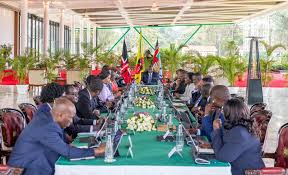
The Cabinet approved recommendations from the Presidential Taskforce on Religious Organisations, a landmark move to safeguard the integrity of religious practice while curbing exploitation.
The proposed reforms, developed in response to the Shakahola tragedy, place religious leaders at the centre of accountability efforts, emphasising self-regulation over State control.
President Ruto chaired the meeting at State House in Nairobi.
Key proposals include enacting a legal framework to govern religious organisations, establishing a Religious Affairs Commission, and strengthening umbrella faith organisations for coordination.
The model blends institutional autonomy with supportive oversight and calls for leadership standards, reforms to religious broadcasting, and civic education to promote tolerance and prevent extremism.
A multi-agency collaboration involving security agencies, interfaith platforms, and educational institutions will support implementation.
To address pending bills, the Cabinet approved further measures to accelerate momentum in the roads sector. This builds on the successful rollout of the road financing policy through the securitisation of the Road Maintenance Levy Fund (RMLF), which has already disbursed Sh64.2 billion, settling 40% of verified contractor claims of 575 contracts covering 393 projects.
To deepen this novel model in infrastructure development, the Cabinet approved an additional payment of up to 40%, bringing the total settlement to 80%, on the condition that contractors extend the final
payment deadline by another 120 days.
These measures have resolved long-standing financial obligations, unlocked stalled projects, improved contractor cash flow, and ensured continuity in infrastructure development nationwide.
The Cabinet also gave the green light for the reinstatement of Kenya Pipeline Company (KPC) into the privatisation programme, paving the way for partial divestiture of government shares in a move aimed at democratising ownership by Kenyans at the Nairobi Securities Exchange and unlocking the company’s full commercial potential.
The decision reflects the government’s policy shift toward reducing its role in doing business and instead enabling the private sector and industry experts to drive growth, efficiency, and innovation.
KPC, a strategic player in Kenya’s energy supply chain, has maintained a strong profitability record and holds significant asset value.
However, the Cabinet noted that the company has not yet reached its optimum performance and market value, largely due to bureaucratic constraints and public sector inefficiencies.
Bringing in private capital and professional expertise is expected to inject new energy into the company, modernise operations, and position KPC as a regional logistics and energy powerhouse.
Cabinet was reminded that similar moves in the past have yielded transformative results.
Safaricom, Kenya Commercial Bank, and KenGen are prime examples of formerly State-controlled entities that became high-performing companies following privatisation, driving shareholder value, expanding regionally, and creating thousands of jobs.
The divestiture of KPC is expected to follow this path, boosting investor confidence and supporting the development of Kenya’s capital markets.
The approval marks a shift from State dominance in commercial enterprises to a model that embraces private sector-led growth, operational discipline, and accountability, ultimately ensuring that public resources are better used to deliver essential services.
On electrification, the Cabinet has given the nod to the implementation of Phase III of the Last Mile Connectivity Project, targeting 180,500 new electricity connections for households, schools, health centres, and MSMEs, while strengthening Kenya’s distribution grid.
The project addresses key challenges, including high connection costs, underutilised transformers, and weak infrastructure in remote areas.
Implemented in partnership with the African Development Bank (AfDB) and the Canada-AfDB Climate Fund, the programme will give priority to counties with low electricity access and no prior support from similar initiatives. It will also optimise use of idle transformers and reinforce strained substations to improve reliability.
The project is expected to deliver broad socio-economic benefits, including access to clean and affordable power for marginalised communities, round- the-clock health services, enhanced learning through digital tools, and support for over 10,500 MSMEs through three-phase power connections.
Energy security was further boosted by the approval of the Olkaria VII Geothermal Power Project, a strategic initiative that will inject 80.3MW of clean, reliable baseload electricity into the national grid by June 2027.
The project will tap 19 production wells, with plans for seven more over its 25-year operational life, and will ensure sustainability through the reinjection of geothermal fluids.
Olkaria VII is designed to meet Kenya’s rising energy demands driven by population growth, industrial expansion in Special Economic Zones, and the rapid uptake of electric vehicles.
With annual power demand projected to grow by 100MW, and EV energy needs expected to reach 334MW by 2032, the plant will play a critical role in supporting this shift. Kenya’s industrial strategy will also require over 1,000MW in new capacity by 2032.
The project, to be undertaken in partnership with the Government of Japan and the European Investment Bank, will help reduce reliance on costly and polluting fossil fuels, while reinforcing Kenya’s position as a regional leader in renewable energy.
Email your news TIPS to Editor@Kahawatungu.com — this is our only official communication channel
