


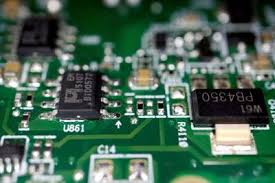
China appears to have quietly rolled back retaliatory tariffs of 125% on some semiconductors made in the US, according to details provided to CNN on Friday by three import agencies in the southern technology hub of Shenzhen, as Beijing tries to soften the blow of an ongoing trade war on its all-important tech industry.
The exemptions apply to integrated circuits, also known as microchips or semiconductors, according to the agencies. They found out about the exemptions, which have not been officially announced, on Thursday.
On April 12, China raised its reciprocal tariffs to 125% for all goods originating from the United States, in response to US President Donald Trump’s move to hike levies on Chinese goods to a sky-high 145%.
For months, Beijing has been projecting an air of strength and confidence in its ability to withstand an escalating trade war with the US. But these exemptions suggest it needs to roll back some levies on crucial items that it cannot make at home or source elsewhere. Besides semiconductors, China has decided to grant exemptions on some aircraft parts, including engines and landing gear, according to an aviation executive.
Semiconductors are an indispensable part of just about every electronic device. They are difficult to make because of the high cost of development and the level of knowledge required, meaning much of the production is concentrated among a handful of suppliers.
Although China has made strides in developing its own semiconductor industry, it is still highly dependent on imports of chips and chipmaking equipment from the United States, Taiwan, South Korea, Japan and the Netherlands. Last year, China imported $11.7 billion worth of semiconductors from the US, according to customs data.
Duncan Clark, chairman of technology investment advisory firm BDA, said the exemptions suggest China does not have “autonomy in chips.”
“It has ambition for that. But basically, it’s going to be a while before it can be fully autonomous,” he said. Ray Wang, a Washington-based analyst focusing on US-China tech competition, said the exemptions benefit American chipmakers such as Intel, Texas Instruments and Global Foundries, which would be affected by the Chinese tariffs.
Chinese authorities have not confirmed the exemptions on semiconductors publicly. The General Administration of Customs and the customs offices in Shenzhen and Zhongshan, both port cities in Guangdong province, said they were not aware of the exemptions.
A spokesperson for China’s Foreign Ministry said he was not familiar with the situation, when asked about the exemptions at a regular news conference Friday. CNN has reached out to the Chinese Commerce Ministry for comment.
Chen Shaoling, a manager at Zhengnenliang Supply Chain, an import agency, told CNN that she found out on Thursday that tariffs on eight kinds of integrated circuits, covering most semiconductors except for memory chips, had been waived to zero. The discovery was made during a routine custom clearance for her customers, she added.
“We only found out after we filed the declaration — without doing that, we wouldn’t have known,” Chen said. “The news is now spreading like wildfire.”
Caijing, a Chinese business magazine, reportedon the exemptions on Friday, citing multiple tech companies that import semiconductors, including one based in Shanghai. The report was removed roughly three hours after it was published.
Critical components
The exemptions aren’t the first time Beijing has come to the aid of its tech sector, which is starting to enjoy a closer relationship with officialdom after a years-long regulatory crackdown.
Earlier this month, China removed tariffs on chips designed by American firms but manufactured outside the country. For example, US AI chip giant Nvidia’s products are largely made in Taiwan by Taiwan Semiconductor Manufacturing Company (TSMC).
On April 11, the state-backed China Semiconductor Industry Association said in a post on its official social media channel that the “declared country of origin” should be the location of the factory where the product was made.
That means semiconductors from American chip designers like Qualcomm and Nvidia, manufactured outside the US would not be subject to China’s 125% tariff on US goods.
This week’s exemptions appear to apply only to logic chips, which process and control data flow, an area dominated by the US. Memory chips, which store and retrieve data, are not included in the exemptions. South Korean firms Samsung and SK Hynix are the leaders in this market.
The local customs authority in Shenzhen appears to have notified some companies about the update.
“Fantastic news! We have received a new notice from China Customs, stating that eight tariff codes related to semiconductors/integrated circuits are now exempt from additional tariffs on US imports,” Shenzhen HJET Supply Chain wrote in a post on its official social media account Thursday.
“This means that imports originating from the United States under these codes will have their tariffs reduced to zero upon entry into China,” the post added.
A staff member at the company who picked up a call from CNN confirmed the new policy, saying her company was notified by local customs on Thursday.
Taihang Semiconductor, a company also based in Shenzhen that imports chips, told CNN it has received a notice from customs, though it declined to provide further details. “It’s definitely a good thing,” a staff member said when contacted by CNN.
Wider exemptions
China is granting exemptions in other sectors outside of semiconductors, including aviation, according to Olivier Andries, the chief executive of French engine maker Safran.
“Yesterday night, China has decided to exempt from tax any deliveries of engines, nacelles, landing gears or parts,” he said on an earnings call Friday.
The company is a major supplier to China’s aviation industry. It makes the oxygen systems and nacelles (the structure that houses the engines and connects them to the wings) for the C919, China’s first homegrown mainline passenger plane. The C919’s LEAP-1C engines are produced by CFM, a joint venture between US engine-maker GE Aviation and Safran.
According to Reuters, which cited an unnamed source, the Chinese government is also asking businesses to identify goods that could be eligible for exemption from its reciprocal US tariffs.
The world’s two largest economies are at each other’s throats in a bitter tariff fight that has roiled global markets, disrupted supply chains and stoked recession fears.
On April 11, Trump exempted imports of electronics such as smartphones and computers from his “reciprocal” tariffs. That exemption has had a major impact on tech giants like Apple, which make iPhones and other products in China.
In recent days, Trump has softened his tone, saying the astronomical tariffs on Chinese goods will “come down substantially” and promised to be “very nice” at the negotiating table as he attempts to get Chinese leader Xi Jinping to make the first move to initiate trade talks.
But Beijing has brushed off Trump’s apparent olive branch, demanding the US should remove all tariffs on China if it wants to talk. Chinese officials have also repeatedly refuted Trump’s claims that the two sides are in talks about trade.
“There have been no negotiations between China and the United States on the issue of tariffs. The US should not mislead the public,” Guo Jiakun, a spokesperson for the Chinese Foreign Ministry, said at the regular news conference Friday.
The rebuttal came after Trump said on Thursday that his administration had meetings with Chinese officials regarding trade earlier in the morning.
By CNN
Email your news TIPS to Editor@Kahawatungu.com — this is our only official communication channel
