

Court acquits student in funeral image of the president

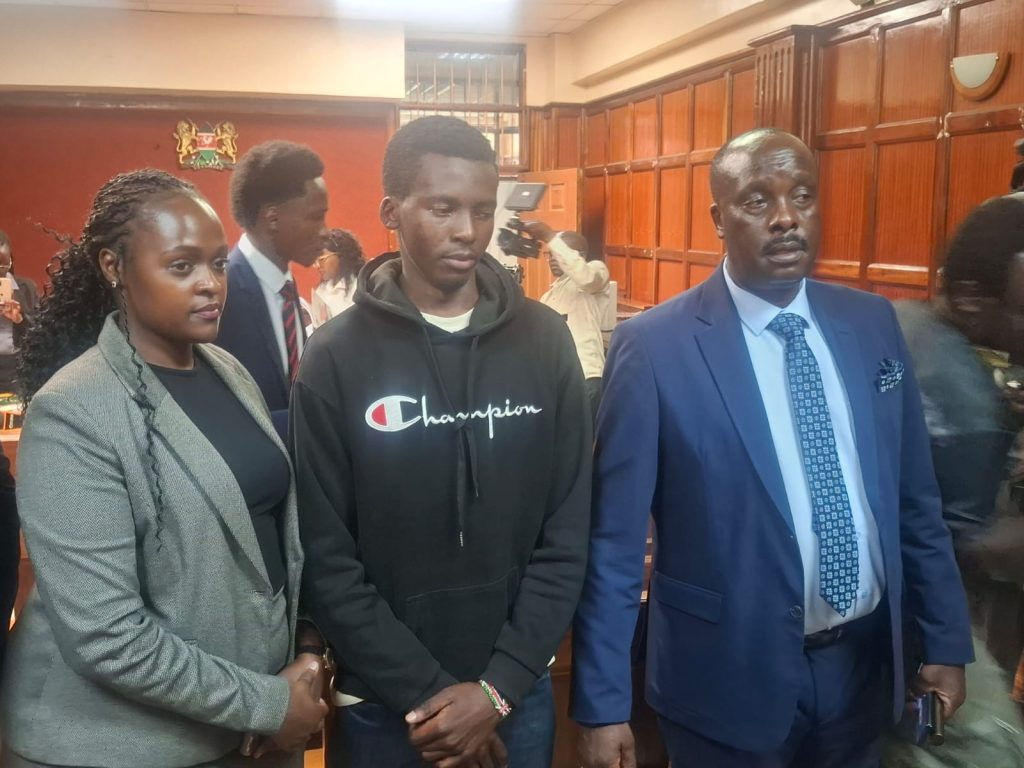
A Nairobi court acquitted a university student, David Mokaya, who had been charged with publishing false information and sharing an image of a funeral procession online allegedly linked to the President.
In a judgment delivered on February 19, 2026 Magistrate Caroline Nyaguthi ruled that the prosecution failed to prove beyond reasonable doubt that Mokaya was the person who authored or published the impugned post on the social media platform.
The court held that screenshots produced in evidence merely demonstrated the existence of an account but did not establish ownership or authorship.
The magistrate ruled that no forensic digital evidence was presented to link the accused to the creation, control, or operation of the X account.
Nyaguthi further said that no data was obtained from the service provider identifying the subscriber, IP address, device, or login history associated with Mokaya.
Evidence before the court showed that the account bore the accused’s personal details.
However, Mokaya explained in his defence that he had previously been tasked with managing the account and that three other individuals had access to it.
The court emphasized that the burden of proof in a criminal trial rests entirely with the prosecution and does not shift to the accused person.
The magistrate ruled that the cybercrime and digital forensic report indicated the post was made on November 13, 2024 at 11:15:27 a.m., with the timestamp showing Nairobi.
Yet evidence before the court showed that Mokaya resided in Andorra and had been arrested there, with no proof presented that he was in Nairobi on the material day.
The court questioned how he could have made the post in Nairobi if he was outside the country, ruling that no IP address correlation or technical data was produced to place him at the location at the time of publication.
A report from the Communications Authority indicated that the number associated with the account differed from Mokaya’s known Safaricom line.
No investigative report was produced in respect of the number linked to the account.
The court found that the accused’s electronic gadgets were seized and subjected to forensic examination without a valid court order.
Although investigators claimed they later obtained judicial authorization, the alleged application and orders were never produced in court.
The magistrate held that the search and extraction of data violated constitutional safeguards on privacy and fair trial.
The court said that cybercrime prosecutions require strict adherence to due process, ruling that digital accounts may be shared, fabricated, hacked or impersonated.
It further held that criminal liability attaches only to the actual publisher of content and that the prosecution had failed to establish the necessary digital nexus between Mokaya and the alleged publication.
Mokaya was acquitted under Section 215 of the Criminal Procedure Code and set at liberty.
Six witnesses were called to testify in the case.
“In this case, the prosecution failed to bridge the evidentiary gap between the existence of the publication and the responsibility of the accused person. On the second issue, even if the court was to accept the prosecution’s evidence against the accused person from the evidence of the accused and the submissions by the defence and the law society of Kenya, the accused person’s gadget was seized and examined forensically without any court order. Indeed, the investigating officer in his evidence conceded to the same,” ruled the court.

