

Court declares protest ban in Nairobi CBD illegal, awards Sh2.2 million to petitioners

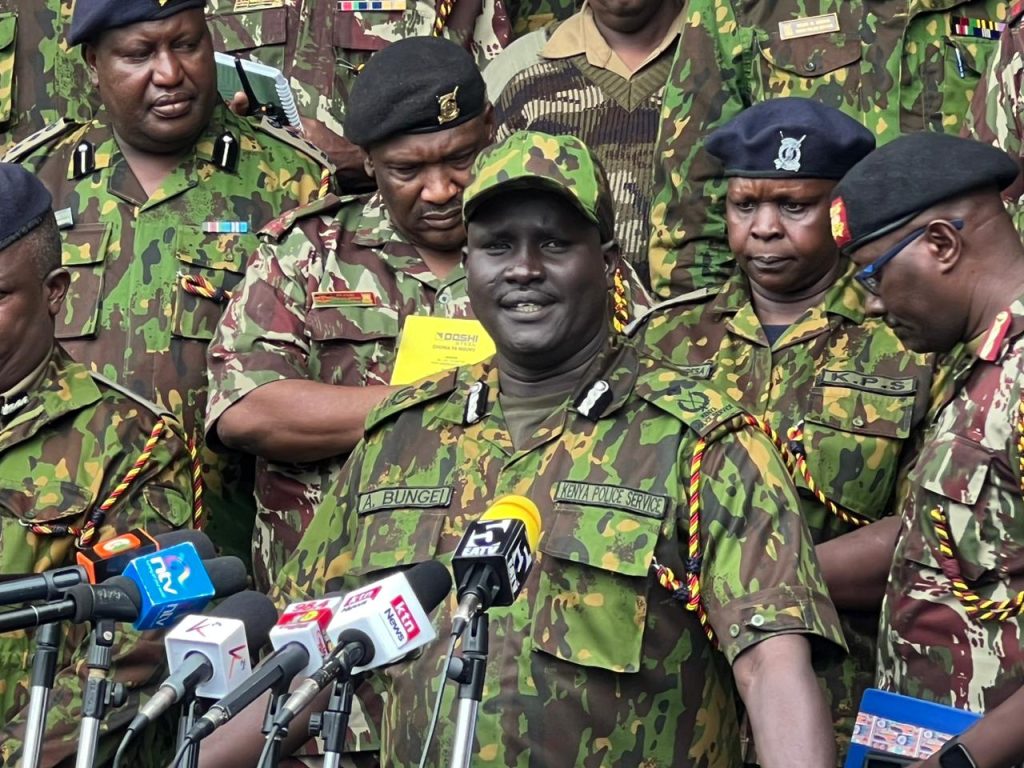
Former Nairobi Police Commander Adamson Bungei
The High Court declared a protest ban issued by former Nairobi Police Commander Adamson Bungei during the 2024 anti-tax demonstrations illegal and unconstitutional.
The case was filed by 11 protesters, represented by Pareno Solonka of Solonka & Solonka Advocates LLP, against Attorney General, Inspector General of Police, and Bungei.
At the center of the case was a media alert issued by Bungei on June 18, 2024, where he declared a ban on protests and public assemblies within Nairobi’s Central Business District (CBD).
Judge Bahati Mwamuye found the ban to be a violation of the Constitution, specifically infringing on the rights to peaceful assembly, freedom of expression, human dignity, protection from arbitrary arrest, and due process, as enshrined under Articles 27, 28, 29, 33, 37, 49, and 244 of the Kenyan Constitution.
Mwamuye ruled that the police had acted ultra vires—beyond their legal powers—and emphasized that peaceful protest is a fundamental right in a democratic society.
In a strong condemnation of the authorities’ actions, the Court awarded a Sh2.2 million in general and exemplary damages to the 11 petitioners, granting each Sh100,000 as compensation for the violation of their constitutional rights.
The 11 petitioners argued that during the protests the police used excessive force on participants, including by beating them with batons, lobbing teargas at them, and spraying them with water canons.
“The Respondents beat, clobbered, maimed and tortured persons participating in the peaceful march, and in the process also treated them in a cruel, inhuman or degrading manner,” they argued
They further told the court that respondents illegally used live bullets on unarmed and peaceful persons participating in the peaceful demonstration.
They said they were illegally and indiscriminately arrested by the police under the direct orders of the inspector general of police , Bungei while participating in the peaceful march.
They submitted that they were never informed of the reasons for the arrest and were also never granted the right to communicate with the advocate of their choice or any other person.
“Despite the 3rd Respondent being fully cognizant of the intended peaceful march, he issued an arbitrary, illegal and unconstitutional press release to Media Newsrooms stating that he had banned any demonstration. This resulted in police officers engaging in the use of excessive and disproportionate use of force against persons participating in the peaceful march,” they argued.
They urged the court to order the police to compensate them for the violations of their rights.
Separately, the court ruled that all police officers deployed to manage public assemblies, demonstrations, or picketing must be in uniform and clearly identifiable, stating they must not cover their faces or wear plain clothes.
Justice Mwamuye issued the order in a case filed by the Law Society of Kenya (LSK), which had petitioned the court following the killing of Rex Masai during a protest.
The LSK claimed the officer responsible for Masai’s death was in civilian clothing and could not be identified at the scene.
LSK urged the court to bar the Inspector General of Police from deploying plainclothes officers during protests. The legal body argued that incidents of police brutality and unlawful killings were often linked to officers operating without uniforms or any form of identification.
The court heard that such officers often blend in with peaceful protestors exercising their constitutional rights under Article 37, making it impossible to hold them accountable for any wrongdoing.
Additionally, these officers reportedly carry no identification documents, further frustrating efforts to trace or prosecute them.
The LSK specifically named and sued officer Isaiah Ndumba Murangiti, alleging that he was responsible for the fatal shooting of Rex Masai.
Mwamuye emphasized the importance of transparency, accountability, and the public’s right to identify law enforcement officers during the exercise of state power, particularly during public demonstrations.

