

CS Ogamba urges teachers to adapt as AI changes the classroom

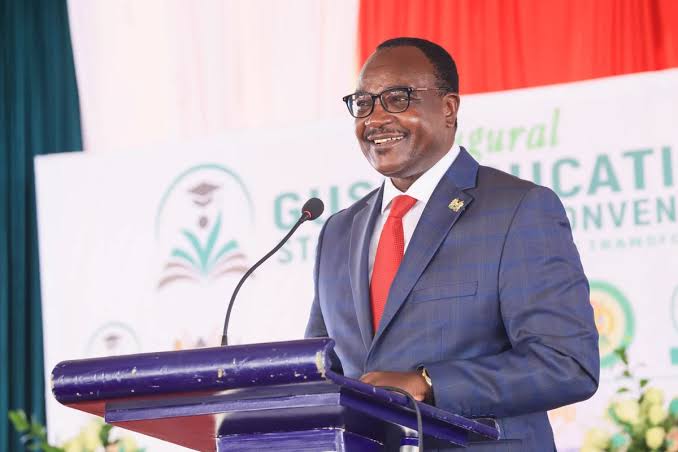
Education Cabinet Secretary Migos Ogamba speaking during the inaugural Gusii Education Stakeholders Convention at Kisii University, held under the theme, “Reimagining Education in the Gusii Region through Collaboration and Innovation for Sustainable Development" at Kisii University
Teachers must develop new skills to keep pace with artificial intelligence and other technologies reshaping how students learn, Education Cabinet Secretary Migos Ogamba has said.
Ogamba said the growing use of digital tools in education was changing the role of teachers from being primarily transmitters of knowledge to facilitators who help learners think critically, solve problems and apply what they learn to real-life situations.
“The digital revolution is no longer approaching. It is already here. Artificial intelligence, digital learning, online resource platforms and emerging technologies are changing the way knowledge is created, shared and applied,” Ogamba said.
He said the shift to competency-based education required teachers to adapt their approach to teaching while continuing to focus on learner development.
“The teacher of today must increasingly be a facilitator, a mentor, an innovator, a researcher and a lifelong learner. The competency-based approach requires teachers to help learners discover, create, collaborate and apply knowledge,” he said.
Ogamba spoke in Kisii on Thursday during the inaugural Gusii Education Stakeholders Convention at Kisii University, which brought together government officials, education agencies, universities and colleges, teachers, parents, learners, development partners and private-sector representatives.
He said the education sector needed to move beyond the question of whether schools should adopt technology and focus on whether digital tools were producing better learning outcomes.
“Our digital transformation agenda must therefore go beyond providing devices,” Ogamba said.
He added that technology could not substitute the role of teachers in translating education policy and new learning approaches into meaningful classroom experiences.
Ogamba said teacher welfare and working conditions also needed attention if educators were to take on the expanded responsibilities created by changes in the education system.
The convention was convened after a baseline assessment by scholars from Kisii University examined the state of education in Kisii and Nyamira counties.
The assessment covered learning outcomes, equity and inclusion, infrastructure, digital transformation, teacher development, technical and vocational education and training, higher education, financing and partnerships, learner well-being, assessment, climate resilience and emerging challenges.
According to Ogamba, the findings pointed to strengths in the region but also highlighted disparities in educational outcomes, resources, infrastructure, inclusion and institutional capacity.
He said the findings should provide a basis for stakeholders to make decisions grounded in evidence rather than assumptions.
“The value of the baseline is not simply that it gives us another report. Its real value is that it challenges us to move from assumptions to evidence, from isolated interventions to coordinated action, and from short-term responses to long-term transformation,” he said.
The CS challenged delegates to turn the convention into a platform for developing practical solutions to the challenges identified in the assessment.
“This must be a working convention. We must leave Kisii University with clear priorities, commitments, partnerships, and mechanisms for implementation,” he said.
Equity Bank Kenya Head of Education Sector Peter Ndoro, who represented Equity Group MD and CEO Dr James Mwangi and Equity Bank Kenya Managing Director Moses Nyabanda, said the changing economy required education stakeholders to look beyond academic achievement.
Ndoro said collaboration between government, schools, universities, teachers, parents, development partners, the private sector and communities was necessary to address the challenges facing learners.
“If we are serious about reimagining education, collaboration cannot be optional. No single institution can transform education alone,” Ndoro said.
He said each stakeholder had a different role to play, from government policy and resources to teachers shaping learners’ skills and character, while the private sector could contribute investment, technology, innovation and opportunities.
Ndoro said the convention provided an opportunity to develop solutions that reflected the realities of learners in Kisii and Nyamira rather than relying on isolated interventions.
“When these players come together around a shared purpose, we can achieve far more than any one institution could achieve alone. This convention provides precisely such an opportunity: a platform to listen, learn from one another, challenge existing approaches and develop solutions that respond to the realities of learners in the Gusii region,” he said.

