

DCI launches probe into Sh6.2 billion government payroll fraud after audit exposes widespread irregularities

DCI launches probe into Sh6.2 billion government payroll fraud after audit exposes widespread irregularities
The Directorate of Criminal Investigations (DCI) has launched investigations into a suspected Sh6.2 billion payroll fraud after Public Service Cabinet Secretary Geoffrey Ruku formally handed over a special audit report detailing widespread irregularities in the Government payroll system.
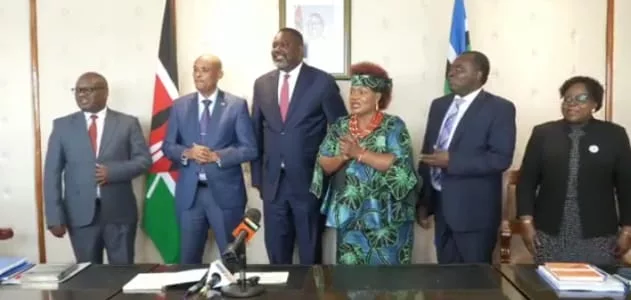
Speaking during the handover at the Ministry of Public Service offices in Nairobi on Tuesday, Ruku said the Government would pursue all those found responsible for manipulating the payroll, warning that no public officer involved would be spared.
The report was received by DCI Director Mohamed Amin, who pledged swift investigations and recovery of public funds lost through the alleged fraud.
“We will work with other agencies, including the Kenya Revenue Authority, the Financial Reporting Centre and the Public Service Commission, to ensure justice is served and recover the money that was stolen,” Amin said.
He revealed that the DCI has already constituted a special investigations team at its headquarters to handle the case and that investigators have identified persons of interest linked to the alleged scheme.
The investigations follow a Cabinet directive issued by President William Ruto ordering the DCI to probe suspected payroll fraud after an audit uncovered Sh6.2 billion in irregularities across government institutions.
According to the audit, which sampled 12 of the 53 State departments, investigators uncovered unauthorised payroll alterations and what they described as systemic manipulation of the Government payroll.
Ruku said the Government was determined to protect public resources and restore integrity in the public service.
“We have very strict instructions from the President on how the public service should operate and to ensure that no public funds are lost through salaries and other emoluments as a result of payroll manipulation. We must actualise Articles 10 and 232 of the Constitution of Kenya, 2010, which provide for the national values and principles of governance and public service,” he said.
Public Service Principal Secretary Jane Imbunya was present during the handover.
The report, prepared jointly by the Office of the Auditor-General and the State Department for Public Service and Human Capital Development, also revealed serious weaknesses in employee records and payroll management.
To assess the integrity of the Human Resource Information System Kenya (HRIS-K), the department commissioned an independent special audit covering the 2024/2025 financial year.
The review examined payroll integrity, system integration, compliance, user access controls, cybersecurity safeguards and infrastructure readiness.
Auditors found that HRIS-K remains poorly integrated with other government systems, with more than 300 State corporations yet to migrate onto the platform.
The audit also exposed numerous payroll data inconsistencies, including missing surnames, invalid KRA PINs, duplicate identity numbers and employees sharing bank accounts.
Among the anomalies were 5,778 employees recorded as having been posted before they were hired, while three employees recruited in 2023 were listed with birth years between 2046 and 2049.
The report identified irregular earnings amounting to Sh5.898 billion, including Sh4.336 billion paid as special salaries, Sh712.6 million in salary arrears of less than six months and Sh555.1 million in arrears exceeding six months.
Investigators further established that 720 payroll editors altered more than 4.7 million payroll records without system-generated timestamps, while 77 employees were found to have edited their own payroll records.
The audit also flagged major cybersecurity weaknesses, including the absence of multi-factor authentication, inadequate database logging, lack of rate limiting and monitoring, and failure to conduct penetration testing for more than a year.
Imbunya said the findings highlighted systemic governance, integration and control failures that expose the Government payroll to significant financial, operational and cybersecurity risks.
She, however, said the Government had already initiated reforms, including deploying a multi-agency technical team and launching a governance reset aimed at strengthening payroll controls.
“The findings underscore systemic weaknesses in integration, governance and controls that expose the Government payroll to significant fiscal, operational and cybersecurity risks. However, the decisive actions already undertaken demonstrate the Government’s commitment to reform,” she said.
The Government is also undertaking a comprehensive system strengthening programme with technical support from the National Intelligence Service (NIS), targeting key weaknesses identified during the audit.
Imbunya said the Government would continue strengthening system integration, enforce compliance with HRIS-K and improve accountability across public institutions while enhancing payroll security and continuous data validation.
She, however, warned that the payroll reform programme faces funding challenges after Parliament did not approve Sh138 million requested by the National Treasury to optimise HRIS-K infrastructure during the Supplementary Budget review.
She also cited non-compliance by some institutions as a major obstacle to the reforms.
The Cabinet has since approved sweeping measures aimed at dismantling what it described as entrenched, decades-old payroll fraud schemes, restoring integrity to the public wage bill and safeguarding taxpayers’ money through a whole-of-government payroll clean-up.