

Dei Biopharma Auction: Uganda’s Shs723.4 Billion Investment at Risk as Properties Face Sale Over Unpaid Loans

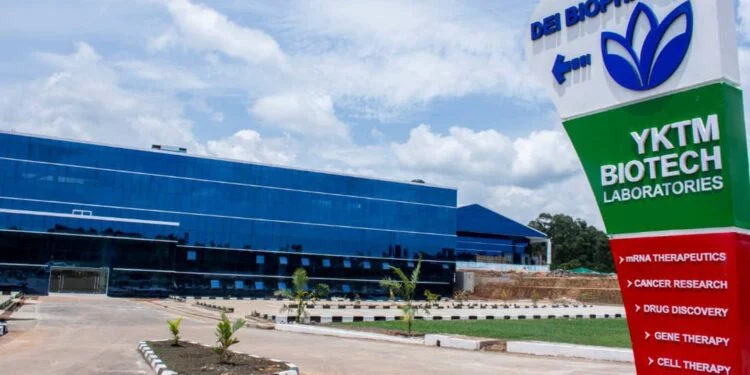
Dei Biopharma Auction
The financial troubles surrounding Uganda’s flagship pharmaceutical project have moved from the courtroom to the auction block.
A debt collection firm, Jald Uganda, has published a notice advertising several high-value properties belonging to Dei Industries International Limited, Dei Natural Products International Limited and businessman Dr Mathias Magoola for sale by public auction or private treaty. The notice, issued under the Registration of Titles Act and Mortgage Act, follows instructions from a financial institution over outstanding loan balances, accumulated interest, fees and disbursements.
The properties on the list are not marginal assets. They include an industrial establishment on approximately 20.673 acres at Matugga in Kyadondo Block 82, a fully integrated wheat milling plant in Luzira, a hospital in Kitende, commercial buildings in Katwe and Seguku, residential developments in Muyenga-Kisugu, and land in Kyamuli-Kungu. Occupants have been told to vacate within 14 days to allow prospective buyers to inspect the premises.
The auction notice does not disclose the identity of the financial institution, the total outstanding balance or the reserve prices. What it does reveal, however, is that the financial distress is not confined to Dei BioPharma Limited itself. It stretches across a wider portfolio of companies and individual holdings associated with the project.
The Shs723.4 Billion Question
The timing is what makes the advertisement so politically sensitive.
Between the 2023/2024 and 2024/2025 financial years, the Ugandan government committed a cumulative Shs723.4 billion to Dei BioPharma. The money came in three tranches: Shs70 billion in the 2023/24 financial year, an additional Shs75 billion in December 2023, and Shs578.4 billion through a supplementary budget. The largest allocation was intended, at least in part, to help the company settle its financial obligations and complete its manufacturing operations.
Yet the loan dispute has continued. In August 2024, Equity Bank Uganda and Equity Bank Kenya filed court claims alleging that Dei Industries International and associated companies had failed to clear outstanding facilities despite receiving government funding. The banks reportedly claimed Shs82.2 billion was owed to Equity Bank Uganda and US$43.23 million to Equity Bank Kenya. The companies disputed the calculations and sought an audit.
That dispute is still unresolved. In September 2026, the Court of Appeal stayed proceedings in High Court Civil Suit No. 929 of 2024 pending an intended appeal. An independent audit by Clayton & Co, appointed through the Institute of Certified Public Accountants of Uganda, had put the alleged indebtedness at US$39,911,245—approximately Shs147.7 billion. Dei’s lawyers challenged the audit process, and the Court of Appeal found that the intended appeal raised arguable issues about the genuineness of the report.
The stay did not extinguish the loan obligations. It simply paused the main case while the challenge to the audit is heard. The auction notice is a separate creditor action, and it signals that at least one lender has lost patience with the pace of the litigation.
What the Auditor General Found
The financial questions predate the auction. In his December 2024 report, Auditor General Edward Akol raised serious concerns about how the Shs723.4 billion had been handled.
The audit found that no valuation report had been produced to establish the company’s net worth before the investment, making it impossible to determine whether the government received shares equivalent to the money it put in. The Auditor General’s team was also denied access to the shareholder agreement, and the government had not received share certificates at the time of the audit. Akol warned that the failure to follow proper procedures could expose the government to legal risk and recommended that the Ministry of Finance engage the Attorney General and the company to resolve the documentation gaps.
Nearly two years later, those gaps have not been closed.
Parliament’s Uncomfortable Numbers
On 6 October 2026, the Parliamentary Committee on Presidential Affairs presented its assessment of the project. The committee, chaired by Martin Mapenduzi, reported that the government holds a 9.4 per cent stake in Dei BioPharma—but that documentary proof of the shareholding had not been presented during the assessment.
The committee also found that the facility is operating well below its envisaged capacity. In the 2024/2025 financial year, Dei BioPharma produced and distributed only six generic medicines: paracetamol, tramadol, metformin, doxycycline and metronidazole among them. Several specialised production lines remained under installation, validation and commissioning.
Despite this, the committee recommended that the Ministry of Finance provide an additional US$434 million—approximately Shs1.74 trillion—to complete and fully operationalise the plant. The recommendation triggered a heated debate in Parliament. Deputy Speaker Thomas Tayebwa questioned whether Parliament could authorise further spending while the ownership, valuation and accountability questions surrounding the existing investment remained unresolved. Leader of the Opposition Joel Ssenyonyi asked why the government would inject more money when there was still no proof of its shareholding.
The committee’s defence is that completing the facility would strengthen Uganda’s medicine security, reduce dependence on imports and create employment. The plant reportedly employs more than 1,000 people and is projected to generate up to 20,000 jobs when fully operational. Those are legitimate objectives. The question is whether the current structure is the right vehicle for achieving them.
Workers Go Unpaid While the Bailout Debate Continues
Perhaps the most troubling reports concern the company’s own workforce.
In May 2026, Mulengera News reported that Dei BioPharma workers had gone on strike after going four months without pay. An official email from the company’s human resources department confirmed that staff had not received their monthly salaries since January. Workers reported that the company had stopped providing meals, that NSSF remittances were unaddressed, and that some employees had taken salary loans that were now being recovered against their vehicles and small plots of land[.
The reports also suggested that some board members had resigned, citing corporate governance concerns.
These allegations have not been independently verified through payroll records, and the company has not issued a detailed public response. But they sit awkwardly alongside the billions already committed and the request for billions more.
What Taxpayers Still Do Not Know
The auction notice adds a new layer of urgency to a set of questions that have been building for more than two years.
Taxpayers do not know exactly how the Shs578.4 billion supplementary allocation was used. The Equity Bank litigation alleged that the money was channelled through another bank rather than used to settle the outstanding facilities, but that allegation has not been finally determined by a court. Taxpayers do not know which properties are encumbered, what the outstanding balances are, or whether the government’s 9.4 per cent stake is legally protected in the event of a creditor recovery.
And they do not know why workers were reportedly going without salaries while the company continued to seek additional public financing.
The Shs723.4 billion question is no longer just about whether Uganda can build a pharmaceutical factory. It is about whether the country is financing a viable industrial investment or repeatedly rescuing a private business whose financial and governance problems remain unresolved. The auction advertisement makes that question harder to avoid.

