Edward Gough Whitlam Siblings: All About Freda Leslie Whitlam

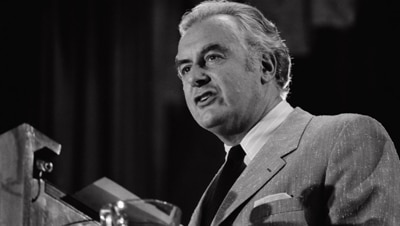
Edward Gough Whitlam PHOTO/ABC News
Edward Gough Whitlam, universally known as Gough Whitlam, was an Australian barrister, politician and statesman who served as the 21st Prime Minister of Australia from 5 December 1972 to 11 November 1975.
Born on 11 July 1916 in Kew, a suburb of Melbourne, Victoria, he was the elder child of Harry Frederick Ernest “Fred” Whitlam, a senior Commonwealth public servant who later became Commonwealth Crown Solicitor, and Martha “Mattie” Maddocks.
From early childhood he was called by his middle name, Gough.
The family lived in Melbourne, then Sydney, and from the late 1920s in Canberra, where Whitlam spent formative years.
He studied arts and law at the University of Sydney, served as a navigator in the Royal Australian Air Force during the Second World War, rising to the rank of flight lieutenant, and was admitted to the New South Wales Bar in 1947, taking silk as Queen’s Counsel in 1962.
Siblings
Gough had one sibling, a younger sister named Freda Leslie Whitlam, born in 1920.
The two children of Fred and Martha Whitlam shared a stable, intellectually stimulating upbringing shaped by their father’s public-service career and commitment to human rights and international affairs.
Freda pursued a distinguished career in education and the church.
She became principal of Presbyterian Ladies’ College in Sydney and later served as moderator of the New South Wales Synod of the Uniting Church in Australia.
Like her brother, she enlisted in the Royal Australian Air Force during the Second World War.
She remained a private but supportive figure in relation to Gough’s public life and lived to an advanced age, dying in 2018.
Also Read: Paul Keating Siblings: Get to Know Anne, Greg and Lyn Keating
Career
After war service and admission to the bar, Whitlam joined the Australian Labor Party in 1945.
He entered the House of Representatives in November 1952, winning the Sydney seat of Werriwa at a by-election, and held it until his retirement from parliament in 1978.
He became Deputy Leader of the federal parliamentary Labor Party in 1960 and Leader in 1967, succeeding Arthur Calwell.
Over the following years he modernised the party’s organisation and platform, broadened its appeal, and led it to victory at the 1972 election under the slogan “It’s Time,” ending 23 years of Coalition government.
As prime minister he pursued an ambitious reform agenda that included the establishment of Medibank (the precursor to Medicare), the abolition of tertiary education fees, the introduction of no-fault divorce and the Family Court, equal pay for women, the recognition of Aboriginal land rights (including the symbolic return of Wave Hill Station), the lowering of the voting age to 18, the end of conscription, diplomatic recognition of the People’s Republic of China, and a more independent foreign policy.
Economic difficulties, inflation, unemployment and a series of ministerial controversies weakened the government.
In October 1975 the Opposition used its Senate majority to block supply.
On 11 November 1975 Governor-General Sir John Kerr dismissed Whitlam and commissioned Malcolm Fraser as caretaker prime minister.
Whitlam’s Labor Party was heavily defeated at the subsequent election.
He remained Leader of the Opposition until 1977, left parliament in 1978, and later served as Australia’s Ambassador to UNESCO (1983–1986) and in a range of public and cultural roles.
Accolades
Whitlam was appointed Queen’s Counsel in 1962 and Companion of the Order of Australia (AC) in 1978.
He received numerous honorary doctorates from Australian universities and decorations from the governments of the United States, China, Greece, Italy, the Philippines, Cyprus and Papua New Guinea, among others.
He was awarded the Socialist International Plate of Honour and the Redmond Barry Award from the Australian Library and Information Association.
Beyond formal honours, his legacy is marked by the Whitlam Institute within Western Sydney University, numerous public buildings, scholarships and cultural institutions that bear his name, and by the enduring recognition of his government as one of the most consequential reform periods in modern Australian history.