


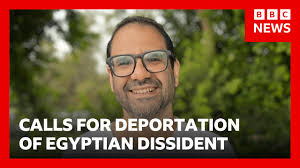
The Conservatives have called for an Egyptian activist to be deported from the UK and for his British citizenship to be revoked.
Shadow justice secretary Robert Jenrick said Alaa Abdel Fattah should “be made to live in Egypt or frankly anywhere else in the world” after social media messages emerged of him calling for Zionists to be killed.
Sir Keir Starmer has been criticised for being “delighted” at Fattah’s arrival, but it is understood the messages were not brought to his attention until recent days.
The Foreign Office said it had been “a long-standing priority under successive governments” to work for Fattah’s release but it condemned his posts and said it considered them “abhorrent”.
Fattah, a dual British national, arrived in the UK this week after being convicted in 2021 of “spreading fake news” in Egypt for sharing a Facebook post about torture in the country. His family has been approached for comment.
Speaking on GB News, Jenrick criticised senior ministers for “rejoicing at the fact this man was coming here, bragging that they’d achieved some kind of diplomatic coup that someone who basically hates Britain, hates everything that we stand for, is now going to be coming here to roam our streets, and live potentially the rest of his life amongst us.”
He added: “It is an absolute disgrace, it tells you everything you need to know about this Labour government and it has to be stopped if we can.
“I think this man’s citizenship should be revoked and he should be made to live in Egypt or frankly anywhere else in the world other than the UK.”
Conservative governments, including ones in which Jenrick served, also repeatedly campaigned for Abdel Fattah’s release.
Separately, the Board of Deputies of British Jews said the case was of “profound concern”.
Adrian Cohen, the board’s senior vice-president, said: “His previous extremist and violent rhetoric aimed at ‘Zionists’ and white people in general is threatening to British Jews and the wider public.
“The cross-party campaign for such a person, and the warm welcome issued by the government, demonstrate a broken system with an astonishing lack of due diligence by the authorities.”
Fatah is also accused of saying the police do not have rights and “we should kill them all”.
Abdel Fattah’s release in September followed a long campaign by his family – backed by celebrities such as actresses Dame Judi Dench and Olivia Colman – and lobbying by the British government.
He had spent more than a decade of his life behind bars, including being handed a five-year sentence in December 2021 following a trial that human rights groups said was grossly unfair.
The previous Conservative administration had also lobbied for the activist to be freed and a government spokesman said: “He is a British citizen. It has been a long-standing priority under successive governments to work for his release from detention, and to see him reunited with his family in the UK.”
Former Conservative leader Sir Iain Duncan Smith signed a cross-party letter in December last year urging the government to secure his release in Egypt.
Writing on X on Sunday, Sir Iain said: “I do, however regret signing the letter calling for the release of Alaa Abd el-Fattah, given his views, that have since come to light, are utterly abhorrent.
“Had I known of these I would not have signed the letter. I urge the police to investigate the nature of these extremist comments.”
A Labour source accused Jenrick of trying to rewrite history for his own political advantage.
A writer, intellectual and software developer, Abdel Fattah rose to prominence during an uprising in 2011 that forced the former Egyptian president, Hosni Mubarak, to resign.
In 2014, Abdel Fattah was nominated for a European human rights award, the Sakharov Prize, but this was withdrawn over tweets about Israel he posted in 2012.
He said his comments had been part of a “private conversation” that took place during an Israeli offensive in Gaza and had been taken out of context.
After being removed from a travel ban list imposed by Egyptian authorities that kept him in the country for three months after his release from jail, Abdel Fattah has now reunited with his 14-year-old son, who lives in Brighton.
Speaking to the BBC from Cairo in October after his release, he said: “I’m learning how to get back into life.”
He added: “I’m doing much better than I would have expected. Much better than most people would have expected.”
By BBC News
Email your news TIPS to Editor@Kahawatungu.com — this is our only official communication channel
