

Evening beer, machete and rubble: Inside the Kisii Shrine owner’s desperate battle for privacy

It had begun quietly.
Then it grew.
For days, pilgrims had been trickling into Charles Onsombi’s compound in Emenwa, Bogichoncho village, Nyamache, drawn by claims that an image resembling the Virgin Mary had appeared inside one of the houses.
What began as whispers among villagers was quickly becoming something bigger — a pilgrimage site.
Then some unruly boda boda riders ripped off the door of the house where the suspected apparition was said to have appeared.
For Onsombi, that was the tipping point.
He did not believe in the apparition. He had reportedly told friends that his wife, Mary, had taken her religious devotion too far.
But as the number of visitors increased and strangers began streaming into his compound, his patience appeared to run out.
On Sunday evening, after drinking beer, Onsombi moved swiftly to hire young men from the neighbourhood to dismantle the structure that was fast assuming the character of a shrine.
“All the while he appeared drunk,” a villager said.
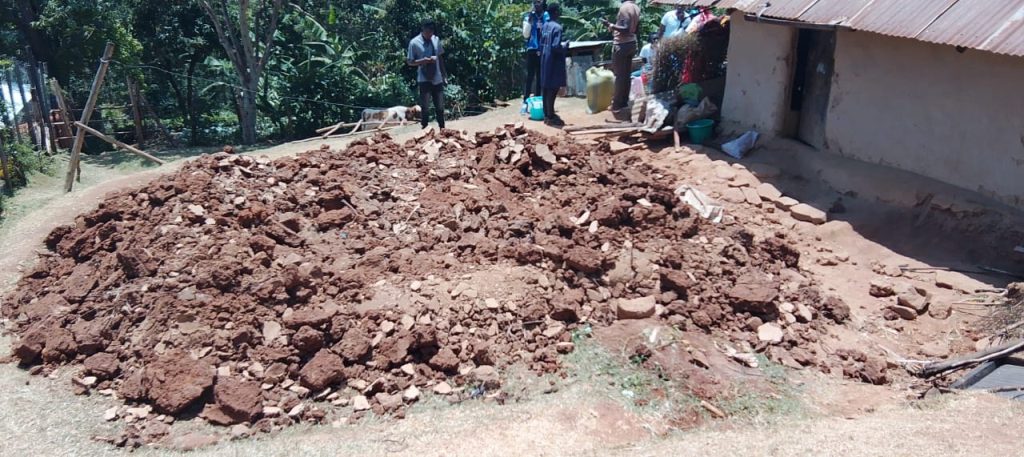
By Monday morning, the mud house had been reduced to rubble.
“I am tired. I don’t want any further visitors here,” Onsombi said, swinging a machete as he confronted some of the people gathered at his gate.
“For those who want to pick the dry mud, they can do so, but leave me alone in peace,” he told this journalist.
Yet the demolition did little to extinguish the mystery.
If anything, it appeared to deepen the fascination.
Among those still arriving that morning were pilgrims who had travelled for hours from Nairobi and Kisumu, only to find the destination they had come to see lying in ruins.
Their excitement quickly turned to disbelief.
“We have travelled all the way from Nairobi because we heard that the Virgin Mary had appeared here. We did not come to cause trouble. We only wanted to pray and see the place for ourselves,” said one visibly frustrated pilgrim.
Another pilgrim from Kisumu said she had made the journey in faith, only to arrive at a scene she had never expected.
“I left Kisumu believing I would come here, pray and perhaps experience something that would strengthen my faith. Instead, we have arrived and found the house demolished. Why destroy something that people believe is sacred?” she asked.
For some, the demolition was difficult to understand.
“We spent money on transport to come here. Some of us travelled through the night. We did not come looking for a fight. We came as believers,” said another pilgrim.
But the frustration was not only about the demolished structure.
The pilgrims were angry that their journey had ended before they could even get close to the spot that had drawn them there.
“We have come from far because of what we heard. At least they should have allowed us to enter, pray and leave peacefully. Nobody should force faith on another person, but neither should people mock what others believe,” said a pilgrim who identified himself as having travelled from Narok.
Onsombi, however, appeared unmoved by their pleas.
He did not want a shrine in his compound.
He did not want strangers streaming into his homestead.
And, above all, he did not want what he regarded as his private home transformed into a destination for pilgrims.
When some visitors insisted on entering his compound, the confrontation escalated.
Onsombi hired a guard.
The man was armed with a machete.
Together, they moved to keep the pilgrims away.
By 10am on Monday, two unruly worshippers had reportedly sustained injuries during a tussle with the guards.
Then a political aspirant arrived carrying goodies, including food.
Onsombi appeared to soften.
“We can only allow those with gifts,” he said.
The remark captured the strange mood that had descended on the homestead — part religious gathering, part confrontation, part spectacle.
The scene was startling: a private home caught between faith and ownership, between people who believed they had discovered something sacred and a homeowner determined to reclaim his privacy.
For the pilgrims, however, the rubble was not the end of the story.
It was merely another chapter.
They continued to come.
Some who managed to enter searched through the remains.
There was no apparition.
Only rubble.
But some collected pieces of dry mud from the demolished structure, convinced that the site still carried spiritual significance.
For Onsombi, every visitor was another reminder that the rumours had taken on a life of their own.
He could demolish the house.
He could remove the door.
He could hire men to guard his compound.
But he could not demolish a belief once it had taken root.
And so, in this quiet corner of Nyamache, the battle is no longer simply about a house.
It is about what happens when private space becomes public faith.
It is about whether belief can transform an ordinary homestead into a place of pilgrimage — even against the wishes of the person who owns it.
For the pilgrims, Emenwa has become a place of faith, drawing hundreds of local boda boda riders and other businesses into the sudden stream of visitors.
For Onsombi, it remains his home.
And between those two convictions lies the rubble.

