


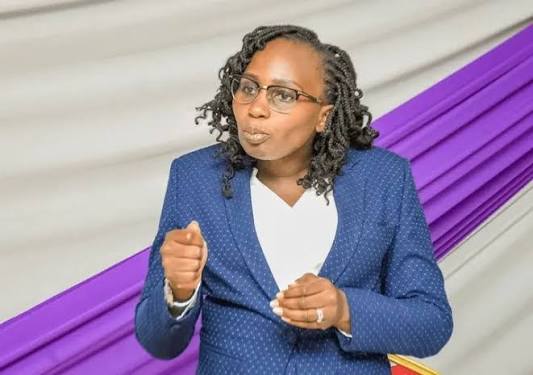
Former Law Society of Kenya president Faith Odhiambo has raised concerns over the Controller of Budget’s reported inability to trace certain government funds and levies because they are held outside the Consolidated Fund.
Odhiambo said the situation raises constitutional questions about the management and oversight of public finances, arguing that Article 206(1) of the Constitution requires money raised or received by or on behalf of the national government to be paid into the Consolidated Fund, except where an exception is expressly authorised by law.
She said the constitutional framework was designed to ensure that public money remains traceable and subject to oversight.
“By constitutional design, public money must be traceable and accountable,” Odhiambo said, warning that arrangements that limit such visibility could weaken public-finance controls established under the 2010 Constitution.
She pointed to Articles 206 and 228, which provide for the administration and oversight of public funds, including the Controller of Budget’s role in authorising withdrawals from the Consolidated Fund and other public funds within the constitutional framework.
Odhiambo said the concern was particularly relevant in the debate over the proposed Sovereign Wealth Fund, where she argued that a fund operating without proceeds first being credited to the Consolidated Fund and without appropriate oversight by the Controller of Budget could create a parallel financial structure outside the national budget framework.
She said such arrangements could reduce Parliament’s ability to scrutinise public expenditure and limit independent oversight.
Her comments come against the backdrop of government spending figures contained in the Controller of Budget’s National Government Budget Implementation Review Report for the 2025/26 financial year.
The report records total national government travel expenditure at Sh30.69 billion during the year ended June 30, 2026. Of this, Sh21.98 billion was spent on domestic travel while Sh8.71 billion went towards foreign travel.
State House recorded the highest travel expenditure at Sh2.5 billion, comprising KSh2.4 billion on domestic travel and KSh159 million on foreign travel.
It was followed by the State Department for Internal Security and National Administration at Sh1.4 billion, the State Department for Immigration and Citizen Services at Sh1.1 billion, and the Office of the Deputy President at Sh655 million.
Odhiambo argued that the scale of expenditure makes effective financial oversight particularly important, especially where some funds and levies may not be visible through the conventional Consolidated Fund framework.
She said public finance management should ensure that Parliament, the Controller of Budget and the Auditor-General can track public resources from collection to expenditure.
“The Constitution does not entertain secret budgets,” Odhiambo said, arguing that revenue collected from citizens should be subjected to clear legal and institutional oversight.
She called for all government revenue to be routed through the appropriate constitutional and statutory mechanisms, alongside timely publication of financial accounts and stronger enforcement mechanisms allowing Parliament and oversight institutions to trace public funds.
“If money bypasses the Treasury, it bypasses the people’s control,” she said.

Email your news TIPS to Editor@Kahawatungu.com — this is our only official communication channel
