

FAO hands over KIAMIS to Ministry as Kenya Moves to digitize agricultural, livestock data

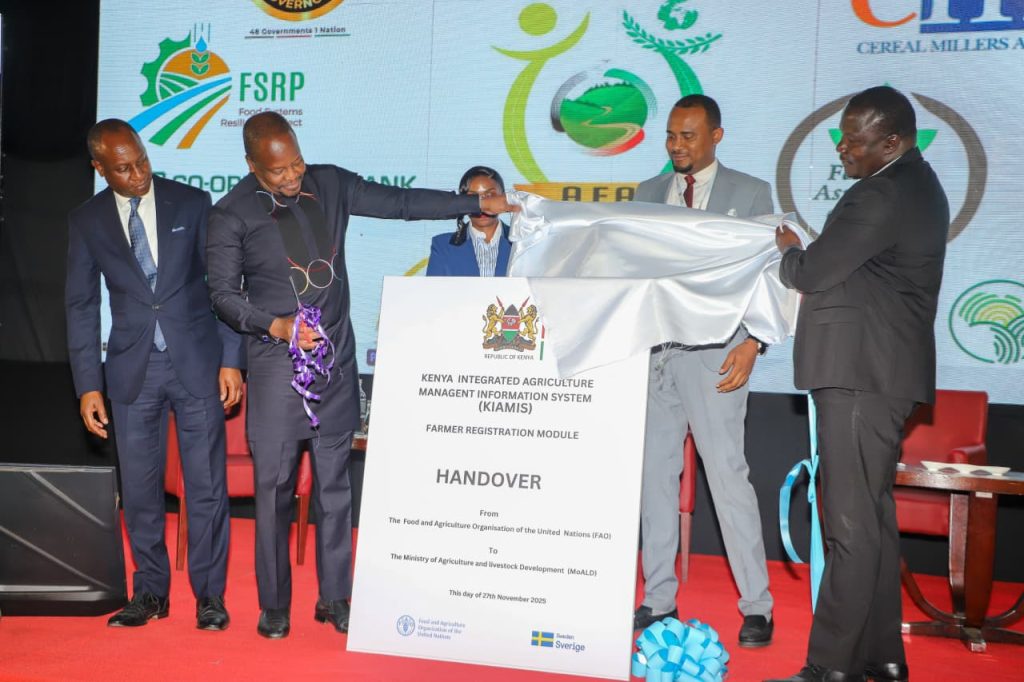
The Food and Agriculture Organization of the United Nations (FAO) and development partners have officially handed over the Kenya Integrated Agriculture Management Information System (KIAMIS) to the Ministry of Agriculture and Livestock Development, marking one of the biggest digital milestones in Kenya’s agricultural transformation journey.
The handover, witnessed during the ongoing Intergovernmental Forum on Agriculture in Naivasha, was led by Hamisi William, FAO Deputy Country Representative, who presented the system to Agriculture and Livestock Development Cabinet Secretary Mutahi Kagwe.
KIAMIS, which now hosts over 7.1 million registered farmers across crops and livestock, will be domiciled at the newly transformed Kenya Agriculture Data and Information Centre (KADIC), formerly AIRC, positioning KADIC as the country’s central hub for agriculture intelligence.
Hamisi revealed that FAO is also working closely with the Ministry of Lands, noting that the two digital technologies will be fully integrated to strengthen planning, farmer verification, credit access, and digital extension.
Kagwe welcomed the handover, describing it as a “new dawn for Kenyan farmers” and a key plank of President Ruto’s Digital Super Highway agenda.
“Every village in Kenya and every farmer will now be connected to the digital super highway,” said Kagwe.
“This is critical for delivering subsidized farm inputs, soil health information, and tailored agronomic advisories directly to farmers’ phones.”
The milestone comes at a transformative moment for KADIC, now led by youthful Director Betty Cheroigin and Digital Director Juma Salim, with the centre also taking on a second national system: ANITRAC, Kenya’s new livestock traceability platform.
According to Livestock Principal Secretary Jonathan Mueke, ANITRAC is already revolutionising Kenya’s livestock value chain and placing the country on a competitive footing in global premium markets.
Mueke emphasized the rising global demand for verifiable food systems:
“Today’s consumer wants traceability — farm to fork. If we are going to compete in premium global markets, we must demonstrate that our farmers meet every export requirement with absolute integrity.”
He confirmed that ANITRAC is now fully developed, calling it more than just a digital tool:
“We have completed the development of ANITRAC, Kenya’s new livestock traceability system. This is not just a platform; it is a policy instrument that anchors transparency, food safety, and market confidence.”
The impact, he noted, is already visible.
“Since we rolled out the ANITRAC policy, Kenya’s meat exports have grown by 45%. That is the clearest sign that structured traceability opens doors to high-value markets.”
Mueke also assured international buyers of the system’s integrity:
“Whatever is keyed into ANITRAC cannot be manipulated. Importers can now verify every detail in real time — guaranteeing that the meat they buy from Kenya meets the highest global food-safety standards.”
He added that vaccination records — a key compliance requirement for export markets — are now fully captured:
“Vaccination is central to export compliance. Through ANITRAC, all vaccine records, farm practices, and movement permits are captured in one matrix that international buyers can authenticate instantly.”
With KIAMIS and ANITRAC now consolidated under KADIC, Kenya becomes one of the few African countries with an integrated national digital agriculture and traceability architecture — unlocking data-driven farming, efficient service delivery, export readiness, and farmer verification at scale.