

Felipe González Siblings: Meet Lola, Maruja, Felipe and Germán Palomino González

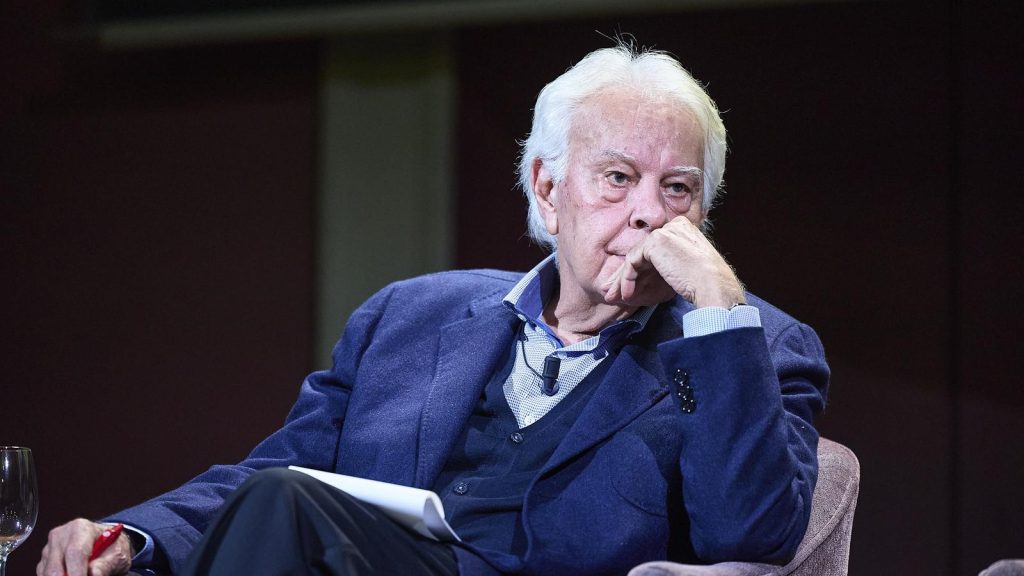
Felipe González PHOTO/Telegraph
Felipe González Márquez is a Spanish lawyer and politician born on 5 March 1942 in the Bellavista neighbourhood of Seville.
The son of Felipe González Helguera, a livestock dealer originally from Cantabria, and Juana Márquez Domínguez from Huelva, he grew up in a middle-class family.
Márquez studied law at the University of Seville, graduating in the mid-1960s, and also took a course in economics at the Catholic University of Louvain in Belgium.
He began practising as a labour lawyer, defending workers’ rights during the Franco dictatorship.
Márquez joined the Socialist Youth in 1962 and the then-clandestine Spanish Socialist Workers’ Party (PSOE) in 1964, rising quickly through its ranks under the code name “Isidoro.”
He served as Secretary-General of the PSOE from 1974 to 1997 and as Prime Minister of Spain from 1982 to 1996, the longest tenure of any democratically elected Spanish prime minister.
After leaving office he remained active in public life, diplomacy and private initiatives.
Siblings
Felipe was the second of four siblings in a family of modest but relatively comfortable means.
His older sister is Maruja González Márquez.
His younger sister is Lola González Márquez, who married Francisco Germán Palomino Romera and has two sons, Felipe and Germán Palomino González.
His younger brother was Juan María González Márquez, an Andalusian businessman linked to various regional enterprises; he died in Seville in May 2019 at the age of 71 after a long illness.
Only Juan María occasionally appeared in media reports in connection with business activities and family matters during the 1990s.
Also Read: Wout Weghorst Siblings: All About Twan, Ralf and Niek Weghorst
Career
After qualifying as a lawyer, González specialised in labour cases while becoming increasingly involved in underground socialist politics under Franco.
He helped rebuild the PSOE in Andalusia and nationally.
At the party’s 1974 congress in Suresnes, France, he was elected Secretary-General, modernising the organisation, distancing it from rigid Marxism and positioning it as a broad social-democratic force.
Following the legalisation of the party and Spain’s transition to democracy, he led the PSOE to successive electoral victories.
In the 1982 general election the party won an absolute majority, and González became Prime Minister at the age of 40.
He won re-election in 1986, 1989 and 1993, governing for thirteen and a half years.
His governments oversaw Spain’s entry into the European Economic Community in 1986, the modernisation of the armed forces, economic reforms, industrial reconversion, and the consolidation of democratic institutions.
After electoral defeat in 1996 he remained a deputy until 2000 and later took on roles including special ambassador for the bicentenary of Latin American independence and participation in European advisory groups.
In later years he has written books, given lectures and commented on political affairs while cultivating personal interests such as bonsai.
Accolades
In 1993 González was awarded the Charlemagne Prize in Aachen for his contribution to European unity.
He holds the Grand Cross of the Order of Christ (Portugal, 1984) and the Order of José Martí (Cuba, 1986).
Spanish honours include the title of Favourite Son of Andalusia (1998), the Medal for Work on European Integration (2005), the Gold Medal of Madrid (2011) and Favourite Son of Seville (2012).
In 2015 the Inter-American Dialogue gave him its Distinguished Leadership Award for Public Service in the Americas.
In 2023 he received the Ibero-American Torre del Oro Prize, and in 2025 King Felipe VI named him a Knight of the Order of the Golden Fleece.

