

From garbage mountain to green haven: How Arati gave Kisii’s ugliest dump site a new life

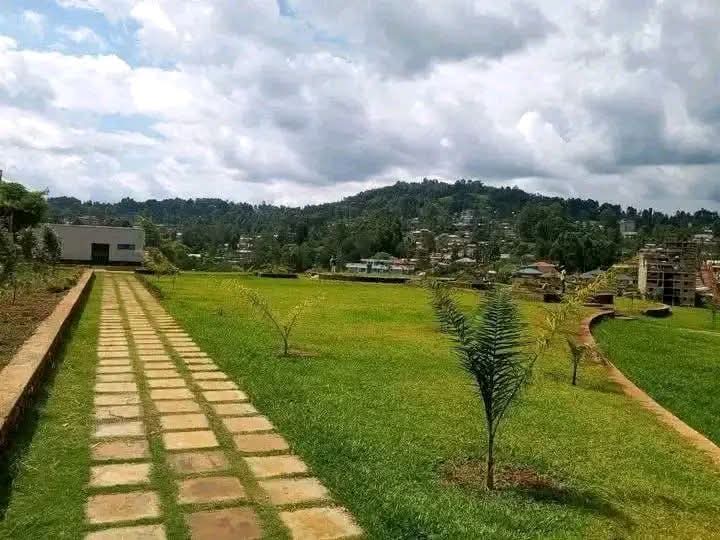
For years, Nyambera, on the outskirts of Kisii Teaching and Referral Hospital, was a place residents hurried past.
And for good reason.
The dumpsite was an ugly, sprawling wasteland of rotting garbage, torn plastic bags, discarded food, broken bottles and foul-smelling waste piled into chaotic heaps.
Clouds of flies swarmed over decomposing rubbish as marabou storks circled overhead and stray dogs rummaged through the filth.
A putrid stench hung heavily in the air, turning the site into one of Kisii town’s most visible symbols of neglect, pollution and urban decay.
When the rains came, dirty water oozed from the waste, turning the surrounding ground into a muddy mess and raising concerns about contamination.
Studies have previously documented elevated concentrations of some heavy metals around Nyambera, underscoring the environmental concerns associated with the old dumpsite.
But the ugly chapter of Nyambera has slowly given way to a remarkable new story.
The former dumpsite has since been transformed into a scenic recreational space, with trees, gardens and areas where residents can sit, walk and relax.
The project follows a decision by the Kisii County Government, under Governor Simba Arati, to decommission the dumpsite and reclaim the land for public use.
“It was embarrassing to have such a place at the heart of our town. The smell was unbearable and birds were everywhere,” said Nancy Hillary, a resident who has witnessed the transformation.
“Today, when you look at the place, you can see the difference.”
John Kerosi, another resident, said the project had restored hope to a neighbourhood that had for years lived with the consequences of poor waste management.
“We used to worry about smoke, waste and children going near the dumpsite. Now there is a place where families can come and relax. It has changed the face of the area,” he told Kahawatungu at the site.
For Arati, however, the project is about more than beautification. It is part of an attempt to change how Kisii handles the mountains of waste generated every day by homes, businesses and institutions.
“We want to make sure that all the waste that emanates from our homes and residential places is disposed properly, not only for the sake of our public health but also to be considered as a form of an income-generating activity,” Arati said.
The governor has also promoted the idea of turning waste into an economic resource through sorting, recycling and production of manure.
“We want to make sure that waste is properly managed,” he said while outlining his administration’s wider waste-management programme.
The county has invested in waste-management equipment and established a material recovery facility where waste can be sorted and recycled.
The approach is intended to move Kisii away from indiscriminate dumping and towards a system in which waste can generate economic value.
According to Arati, the transformation of Nyambera is therefore symbolic.
Where garbage once dominated the landscape, greenery is taking centre stage.
Where scavenging birds once descended on heaps of refuse, families can now imagine gathering for recreation.
And where residents once complained about smell, smoke and filth, there is now an emerging public space.
“Nyambera should no longer be remembered only as a dumpsite,” Arati said while commissioning work at the site a year ago.
But the transformation comes with a responsibility.
Beautification alone will not solve Kisii’s waste problem.
The county must sustain garbage collection, enforce disposal regulations, protect the reclaimed land and ensure that another mountain of rubbish does not return.
Recent county efforts have included plans to improve waste collection, sorting and recycling, while the county has also moved to develop alternative waste-management infrastructure.
For residents, however, Nyambera’s rebirth is already a powerful reminder that even the ugliest corners of a city can be given a second life.
The garbage mountain has disappeared.
In its place, a green haven is taking shape — offering Kisii not just a park, but a visible reminder that neglected urban spaces can be reclaimed, restored and returned to the people.

