

From Telco to TechCo: How Fintech 2.0 and AI Are Powering Safaricom’s Next Growth Chapter

For more than two decades, Safaricom has been measured like a telecommunications company. Investors tracked subscriber growth, network coverage, voice revenues and data consumption. Every quarter revolved around one question: how many more customers could the network connect?
That question is rapidly becoming obsolete.
The company’s next chapter is less about connecting people to a mobile network and more about connecting them to an expanding digital economy powered by artificial intelligence, financial technology, and digital platforms. It is a shift that executives increasingly describe as the evolution from a Telco to a TechCo; a transformation that could redefine how investors value East Africa’s most profitable company.
Around the world, telecommunications companies are confronting a difficult reality. Mobile penetration has matured, competition has intensified and traditional revenue streams are growing more slowly than they once did. Networks alone are no longer enough to sustain long-term growth.
The companies attracting investor attention today are those building technology ecosystems rather than simply selling connectivity.
Read: M-PESA Marks Landmark 2025 with Fintech 2.0 Push and Industry Recognition
For Safaricom, that evolution is being built on an asset it has spent nearly two decades developing: M-Pesa.
Originally launched as a mobile money transfer service, M-Pesa has become the foundation of Kenya’s digital economy. Today it supports merchant payments, savings, credit, investments, international remittances and business transactions. Increasingly, the platform resembles digital financial infrastructure rather than a payments product.
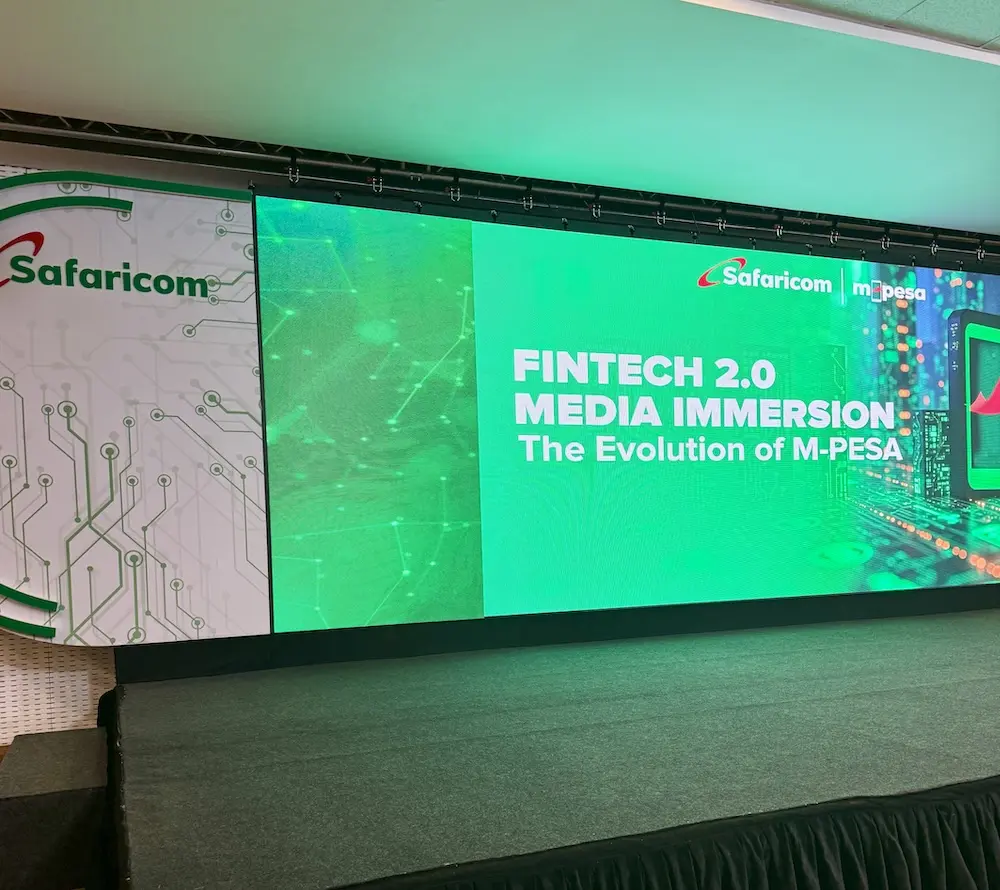
This is what many analysts describe as Fintech 2.0.
The first generation of mobile money focused on replacing cash. The second aims to integrate every stage of a customer’s financial life into a single digital ecosystem—from earning and spending to borrowing, investing and managing businesses.
Artificial intelligence is expected to accelerate that transition.
AI is already reshaping how financial institutions detect fraud, personalize services and automate customer support. For a business serving tens of millions of customers, even small improvements in customer experience or operational efficiency can translate into significant commercial gains.
Industry observers believe AI will also help Safaricom strengthen cybersecurity, optimize network performance and develop smarter financial products based on customer behaviour.
Read Also: Safaricom Tightens SIM Swap Security as Fraudsters Refine Tactics
The company’s expansion into Ethiopia further strengthens that ambition. Rather than replicating yesterday’s telecom model, Safaricom now has an opportunity to export a technology ecosystem built around connectivity, digital payments and intelligent services.
The implications extend beyond Safaricom itself.
As digital infrastructure becomes increasingly central to African economies, telecommunications companies are competing not only with each other but also with banks, fintech startups, cloud providers and global technology firms.
Success will depend less on who owns the largest network and more on who builds the most valuable digital platform.
That is why Safaricom’s future may ultimately be measured not by airtime sales or data bundles, but by how successfully it transforms itself into a technology company whose products happen to include a mobile network.
If the strategy succeeds, investors may eventually stop asking how many subscribers Safaricom has—and start asking how much of East Africa’s digital economy flows through its platforms.

