

Gangs now control 90% of Haitian capital: UN says

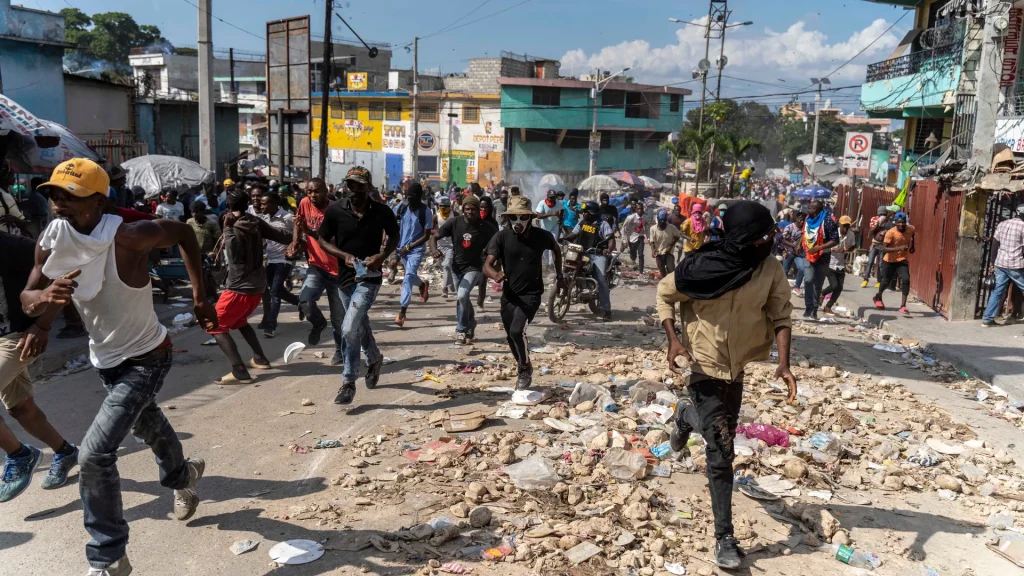
Armed gangs have tightened their grip on Haiti’s capital Port-au-Prince, UN officials warned Wednesday, saying it is possible a “total collapse” of state presence in the city could occur.
This comes as Kenya marked a year since its first batch of police landed in Haitian capital to help control gang violence.
The first group arrived on June 25, 2024 amid celebrations from locals who saw them as hope to contain the surging gangs.
And a year later, on June 24, 2025, Kenya’s new Consular General Noor Gabow arrived in Port-au-Prince ready for the task ahead.
He was scheduled to present his papers to the local president to officially start his work. Gabow, the immediate former Deputy Inspector General of Administration Police had led the mission and landed there with the first group of police officers on June 25, 2024.
The UN said Wednesday the situation on the ground is dire.
“We have continued to witness a sharp erosion of state authority and the rule of law. Brutal gang violence affects every aspect of public and private life,” Miroslav Jenca, UN assistant secretary-general for Europe, Central Asia and the Americas, told a Security Council meeting.
Despite “their best efforts,” local police and a Kenya-led multinational support mission have been unable to make headway in restoring state authority, he said.
Haiti — the poorest country in the Americas — has suffered from political instability for decades and over the past year has seen soaring violence by armed groups. “Without increased action by the international community, the total collapse of state presence in the capital could become a very real scenario,” Jenca said.
“The options we have on the table now will be considerably less costly and complex than if there is a total collapse of state presence,” he said, referring to the Secretary-general Antonio Guterres’s proposal to create a UN mission to provide logistical support for the Kenya-led force.
Violent armed gangs now have some 90 percent of Port-au-Prince under their grip, said Ghada Waly, director of the UN Office on Drugs and Crime. The previous assessment was 85 percent.
With the state’s capacity to govern rapidly shrinking, criminal gangs are stepping into the void, she warned.
“They are establishing parallel governance structures and providing rudimentary public services,” she said.
“Even more disturbing are new allegations of trafficking in persons for the purpose of organ removal,” she said, citing related reports at a medical facility in Petion-Ville and a hospital in northern Haiti.
Gang violence has continued to soar since an organized assault prompted the resignation last year of prime minister Ariel Henry.
He was replaced by a frail transitional council that is mandated to prepare for elections by February 2026. Its last elections were in 2016.
While the U.N. aimed for the mission, which was sent to aid the Haitian National Police, to reach some 2,500 troops, well under half are currently deployed.
More than 3,000 personnel were pledged in initial commitments.
In a note sent to the U.N. Security Council, Kenya said 991 troops were currently deployed, mostly Kenyans but also 150 Guatemalans, 78 Salvadorans, 23 Jamaicans, six Bahamians and two Belizeans.
He said that many were on standby because existing contracts for logistical support could not provide for them.
“The MSS is also operating below the required capabilities in terms of equipment and operational support necessary to execute the mission effectively,” the note said.
“The equipment levels stand at below 30% of planned capabilities.”

