

Glacial collapse caused seismic activity, ‘catastrophic’ Nepal floods, USGS says

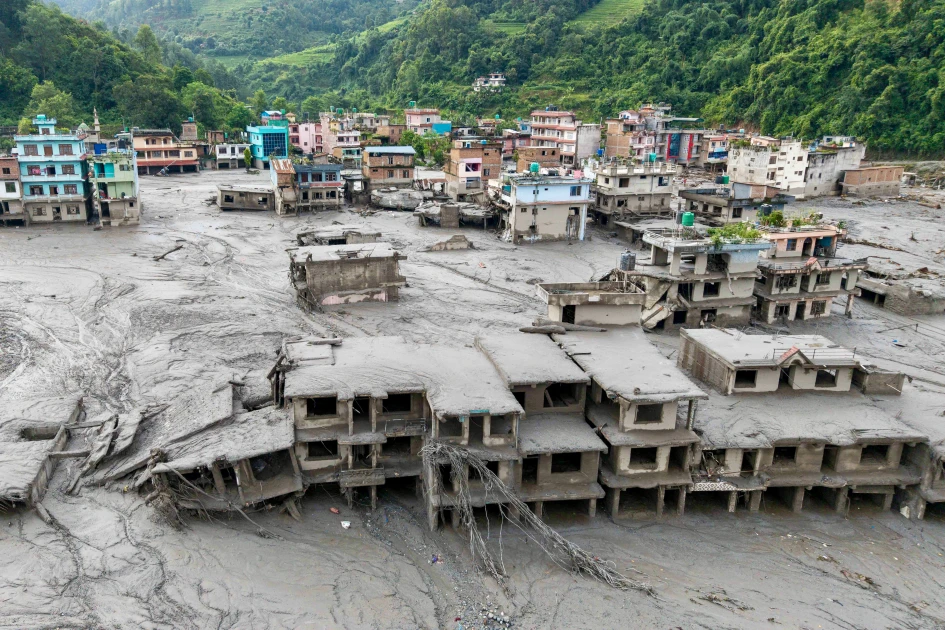
A glacial collapse caused seismic activity and “catastrophic” downstream impacts in Nepal and Tibet, the US Geological Survey said Thursday.
The agency said seismic activity initially reported as an earthquake “was instead a glacial collapse and debris flow” that “caused subsequent catastrophic impacts downstream”.
At least 160 people were killed by torrents of water and debris that crashed downstream on either side of the Nepal-Tibet border, with hundreds reported missing in both areas.
The cause of the disaster was not immediately clear in the hours after it occurred early Wednesday, but Nepal’s Foreign Minister Shishir Khanal had said an earthquake likely triggered a landslide, in turn blocking a river and sending water gushing downstream.
Other theories advanced included a glacial lake flood — when a fragile debris wall holding back glacier melt collapses — or an ice avalanche.
USGS said “a magnitude 5.2 seismic event occurred near the border between Nepal and China on Aug 26 at 8:37am local time.”
“This event was initially reported as a magnitude 4.4 earthquake. Additional analysis of nearby seismic stations, long period seismic waves, and satellite imagery led to the determination that the seismic event was instead a glacial collapse and debris flow, and that no earthquake had occurred.”
The exact sequence of events is still unclear, but on Wednesday morning, torrents of water and debris crashed downstream on both sides of the border.
Surveillance video from the Chinese side showed a wall of mud and water crashing over a building as terrified people ran away.
In Nepal, a surge of water hit villages and towns on the path of two rivers — Bhote Koshi and Trishuli.
The disaster was intially described as a flood on the Nepalese side, and a mudslide by Chinese authorities.
Hundreds missing, many dead
At least 165 people have been reported dead, 162 in Nepal and three in Tibet.
Chinese authorities have said the disaster caused “major casualties” and reported another 558 missing — 260 of whom are foreigners.
On the Nepalese side, authorities said Thursday that 468 tourists, 393 of them foreigners, were unaccounted for.
The missing include Indians and others from Ukraine, Malaysia, the United Kingdom, South Africa and elsewhere.
Australia said 34 of its citizens were missing in Nepal.
Another 93 Nepalese citizens have also been reported missing.
Aid
Promises of aid and assistance came in soon after reports of the scale of the disaster.
The United States has pledged $500,000 in emergency assistance, and the International Federation of the Red Cross and Red Crescent Societies released $1.4 million.
“The priority now is to reach affected communities and get assistance to people who have lost their homes, suffered injuries or have been cut off,” its Nepal head David Fisher said.
The European Union said it had activated its Copernicus satellite surveillance system to help recovery efforts and was ready to provide more help, while the World Health Organisation said it had dispatched emergency medical supplies.
Neighbouring India has sent an initial 10 tonnes of humanitarian assistance.
Cause
The explanation for the calamity has evolved since it struck, but appears linked to a collapsing glacier.
Within hours of the flooding, Nepal’s Foreign Minister Shishir Khanal said an earthquake likely triggered a landslide, in turn blocking a river and sending water gushing downstream.
China also reported a landslide, saying a border hub between Tibet and Nepal had been hit by a surge of debris.
The Nepali foreign minister’s statement aligned with a US Geological Survey report of a quake in Tibet that was north of the disaster zone.
However, USGS subsequently updated its conclusion to say the seismic activity initially reported as a quake “was instead a glacial collapse and debris flow” that “caused subsequent catastrophic impacts downstream”.
“Additional analysis of nearby seismic stations, long period seismic waves, and satellite imagery led to the determination that the seismic event was instead a glacial collapse and debris flow, and that no earthquake had occurred.”
By Agencies

