

Govt Moves to End Chronic Underfunding of Children’s Services

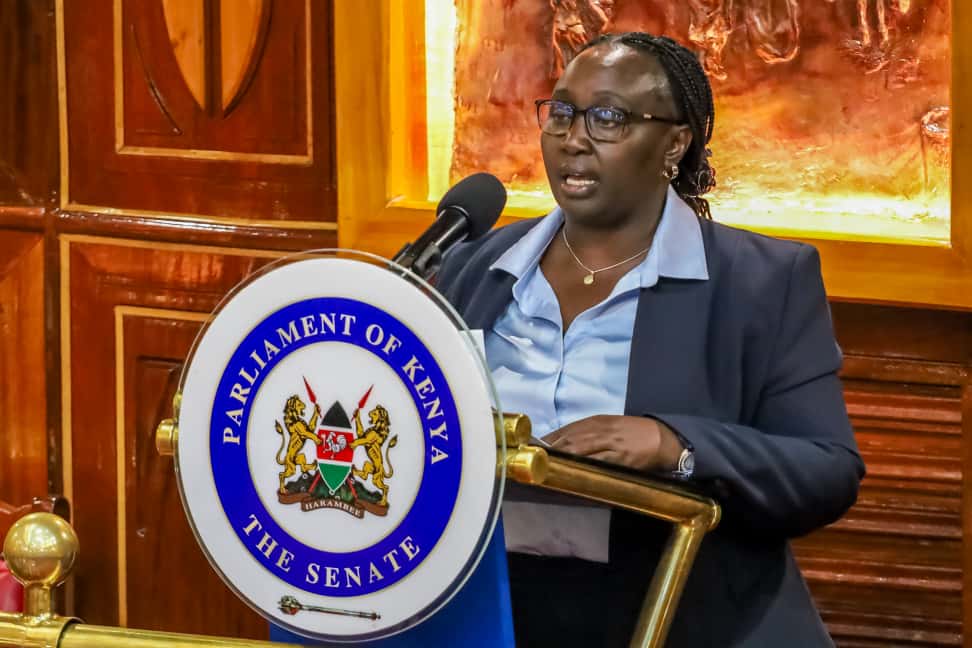
The government is working on new measures to end the long-standing underfunding of children’s services, Cabinet Secretary for Gender, Culture and Children Services Hanna Wendot Cheptumo told the Senate on Wednesday.
Cheptumo appeared before the Senate to respond to questions raised by Nominated Senator Miraj Abdilahi, who sought answers on how the government plans to strengthen the newly established State Department for Children Services and improve the welfare of children across the country.
The CS admitted that her ministry has faced major financial challenges that have affected service delivery and child protection efforts nationwide.
“The Ministry fully recognises the long-standing challenge of underfunding,” said Cheptumo. “We have adopted a multi-pronged approach to ensure that child protection financing is integrated into national planning and resource mobilisation frameworks.”
Cheptumo said her ministry has already begun talks with Parliament’s Departmental Committee on Social Protection to secure an additional Sh10 billion on top of the current allocation for the 2025/2026 financial year.
She explained that the funds are needed to boost child protection services, hire more officers, operationalise new sub-county offices, and enhance data management through the Child Protection Information Management System (CPIMS).
According to her submission to the National Treasury, the ministry’s total budget estimate for 2025/2026 stands at Sh12.3 billion, which includes Sh12.07 billion for recurrent expenditure and Ksh244 million for development projects.
The CS said the ministry’s priorities have been aligned with key national plans — including Vision 2030, the Fourth Medium-Term Plan (2023–2027) and the Bottom-Up Economic Transformation Agenda (BETA) — to ensure children’s services are recognised as a national priority during budget discussions.
Cheptumo noted that separating the State Department for Children Services from the Department for Social Protection and Senior Citizens Affairs has improved transparency and allowed for more focused planning.
She assured senators that strict financial controls have been put in place in line with the Public Finance Management Act (2012) and the Public Procurement and Disposal Act (2005) to ensure all funds are used efficiently.
“We have prioritised timely approval of work plans, procurement plans and cash flow schedules,” she said. “We are also ensuring prompt release of funds from the National Treasury to eliminate bureaucratic delays.”
Cheptumo added that the Victim Protection Trust Fund, established under the Victim Protection Act of 2014, remains a key instrument for supporting victims of crime and abuse, especially children.
Sen. Miraj also questioned the shortage of Children Officers across the country. The CS revealed that as of June 2025, there were 714 officers deployed in all 47 counties, 290 constituencies and 353 sub-county offices — a number she admitted is still too low.
“Kenya currently has about 18 million children, meaning each officer is responsible for roughly 25,000 children,” she said.
A recent National Workforce Mapping Report, developed with support from UNICEF, highlighted the serious shortage of staff, limited resources, and heavy workloads facing officers.
To ease the pressure, the ministry plans to recruit 500 new Children Officers in the 2025/2026 financial year, enhance training, and expand the use of CPIMS for real-time data and monitoring.
During the session, senators urged the ministry to move beyond planning and deliver visible results for Kenya’s children.
In her closing remarks, Cheptumo assured lawmakers that her ministry is fully committed to improving child protection services and will continue engaging Parliament to ensure accountability.
“We are determined to protect and empower Kenya’s children,” she said. “This ministry will continue working with the Senate and other stakeholders to ensure no child is left behind.”