

Govt-Owned Enterprise Act Clears Path For Privatisation Of 65 State Corporations

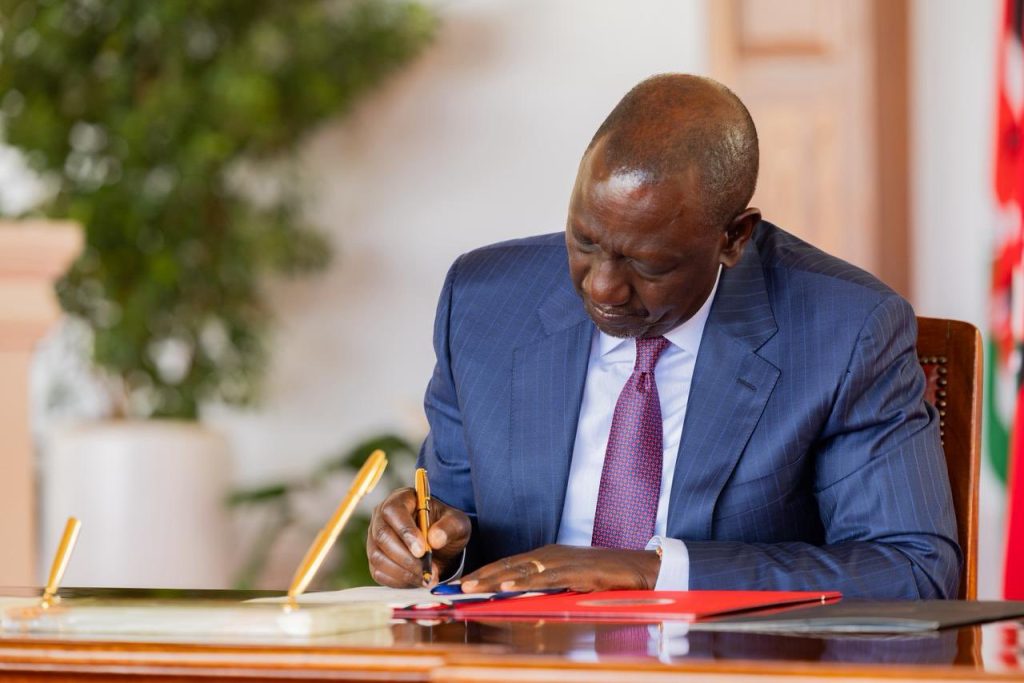
President William Ruto assented to the Government-Owned Enterprises Bill, officially bringing it into law.
The law, which was passed by the National Assembly on Tuesday, focuses on establishing clear rules for state-owned enterprises.
It provides a framework for the creation, control, governance, performance, and ownership of Government-Owned Enterprises (GOEs). It also defines the public service obligations that these enterprises must fulfil.
The law seeks to ensure that GOEs operate efficiently, transparently, and in alignment with national development priorities.
By establishing governance guidelines, it aims to strengthen accountability in the management of public resources.
The GOE Act has identified 65 key state-owned enterprises for privatisation as part of efforts to boost efficiency and reduce the public wage burden.
The targeted entities include the Kenya Literature Bureau, National Oil Corporation of Kenya, Kenya Seed Company Limited, Rivatex East Africa Ltd, Kenyatta International Convention Centre (KICC), and New Kenya Cooperative Creameries (New KCC), among others.
On Wednesday, Majority Leader Kimani Ichung’wah introduced an amendment during the Committee of the Whole House, during which the House voted to remove the Kenya Pipeline Company from Schedule 1 of the Bill.
“I beg to move that the First Schedule be amended as it is on the Order Paper. This is just to remove from the Schedule the Kenya Pipeline Company, which is already undergoing privatisation and therefore cannot be categorised as part of the Government-Owned Enterprises,” he said while moving the amendment.
The government has set March 2026 as the target date to conclude the privatisation of the Kenya Pipeline Company (KPC) through an initial public offering (IPO) on the Nairobi Securities Exchange (NSE).
According to a notice by the Privatization Commission, the process follows Cabinet and National Assembly approval under the Privatization Act, 2005, paving the way for the state to sell part of its stake in the firm.
The government plans to sell 65 percent of its shareholding in KPC, a move expected to raise over Sh100 billion. The state will retain a 35 percent stake after the IPO.
KPC, which transports and distributes petroleum products across Kenya and to regional markets including Uganda, Rwanda, Burundi, South Sudan, and parts of the Democratic Republic of Congo, is currently fully owned by the government through the National Treasury (99.9 percent) and the Ministry of Energy and Petroleum (0.1 percent).
The listing aims to give Kenyans an opportunity to own a stake in one of the country’s most profitable state corporations while enhancing transparency, corporate governance, and public participation in strategic national assets.
In another development the Provisional Collection of Taxes and Duties (Repeal) Bill, 2025 (National Assembly Bills No. 18 of 2025) was sponsored Ichung’wah.
It was published on May 6, 2025 and introduced in the National Assembly on September 23, 2025.
The Bill was passed on November 18, 2025 without amendments.
The Bill repeals the Provisional Collection of Taxes and Duties Act, Cap. 415, to align it with the provisions of the Constitution on the collection of taxes and the decision of the Court in Okiya Omtatah Okoiti v Cabinet Secretary, National Treasury & 3 others [2018] KEHC 9439 (KLR) declaring the statute asunconstitutional.
The Act, which commenced on November 17, 1959 is an outdated legislation which previously allowedthe Cabinet Secretary for the National Treasury to provisionally collect taxes proposed to be levied in a revenue raising Bill during the period between the introduction of the Bill and its passage.
The Act allowed for the provisional collection of taxes proposed in a Finance Bill, before its passage. This effectively suspended the power vested in Parliament to impose taxes through laws, contrary to the provisions of Articles 93(1), 94(1), 95(3), 96(2), and 109-113 of the Constitution.
The Bill repeals an outdated Act of Parliament to clean up the statute book and align it with the constitutional requirement that taxes may only be imposed through legislation.