


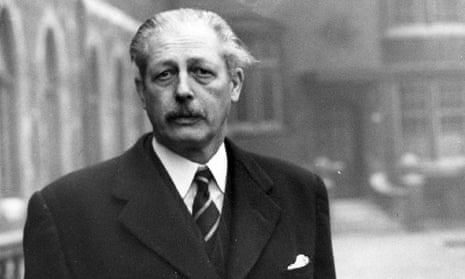
Maurice Harold Macmillan, 1st Earl of Stockton, was a British Conservative politician and statesman who served as Prime Minister of the United Kingdom from 1957 to 1963.
Born on 10 February 1894 at 52 Cadogan Place in Chelsea, London, he was the son of Maurice Crawford Macmillan, a publisher, and Helen Artie Tarleton Belles, an American artist and socialite from Spencer, Indiana.
His paternal grandfather, Daniel Macmillan, co-founded the Macmillan publishing firm with his brother Alexander after rising from a Scottish crofting background on the Isle of Arran.
Macmillan considered himself Scottish by heritage.
Educated at Eton and Balliol College, Oxford, where he studied classics, his university studies were interrupted by the First World War.
He served as an officer in the Grenadier Guards, was wounded multiple times including at the Battle of the Somme, and suffered lasting pain and partial immobility.
After the war he joined the family publishing business and later entered politics.
He married Lady Dorothy Cavendish, daughter of the 9th Duke of Devonshire, in 1920; they had four children.
Macmillan died on 29 December 1986 at Birch Grove in Sussex at the age of 92.
Siblings
Harold was the youngest of three sons and had two older brothers, with no sisters.
Daniel Macmillan, born in 1886 and eight years Harold’s senior, worked in the family publishing firm.
In 1936 he and Harold took control of Macmillan Publishers, with Daniel later serving as chairman from 1936 until his death in 1965.
Arthur Macmillan, born in 1889 and four years older than Harold, pursued a career as a publisher and lawyer.
Also Read: Boris Johnson Siblings: Meet the Siblings Squad Behind the British Politician
Career
After recovering from war wounds Macmillan joined Macmillan Publishers as a junior partner in 1920 and remained involved with the firm for much of his life, focusing at times on political and non-fiction titles.
He entered Parliament as Conservative MP for Stockton-on-Tees in 1924, lost the seat in 1929, and regained it in 1931, holding it until 1945.
He later represented Bromley from 1945 to 1964.
Early in his career he was known as a progressive Tory critical of appeasement and supportive of social reform and a mixed economy, as outlined in his 1938 book The Middle Way.
During the Second World War he held posts including Parliamentary Secretary to the Ministry of Supply and Minister Resident at Allied Headquarters in the Mediterranean, where he worked closely with Allied leaders.
After the Conservatives returned to power in 1951 he served as Minister of Housing and Local Government, successfully meeting the target of building 300,000 houses a year, then as Minister of Defence, Foreign Secretary, and Chancellor of the Exchequer under Winston Churchill and Anthony Eden.
Following Eden’s resignation after the Suez Crisis, Macmillan became Prime Minister and Leader of the Conservative Party in January 1957.
His premiership saw economic growth and rising living standards, restoration of the special relationship with the United States, acceleration of decolonisation in Africa, negotiation of the Partial Nuclear Test Ban Treaty, and an unsuccessful attempt to join the European Economic Community.
He led the Conservatives to victory in the 1959 general election but resigned in October 1963 amid health concerns and political difficulties including the Profumo Affair.
In retirement he returned to publishing, wrote multi-volume memoirs, and later sat in the House of Lords.
Accolades
Macmillan received the Order of Merit in 1976, one of Britain’s highest civilian honours limited to a small number of recipients.
In 1984, on his 90th birthday, he accepted a hereditary peerage and was created Earl of Stockton and Viscount Macmillan of Ovenden, becoming the first former prime minister in decades to receive an earldom; the titles remain the most recent non-royal hereditary peerages of that rank.
He was a Privy Counsellor and later a Fellow of the Royal Society under Statute 12 for distinguished public service.
Additional recognition included the Four Freedoms Award Freedom Medal and various honorary degrees.
His wartime service earned him the 1914-15 Star, British War Medal, and Victory Medal.

Email your news TIPS to Editor@Kahawatungu.com — this is our only official communication channel
