


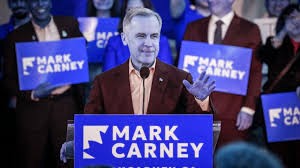
The former Bank of England boss, Mark Carney, became Canada’s prime minister after he was sworn in on Friday. He will need all his experience handling global economic crises as the country faces a trade war launched by US President Donald Trump.
Mark Carney was the first non-British person to become governor of the Bank of England in its more than 300-year history when he took the job in 2013.
He had previously steered his home country through the Great Recession as the governor of the Bank of Canada, the country’s central bank, before being poached for Britain’s top banking job.
But unlike most PM-hopefuls, Carney has never held political office. Still, he won the contest to replace outgoing Prime Minister Justin Trudeau handily. Now, he must lead the country through one of its toughest challenges yet – an escalating trade war with its biggest trading partner, the United States.
But holding on to the role of PM will be a fight in and of itself. Canada’s next federal election is scheduled for this October, but many expect Carney to call it soon after he is sworn in.
Although Carney has travelled the globe, working for Goldman Sachs in places like New York, London and Tokyo, he was born in the remote northern town of Fort Smith, in the Northwest Territories.
The son of a high-school principal, he went to Harvard University on scholarship where he played the most Canadian of sports, ice hockey. In 1995, he earned his PhD in economics from Oxford University.
In 2003, he left the private sector to join the Bank of Canada as a deputy governor, then worked for the Department of Finance as senior associate deputy minister.
In 2007, he was appointed governor of the Bank of Canada, shortly before global markets crashed, sending the country into a deep recession. His leadership at the central bank is widely praised for helping the country avoid the worst of the crisis.
Although central bankers are notoriously circumspect, he was open about his intentions to keep interest rates low for at least a year, after dramatically cutting them.
That move would be credited for helping businesses keep investing even when the markets sank. He would go on to take a similar approach when he was lured back to London – this time as the governor of the Bank of England.
In his time at the Bank’s Threadneedle Street headquarters, he oversaw considerable changes in how the institution worked. At the start of his tenure, the Bank assumed responsibility for financial regulation after the abolition of the Financial Services Authority.
He is credited with modernising the Bank, appearing much more frequently in the media than his predecessor.
In 2015, the Bank reduced the number of interest rate meetings from 12 to eight a year, and started publishing minutes alongside the announcement of interest rate decisions.
Interest rates were anchored at historic lows when he took over, but he introduced a policy of “forward guidance”, where the Bank would try to further support the economy and encourage lending by pledging not to raise rates until unemployment fell below 7%.
Confusion about this policy saw an MP compare him to an “unreliable boyfriend”, a monicker which stuck around long after the original controversy died down.
Unlike previous governors who generally kept a low profile, he made controversial interventions ahead of two big constitutional referendums.
In 2014 he warned that an independent Scotland might have to surrender powers to the UK if it wanted to continue using the pound.
Before the Brexit referendum, he warned that a vote to leave the EU could spark a recession.
In the wake of the leave vote, after David Cameron resigned as prime minister and the pound plunged, he addressed the nation in a bid to reassure the country that the financial system would operate as normal.
He described it as his “toughest day” on the job, but said the contingency plans the Bank put in place worked effectively.
The Bank later cut interest rates from 0.5% to 0.25% – and restarted its quantitative easing programme to support the economy.
His final week in March 2020 saw the start of the acutest phase of the Covid pandemic – the Bank cut rates by 0.5% to support the economy, and Mr Carney told the country that the economic shock “should be temporary”.
Carney’s time at the bank gave him plenty of experience dealing with Donald Trump – who has not only imposed steep tariffs on Canada since returning to office in January, but has also suggested that America should annex its less powerful neighbour.
From 2011-18, Carney was chair of the Financial Stability Board which co-ordinated the work of regulatory authorities around the world, giving him a key role in the global response to the policies of the first Trump presidency.
He was a regular at the G20 meetings, with a pitch-side view of Trump on the global stage.
He is also known as an advocate for environmental sustainability. In 2019 he became a UN special envoy for climate change, and in 2021 launched the Glasgow Financial Alliance for Net Zero, a grouping of banks and financial institutions working to combat climate change.
His political ambitions have been rumoured for years, but until recently the 59-year-old had brushed off the idea.
“Why don’t I become a circus clown?” he told a reporter in 2012.
Things changed, however, when Trudeau stepped down in January after his finance minister, Chrystia Freeland quit his cabinet, sparking a party squabble that, coupled with Trudeau’s tanking poll numbers, led the prime minister to announce his resignation.
Reports suggested Trudeau had intended to replace Freeland with Carney in the finance post.
Freeland – a personal friend – even ran against him in the race to replace Trudeau. But Carney won by a landslide, pitching himself as the best equipped to take on Trump, who has imposed steep tariffs on Canadians goods.
“I know how to manage crises,” Carney said during a leadership debate late last month. “In a situation like this, you need experience in terms of crisis management, you need negotiating skills.”
Still, his time in the world of finance has opened him up to criticism from political rivals in Canada.
The Conservatives have accused Carney of lying about his role in moving investment firm Brookfield Asset Management’s head office from Toronto to New York, though Carney says the recent formal decision to relocate the firm was made after he quit the board.
They have also pushed him to disclose his financial assets, which Carney currently does not need to do as he is not an elected member of parliament.
His team has said he will comply with all applicable ethics rules and guidelines once he is prime minister.
By BBC News
Email your news TIPS to Editor@Kahawatungu.com — this is our only official communication channel
