

How Businesses Use Outdoor Branding to Build Trust and Visibility

How Businesses Use Outdoor Branding to Build Trust and Visibility
In competitive markets where attention is limited and skepticism is high, businesses cannot rely on digital impressions alone. Physical presence still plays a decisive role in shaping how a brand is perceived. Outdoor branding, when executed strategically, becomes more than visibility,it becomes a credibility signal.
From trade shows and local markets to corporate events and public activations, brands that invest in consistent, high-quality outdoor setups position themselves as reliable, established, and worth engaging with.
How Outdoor Branding Works in a Digital First World
While online marketing drives awareness, offline branding reinforces legitimacy. When customers encounter a business physically through structured setups, branded environments, and organized displays, it bridges the gap between “seen online” and “trusted in real life.”
Outdoor branding works because it:
- Creates tangible brand presence
- Signals operational readiness and professionalism
- Builds instant familiarity through repetition
- Encourages face-to-face interaction, which accelerates trust
A well-designed outdoor setup communicates stability. It shows that the business is not temporary, not experimental but committed.
The Psychology Behind Trust in Outdoor Setups
Trust is rarely built through claims. It is built through cues.
Outdoor branding provides multiple trust cues simultaneously:
- Visual consistency (logos, colors, messaging)
- Structural quality (sturdy frames, clean layouts)
- Spatial organization (clear entry points, defined product areas)
- Brand confidence (clear messaging without clutter)
Customers subconsciously evaluate these elements within seconds. A poorly executed setup raises doubts, while a professional one eliminates hesitation.
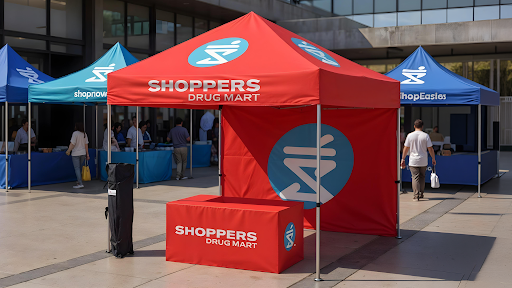
This is where structured branding tools like custom pop up tents become critical. They act as both a visual anchor and a functional environment, helping businesses control how their brand is experienced outdoors.
Creating a Recognizable Brand Environment
Outdoor branding is not just about placing a logo on a surface. It is also about creating an environment that feels cohesive.
Effective businesses treat their outdoor presence as a mini storefront, even in temporary settings.
This includes:
- A defined top structure (canopy or tent)
- Supporting visuals like banners and backdrops
- Functional elements such as tables, counters, and display booths.
- Branded accessories that reinforce identity
When all these elements align, the result is a space that customers can instantly recognize even from a distance.
For example, a business using a branded canopy ensures visibility from afar, while coordinated graphics maintain consistency up close. Over time, repeated exposure builds familiarity, which directly contributes to trust.
Visibility That Converts Into Engagement
Visibility alone does not guarantee results. The goal is to convert attention into interaction.
Outdoor branding supports this by:
- Creating clear entry points that invite people in
- Reducing confusion through structured layouts
- Highlighting key offerings without overwhelming visitors
A well-branded outdoor setup acts like a silent salesperson. It answers key questions before a conversation even begins:
- Who are you?
- What do you offer?
- Why should I stop here?
When these answers are clear, engagement becomes natural rather than forced.
Mobility Without Compromising Professionalism
One of the biggest advantages of modern outdoor branding tools is mobility. Businesses no longer need permanent locations to create strong brand impressions.
With solutions like Custom Pop Up Tents, brands can:
- Set up quickly in different locations
- Maintain consistent branding across events
- Adapt to various environments without losing identity
This flexibility allows businesses to scale their presence without scaling overhead costs. Whether it’s a weekend market, a corporate event, or a large trade show, the brand experience remains consistent.
And that consistency, in turn, strengthens trust.
Standing Out in High-Competition Environments
Outdoor events are inherently crowded. Multiple brands compete for the same attention within limited space.
Standing out requires more than bright colors or large logos. It requires:
- Clarity in messaging
- Confidence in presentation
- Strategic use of space
Brands that succeed outdoors understand that simplicity often outperforms complexity. A clean, well-structured setup is easier to process, more approachable, and more memorable.
In contrast, cluttered or inconsistent branding creates friction. It forces customers to work harder to understand the offering which most will not do.
Reinforcing Brand Credibility Through Repetition
Trust is not built in a single interaction. It is built through repeated exposure.
Outdoor branding supports this by enabling businesses to:
- Appear consistently across multiple events
- Maintain the same visual identity in different locations
- Reinforce brand recall through repetition
When customers see the same brand setup multiple times whether at different events or over time,it signals reliability. The brand becomes familiar, and familiarity reduces perceived risk.
This is particularly important for businesses operating in competitive or trust-sensitive industries.
Supporting Sales Without Aggressive Selling
Outdoor branding reduces the need for aggressive sales tactics.
When the setup itself communicates professionalism and clarity:
- Customers approach voluntarily
- Conversations start more naturally
- Sales interactions feel less transactional
This shift improves overall customer experience. Instead of being “sold to,” visitors feel like they are exploring a credible brand.
That distinction has a direct impact on conversion rates.
Long-Term Value Beyond a Single Event
Investing in outdoor branding is not a one-time decision but a long-term asset.
High-quality setups can be reused across:
- Trade shows
- Community events
- Product launches
- Promotional campaigns
Over time, the cost per use decreases while brand recognition increases. This makes outdoor branding not just a marketing expense, but a strategic investment.
A Quick Summary
Outdoor branding is one of the few channels where visibility and trust can be built simultaneously. It combines physical presence with controlled brand presentation, allowing businesses to shape perception in real time.
When executed correctly, it does more than attract attention. Businesses that prioritize structured, consistent outdoor branding supported by tools like Custom Pop Up Tents position themselves as credible, prepared, and worth engaging with.
And in markets where trust drives decisions, that positioning makes all the difference

