

IEBC Dismisses Claims Election Laws (Amendment) Bill Seeks to Scrap Electronic Results Transmission

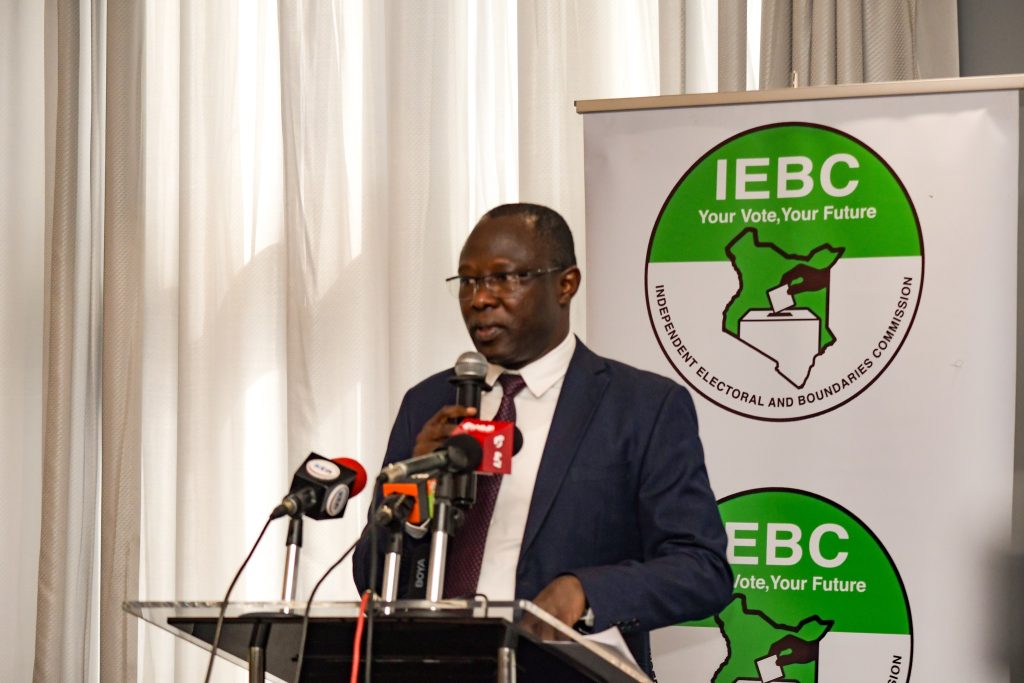
The Independent Electoral and Boundaries Commission (IEBC) has dismissed reports claiming that the Election Laws (Amendment) Bill, 2026 seeks to abolish electronic transmission of election results, ban live broadcasts of poll results and revert Kenya’s elections to a manual system similar to that used during the 2007 General Election.
In a statement issued on Thursday, IEBC Chairperson Erastus Edung Ethekon said the reports were inaccurate and misrepresented the contents of the Bill currently before Parliament.
“The Commission’s attention has been drawn to media reports to the effect that the Election Laws (Amendment) Bill, 2026 seeks to scrap live streaming of poll results, ban live broadcast of poll results and return the voting system to manual voter identification and transmission of poll results akin to what was used in the 2007 General Election,” Ethekon said.
“The media reports are erroneous and a misrepresentation of the Bill as tabled before Parliament,” he added.
Ethekon clarified that the Bill does not propose any amendment to Section 44 of the Elections Act, which provides for the deployment of the Integrated Elections Management System (KIEMS) for voter registration, voter identification and electronic transmission of results.
Instead, he said, the proposed law introduces a complementary mechanism to address situations where electronic transmission is not possible due to the absence of a minimum 3G network connection.
“The Bill seeks to align the law with the Supreme Court’s decision in Presidential Election Petition No. 1 of 2017, which affirmed that the election result is the one recorded in the statutory Results Declaration Form (34A Series), the primary and final record of the results at the polling station,” Ethekon said.
He explained that under the proposal, the Commission would electronically transmit images of the statutory election results declaration forms completed by Presiding Officers and witnessed by political party and candidate agents at polling stations.
“The Commission will ensure that all stakeholders access the result forms through the online public portal as provided under Section 39(1C)(c) of the Elections Act,” he said.
According to the proposed framework, Presiding Officers will also submit the original statutory declaration forms to Returning Officers at constituency tallying centres. The Returning Officers will collate the results, prepare Form 34B and forward both the original Forms 34A and 34B to the National Returning Officer at the National Tallying Centre for tallying, verification and declaration of the presidential election results.
Ethekon emphasized that vote counting and the announcement of results at polling stations will continue to be conducted openly and transparently in the presence of the media, party agents and election observers.
He further noted that the Bill seeks to remove provisions of the Elections Act that were declared unconstitutional by the High Court in Katiba Institute & 3 Others v Attorney General & 2 Others (Constitutional Petition No. 548 of 2017).
The court nullified Sections 39(1C)(a), 39(1D), 39(1E), 39(1F) and 39(1G) of the Elections Act and also invalidated amendments to Section 83, effectively restoring the previous legal threshold for determining election petitions.
“The Bill therefore seeks to align the Act with the Court’s decision and provide a clear and constitutionally compliant statutory framework,” Ethekon said.
He added that the court’s ruling created legislative gaps in the management of election results and the determination of election petitions, making it necessary to amend the law to provide legal certainty, facilitate the conduct of elections and establish a clear framework for resolving electoral disputes.

