

India and EU announce landmark trade deal

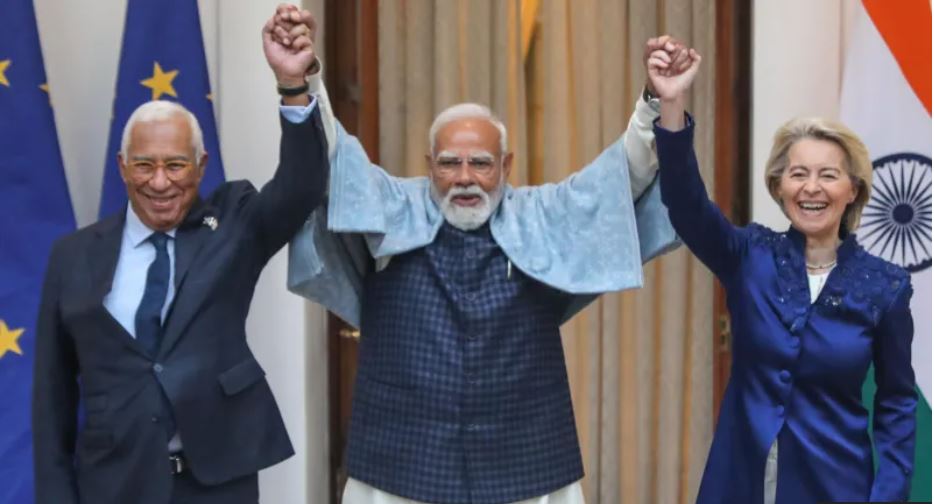
The European Union and India have announced a landmark trade deal after nearly two decades of on-off talks, as both sides aim to deepen ties amid tensions with the US.
“We did it, we delivered the mother of all deals,” European Commission President Ursula von der Leyen said at a media briefing in Delhi. Indian Prime Minister Narendra Modi called the deal “historic”.
It will allow free trade of goods between the bloc of 27 European states and the world’s most populous country, which together make up nearly 25% of global gross domestic product and a market of two billion people.
The pact is expected to significantly reduce tariffs and expand market access for both sides. Von der Leyen and European Council President António Costa are in Delhi, where they met Modi at a bilateral summit.
The European Commission said the agreement would eliminate tariffs on most exports of chemicals, machinery and electrical equipment, as well as aircraft and spacecraft, following phased reductions. Significantly, duties on motor vehicles, currently as high as 110%, would be cut to 10% under a quota of 250,000 vehicles. That is six times larger than the 37,000-unit quota India granted to the UK in a deal signed last July, Bloomberg reported.
India’s deal with the EU is set to lower costs for European products entering the country – such as cars, machinery and agricultural food items, after import duties are reduced.
Brussels said the agreement would support investment flows, improve access to European markets and deepen supply-chain integration.
Delhi said almost all of its exports would get “preferential access” into the EU, with textiles, leather, marine products, handicrafts, gems and jewellery set to see a reduction or elimination of tariffs.
While commodities such as tea, coffee, spices and processed foods will benefit from the agreement, Delhi “has prudently safeguarded sensitive sectors, including dairy, cereals, poultry, soy meal, certain fruits and vegetables, balancing export growth with domestic priorities”, it said.
Delhi and Brussels have also agreed on a mobility framework that eases restrictions for professionals to travel between India and the EU in the short term.
“This is India’s biggest free trade agreement,” Modi said. “It will make access to European markets easier for India’s farmers and small business. It will also boost manufacturing and services sectors. It will boost innovative partnerships.”
The trade deal comes as both India and the EU contend with economic and geopolitical pressure from the US.
Delhi is grappling with 50% tariffs imposed by President Donald Trump last year amid talks aimed at securing a trade deal between India and the US that are still dragging on.
Last week, Trump threatened to escalate his trade war with European allies for opposing a US takeover of Greenland, before backing off.
That larger geopolitical context was evident in statements made by leaders.
On Tuesday, von der Leyen said: “This is the tale of two giants – the world’s second and fourth largest economies.
Two giants which chose partnership in a true win-win fashion. A strong message that co-operation is the best answer to global challenges.”
A day before that Costa had said, without naming the US, that the trade deal would send an “important political message to the world that India and the EU believe more in trade agreements than in tariffs” at a time when protectionism is on the rise and “some countries have decided to increase tariffs”.
Von der Leyen and Costa arrived in Delhi over the weekend and were the chief guests at India’s colourful Republic Day celebrations on Monday.
On Tuesday, the leaders posed for photos with Modi, with the bonhomie between them evident.
The formal signing is likely to take place only later this year, after the agreement is approved by the European Parliament and the European Council.
Alongside the trade agreement, India and the European Union are also advancing separate talks on security and defence co-operation, and climate action.
On Tuesday, India’s Defence Minister Rajnath Singh said he had discussed a range of bilateral security and defence issues with the European Commission’s vice-president Kaja Kallas, including opportunities to integrate supply chains to build trusted defence ecosystems and develop future-ready capabilities.
The two sides are working on a draft security and defence partnership covering areas such as maritime security, cyber threats and defence dialogue, Reuters news agency reported.
The EU is India’s largest trading partner in goods, with bilateral merchandise tradereaching $136bn (£99.4bn) in 2024-25, nearly doubling over a decade.
Talks for a deal between them started in 2007 but stalled in 2013 over roadblocks in market access and regulatory demands. Discussions were formally restarted in July 2022.
Officials from both sides worked hard over the past few days to finalise outstanding chapters of the agreement, aiming to wrap it up before the EU leaders’ visit.
The agreement comes as pressure grows on Delhi and Brussels to secure alternative markets for exporters.
In the past seven months, India signed major trade agreements with the UK, Oman and New Zealand, and a 2024 pact signed with the four-nation European Free Trade Association bloc of Switzerland, Norway, Iceland and Liechtenstein has come into effect.
The EU, meanwhile, signed a trade deal with South American trade bloc Mercosur earlier this month after 25 years of negotiation.
By BBC News