

India top court orders ex-lawmaker to stay in jail over rape

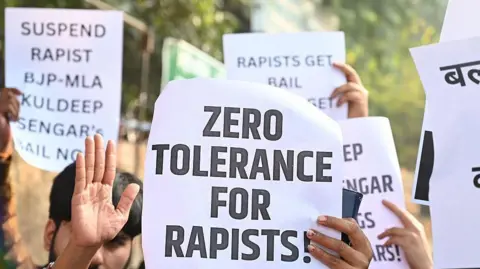
India’s Supreme Court has put on hold a controversial order that had suspended the life sentence of a former lawmaker convicted of raping a teenager.
Kuldeep Singh Sengar, formerly of the ruling Bharatiya Janata Party (BJP), was found guilty in 2019 under the Protection of Children from Sexual Offences (Pocso) Act.
But last week, the Delhi high court suspended his sentence and granted him conditional bail – although Sengar remained in jail in a separate case related to the death of the survivor’s father.
The high court order sparked outrage and protests, including from the survivor and her mother.
The crime against the 17-year-old in Uttar Pradesh state’s Unnao district was one of the most horrific in India in recent years.
The survivor, who can’t be named under Indian laws, alleged that she had approached Sengar for a job in June 2017 and was kidnapped and raped for more than a week by him and others.
Her ordeal first came to national attention in 2018 – a year after the assault – when she tried to set herself on fire, alleging police inaction.
At the time, Sengar was an influential politician from the BJP, which was in power in the state as well as at the national level. The party later expelled him.
Months before Sengar’s conviction in December 2019, the woman survived a suspicious car crash that killed two of her aunts and seriously injured her lawyer.
The family also accused Sengar and his men of assaulting the woman’s father in April 2018. Police charged five men over the attack but also arrested her father for illegal firearms possession. He later died in prison.
In March 2020, Sengar was found guilty of culpable homicide and given a 10-year-jail sentence.
The high court’s decision last week to free Sengar in the rape case was based on whether the assault could be considered “aggravated” or not.
According to the Pocso Act, an assault becomes aggravated and attracts more stringent punishment if it is committed by someone in a “position of trust or authority” – such as a public servant or a police officer inside a police station, members of the security forces or a hospital or jail staff.
Sengar’s lawyers had argued that he was a legislator which was not included in the list of public servants under this law.
The Delhi High Court accepted their argument, noting that without aggravated assault, the law mandates a minimum seven-year sentence – which Sengar had already served. It suspended his sentence and granted bail, sparking nationwide outrage.
The survivor, her family, and activists protested at Delhi’s India Gate, with the woman saying she feared for her life if Sengar were released.
The Central Bureau of Investigation (CBI), which had investigated the case, challenged the high court’s decision in the Supreme Court, arguing that Sengar, as an elected legislator, is a public servant holding a “constitutional position of trust and authority.”
On Monday, the Supreme Court stayed the high court order until it heard the case.
A bench led by Chief Justice Surya Kant said the top court usually did not stay a bail order without hearing the convict or the under-trial.
But in this case, they were doing so because “here are peculiar facts and circumstances since convict is also sentenced for the culpable homicide of the survivor’s father and he is in custody in that case”.
By BBC News

