

Is US crime at a historic low?

Is US crime at a historic low?
resident Donald Trump has claimed that crime and murder in the US are at the lowest level for 125 years, with the White House attributing this to his “unwavering commitment to restoring law and order”.
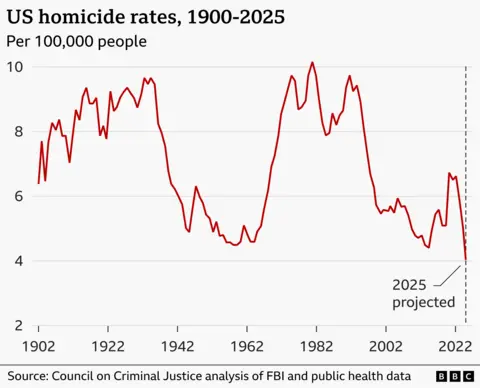
Homicides are projected to reach a 125-year low – according to one study – but the same cannot be said about violent crime in the US, although it has fallen to the lowest point in decades.
BBC Verify has reviewed US crime statistics and spoken to crime experts to assess what is driving the fall.
Has US crime fallen to a record low?
In the Oval Office earlier this month, Trump said: “the crime rate now is the lowest it’s been since 1900, that’s 125 years”.
The FBI is the main source of crime statistics in the US. It does not measure overall crime but it does count the number of violent offences reported to police.
These include homicide – which covers murder and non-negligent manslaughter – rape, robbery and aggravated assault.
In 2024, the rate was 348.6 per 100,000 people – the lowest since 1969, according to analysis of FBI data by US crime expert Jeff Asher.
His analysis uses an older definition of rape (which was revised by the FBI in 2013) to allow for a more accurate comparison of crime rates from earlier decades.
The FBI has not published violent crime data for the whole of 2025 yet but its latest release shows the total number of violent crimes fell about 10% in the year to October 2025, following similar trends in 2023 and 2024.
“The US will likely have the lowest property crime rate ever recorded and lowest violent crime rate since roughly 1968 in 2025”, Asher predicts.
FBI data alone cannot prove or disprove the claim that crime is at a 125-year low because, as he points out, it only started publishing statistics in 1930, and only consistently after 1960.
Have murders fallen to a record low?
The president also told reporters that figures in January showed the US had “the lowest numbers of murders in the history of our country that we have, recorded history, it goes back 125 years”.
When we asked the White House for the source of his claims about murder and crime it sent us a news article by Axios, which cited a study by the Council on Criminal Justice (CCJ) think tank.
The study says “there is a strong possibility that homicides in 2025 will drop to about 4.0 per 100,000 residents”, adding this would be “the lowest rate ever recorded in law enforcement or public health data going back to 1900”.
As FBI figures were only consistently published from 1960, it used public health data (primarily death registration records) to build a picture of longer-term trends for homicides.
But there is still uncertainty about this forecast as the FBI is yet to publish nationwide homicide numbers for 2025.
“If the FBI were to substantially revise down the 2024 homicide rate and/or if the official 2025 homicide rate ultimately comes in higher than our current estimate, 2025 may not be the lowest ever recorded – but it would still rank among the lowest homicide rates observed in the US since 1900,” one of the study’s authors, Ernesto Lopez, told the BBC.
A survey of 67 large US police departments by the Major Cities Chiefs Association showed a preliminary 19% drop in reported homicides between January and September last year, compared with the same period in 2024.
Why is crime falling?
In a recent press release, the White House said falling violent crime is the “direct result” of Trump’s polices, including “surging federal resources to Democrat-run cities that had devolved into war zones, removing savage criminal illegals from our streets, supporting police and prosecutors”.
However, several crime experts we interviewed pointed to a post-pandemic drop in violent crime following the spike observed around 2020.
In other words, a trend that started before Trump returned for his second term in January 2025.
Alex Piquero, a professor of criminology at the University of Miami, said a renewed focus on crime prevention policies could be responsible for the decline, including “policing focused on violent places and violent people” as well as “programs focused on social skills, self-control, and cognitive behavioural therapy”.
“A lot of these strategies were basically ‘turned-off’ during the pandemic and the few years after, and have slowly come back,” he added.
The CCJ’s president, Adam Gelb, said that “while the downward trajectory of crime is clear, it’s extremely difficult to disentangle and pinpoint what’s actually driving the drop”.
One possible factor he identified is changes to society following Covid.
“As schools, workplaces, social programs, churches and civic institutions regained their footing after pandemic disruption, emotional and economic stresses eased and daily routines strengthened,” Gelb added.
He also pointed to people drinking less alcohol “which should mean fewer bar fights and domestic assaults”.
And other countries have seen similar falls.
In the year to September 2025, police in England and Wales recorded the lowest number of homicides since comparable records began in 2003.
“Most other Western countries have indeed seen similar declines [in violent crime] that the US has seen, but bear in mind that these countries, in general, have lower crime rates than the US does,” said Prof Piquero.
By BBC News

