

Jean Chrétien Siblings: A Closer Look at the Former Canada Prime Minister’s Family Tree

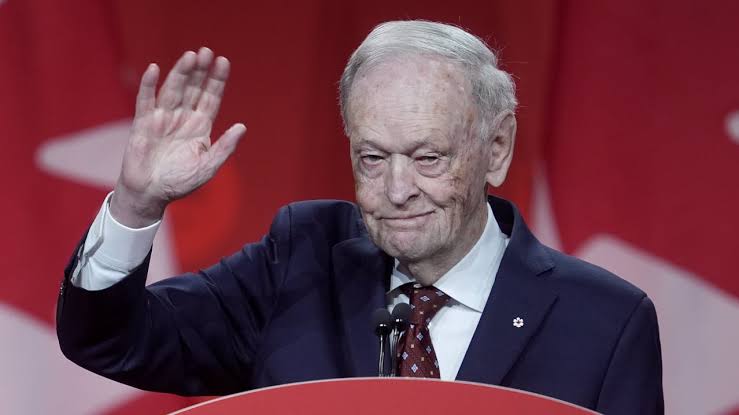
Jean Chrétien PHOTO/CBC
Joseph Jacques Jean Chrétien was born on January 11, 1934, in Shawinigan Falls, Quebec, and is a Canadian lawyer and politician who served as the 20th prime minister of Canada from 1993 to 2003.
The son of Wellie Chrétien, a paper mill machinist and Liberal Party organizer, and Marie Boisvert, he grew up in a large working-class family of modest means in the industrial town of Shawinigan.
At age 12 he suffered from Bell’s palsy, which left one side of his face partially paralyzed and contributed to a distinctive speaking style he later turned to political advantage.
Chrétien studied at classical colleges and earned a law degree from Université Laval, being called to the Quebec bar in 1958.
He married Aline Chaîné in 1957; the couple had three children and remained together until her death in 2020.
Siblings
Jean was the 18th of 19 children born to his parents; ten of the children died in infancy, leaving nine who survived to adulthood.
The family consisted of six brothers and three sisters.
His eldest brother, Maurice Chrétien, a noted gynecologist who died in 2002 at the age of 91, served as a father figure to the younger siblings and helped finance their educations with earnings from his medical practice after winning a scholarship that enabled him to attend medical school.
Maurice was the father of diplomat Raymond Chrétien.
Jean’s younger brother, Michel Chrétien, born two years after him, became a prominent neuroendocrinology researcher and chemist who published hundreds of scientific papers.
The surviving siblings grew up in a household that placed strong emphasis on education as a means of escaping working-class life.
Jean was the youngest son in the family and often described the competitive yet supportive dynamics among the brothers during their school years.
Also Read: Quinten Timber Siblings: Meet the Siblings Squad Behind the Football Player
Career
After practising law in Shawinigan, Chrétien entered federal politics and was first elected to the House of Commons as a Liberal member for Saint-Maurice–Laflèche in 1963.
He rose steadily through successive cabinets under prime ministers Lester B. Pearson and Pierre Elliott Trudeau, holding a wide range of portfolios that included minister of national revenue, minister of Indian affairs and northern development (1968–1974), president of the Treasury Board, minister of industry, trade and commerce, and, in 1977, the first French Canadian to serve as minister of finance.
He later served as minister of justice and attorney general, minister of energy, mines and resources, and briefly as deputy prime minister under John Turner in 1984.
After a short period outside politics in the late 1980s, he returned to win the leadership of the Liberal Party in 1990 and became leader of the Official Opposition.
In the 1993 federal election he led the Liberals to a decisive majority government and went on to win two further consecutive majorities in 1997 and 2000.
As prime minister from November 1993 to December 2003 he focused on eliminating the federal deficit and achieving successive budget surpluses, strengthening national unity, expanding social programs, and maintaining an independent foreign policy that included declining participation in the 2003 Iraq War.
He left office in December 2003 after more than a decade as prime minister and over four decades in public life.
Accolades
Chrétien was appointed a Companion of the Order of Canada in 2007 and invested the following year.
In 2009 Queen Elizabeth II awarded him the Order of Merit, one of the highest personal distinctions in the Commonwealth, and he received the insignia that October.
He has long been a member of the Queen’s Privy Council for Canada and holds the designation of Queen’s Counsel.
Canadian universities have conferred more than twenty honorary doctorates upon him.
He has also been recognized with various commemorative medals, including those marking the centennial of Confederation and the jubilees of Queen Elizabeth II, and has been ranked among the top tier of Canadian prime ministers in multiple historical assessments by publications such as Maclean’s.

