

John Diefenbaker Siblings: Getting to Know Elmer Clive Diefenbaker

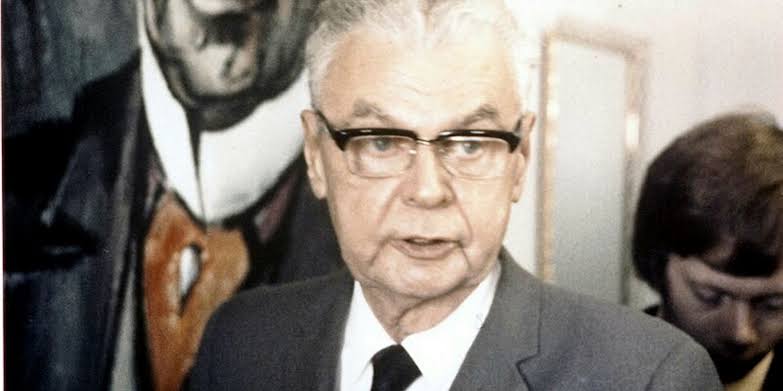
John Diefenbaker PHOTO/The Hill Times
John George Diefenbaker was a Canadian lawyer and politician who served as the 13th prime minister of Canada from 1957 to 1963.
Born on September 18, 1895, in Neustadt, Ontario, to William Thomas Diefenbaker, a schoolteacher of German descent, and Mary Florence Bannerman, of Scottish heritage, he grew up in a Baptist household.
The family relocated westward in 1903 to the Fort Carlton area in what is now Saskatchewan, later settling on a homestead near Borden and moving to Saskatoon in 1910 to improve educational opportunities for the children.
Diefenbaker developed an early interest in politics and public affairs, influenced by his father’s teaching of history.
Called to the Saskatchewan Bar in 1919, he built a successful career as a criminal defence lawyer known for his dramatic courtroom style and willingness to represent ordinary clients.
He married Edna Mae Brower in 1929; after her death in 1951, he married Olive Evangeline Palmer (née Freeman) in 1953.
Diefenbaker died on August 16, 1979, in Ottawa and was buried in Saskatoon near the Diefenbaker Canada Centre at the University of Saskatchewan.
Siblings
John had one sibling, his younger brother, Elmer Clive Diefenbaker, born in 1897,ll in Ontario.
The brothers shared a close family life as their parents moved from teaching posts in Ontario to homesteading and then urban life in Saskatchewan.
In 1910 the family settled in Saskatoon specifically so both John and Elmer could attend high school.
Elmer later worked as an insurance broker and minor entrepreneur, occupying space in John’s law office in Prince Albert for a time.
John maintained a protective and somewhat dominating relationship with his younger brother throughout their lives.
Elmer lived with their mother, Mary, in Saskatoon for many years after their father’s death in 1945. He died in 1971.
Also Read: Edward Heath Siblings: All About John Heath
Career
After establishing his law practice in the small community of Wakaw, Saskatchewan, in 1919 and later moving it to Prince Albert in 1924, Diefenbaker gained a strong reputation as a defence counsel.
He entered local politics early, serving as an alderman in Wakaw.
Despite repeated unsuccessful runs for federal, provincial, and municipal office in the 1920s and 1930s—including federal contests in Prince Albert in 1925 and 1926, a provincial bid in 1929, a mayoral race in Prince Albert in 1933, and leadership of the Saskatchewan Conservative Party that ended in electoral defeat in 1938—he persisted.
Named King’s Counsel in 1929, he was finally elected to the House of Commons in 1940 as the Member of Parliament for Lake Centre.
He later represented Prince Albert from 1953 until his death. In opposition he became known as a skilled and tenacious debater.
After two unsuccessful bids for national leadership, he was chosen leader of the Progressive Conservative Party in 1956.
In the 1957 federal election he led the party to a minority government victory, ending 22 years of Liberal rule, and became prime minister on June 21, 1957.
A snap election in 1958 produced a massive majority of 208 seats, the largest for a single party to that point in Canadian history.
His government introduced the Canadian Bill of Rights in 1960, extended the federal franchise to First Nations and Inuit peoples, appointed the first female cabinet minister (Ellen Fairclough) and the first Indigenous senator (James Gladstone), and took a strong stance against apartheid that contributed to South Africa’s departure from the Commonwealth.
Other measures included agricultural support programs and northern development initiatives.
Controversies over the cancellation of the Avro Arrow project, nuclear weapons policy, and strained relations with the United States contributed to the loss of majority status in 1962 and defeat in 1963.
Diefenbaker remained party leader and Leader of the Opposition until 1967, after which he continued as a private member until his death in 1979.
Accolades
Diefenbaker held the styles of Privy Councillor, Companion of Honour, Queen’s Counsel (earlier King’s Counsel), Fellow of the Royal Society of Canada, and Fellow of the Royal Society of Arts.
In the 1976 New Year Honours he was appointed a Companion of Honour, a personal gift of the Sovereign.
He received numerous honorary doctorates from Canadian and international universities, including degrees from McMaster University, Acadia University, McGill University, the University of Saskatchewan (Doctor of Civil Law in 1958), the University of British Columbia, Princeton University, and others, totalling more than twenty such recognitions.
He served as Chancellor of the University of Saskatchewan for multiple terms in his later years.

