

Kenya reaffirms commitment to inclusive digital society at UN meeting

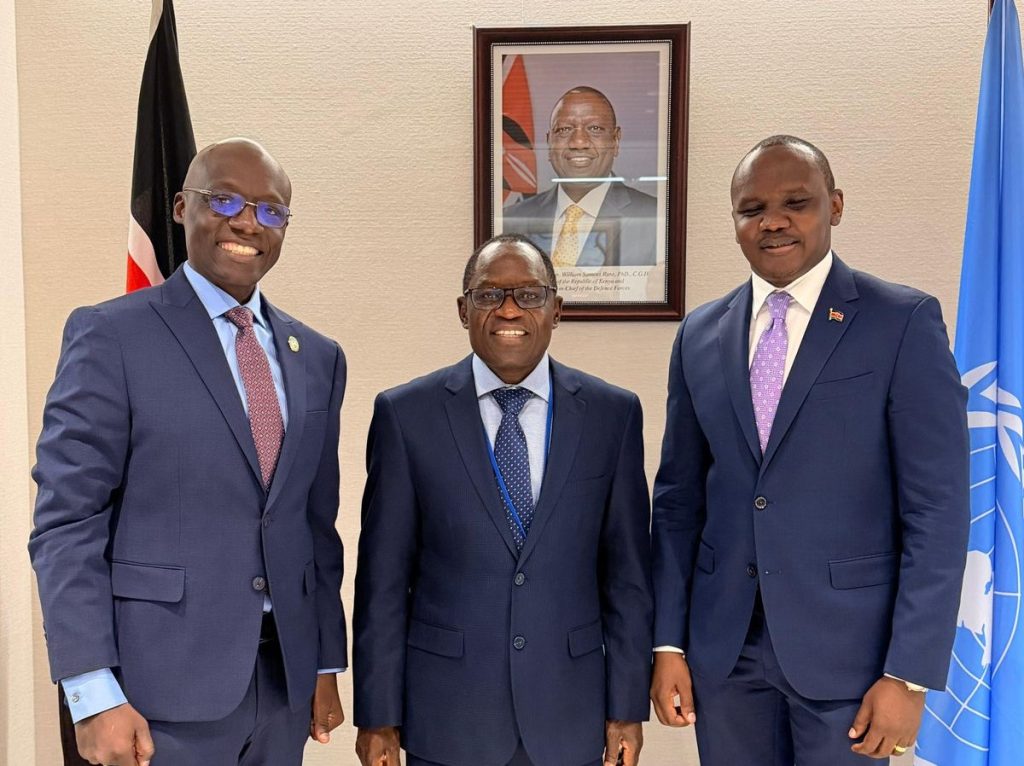
Principal Secretary for Broadcasting and Telecommunications Stephen Isaboke (centre), Kenya’s Ambassador to the US and Permanent Representative to the United Nation Ekitela Lokaale (right) and Kenya’s Special Envoy on Technology Amb. Philip Thigo (left) at the Kenya Embassy in New York during a briefing session on World Summit on Information Society (WSIS+20) Review session
Kenya has reaffirmed its commitment to building a people-centred and inclusive information society, saying affordable and secure internet access is critical for education, health, civic participation and economic growth.
The commitment was made during the World Summit on the Information Society (WSIS+20) High-Level Meeting held in New York, United States, from December 16 to 17, 2025. The meeting brought together UN member states, global leaders and stakeholders to review 20 years of progress in digital development and agree on future priorities.
Speaking at the meeting, ICT Cabinet Secretary William Kabogo said Kenya is taking strong steps to bridge the digital divide by expanding broadband and mobile connectivity to remote areas and setting up ICT hubs across the country.
“Our Universal Service Fund has helped close the gap between urban and rural areas by extending mobile network services to unserved and underserved communities,” Kabogo said in a statement delivered on his behalf by Broadcasting and Telecommunications Principal Secretary Stephen Isaboke.
He added that the government is now rolling out digital hubs in all 1,450 lowest administrative units to connect public offices to broadband internet and support key sectors such as education, justice and agriculture.
Kabogo also said Kenya is investing in digital skills and promoting gender equality, especially by empowering women and girls in science, technology, engineering and mathematics (STEM). He noted that thousands of young people are now earning a living through online opportunities.
Kenya played a key role at the meeting as a co-facilitator of the WSIS+20 process alongside Albania. Kabogo said the country helped guide discussions on artificial intelligence, digital public infrastructure and cybersecurity.
“Kenya is proud to lead in ICT development. We have championed dialogue on AI capacity building, digital infrastructure and frameworks to protect children from online harm,” he said.
During a Partner2Connect side event, Kabogo revealed that Kenya has invested about USD 30.97 million in mobile broadband infrastructure and services, and USD 38.72 million in national fibre optic infrastructure through the Universal Service Fund. This has seen over 8,000 kilometres of fibre backbone laid across the country.
“These investments show our commitment to meaningful connectivity, focusing on access, affordability, quality, digital skills and inclusive content, especially for women, youth and persons with disabilities,” he said.
Kenya’s delegation to the meeting included Ambassador Ekitela Lokaale, Kenya’s Permanent Representative to the UN, Special Envoy on Technology Philip Thigo, and officials from the Communications Authority of Kenya and the Ministry of Foreign and Diaspora Affairs.
The WSIS+20 outcome reaffirmed the importance of cooperation between governments, the private sector, civil society and international organisations. It also stressed the need for safe and secure digital spaces, strong digital governance and continued global collaboration to ensure no one is left behind in the digital age.