


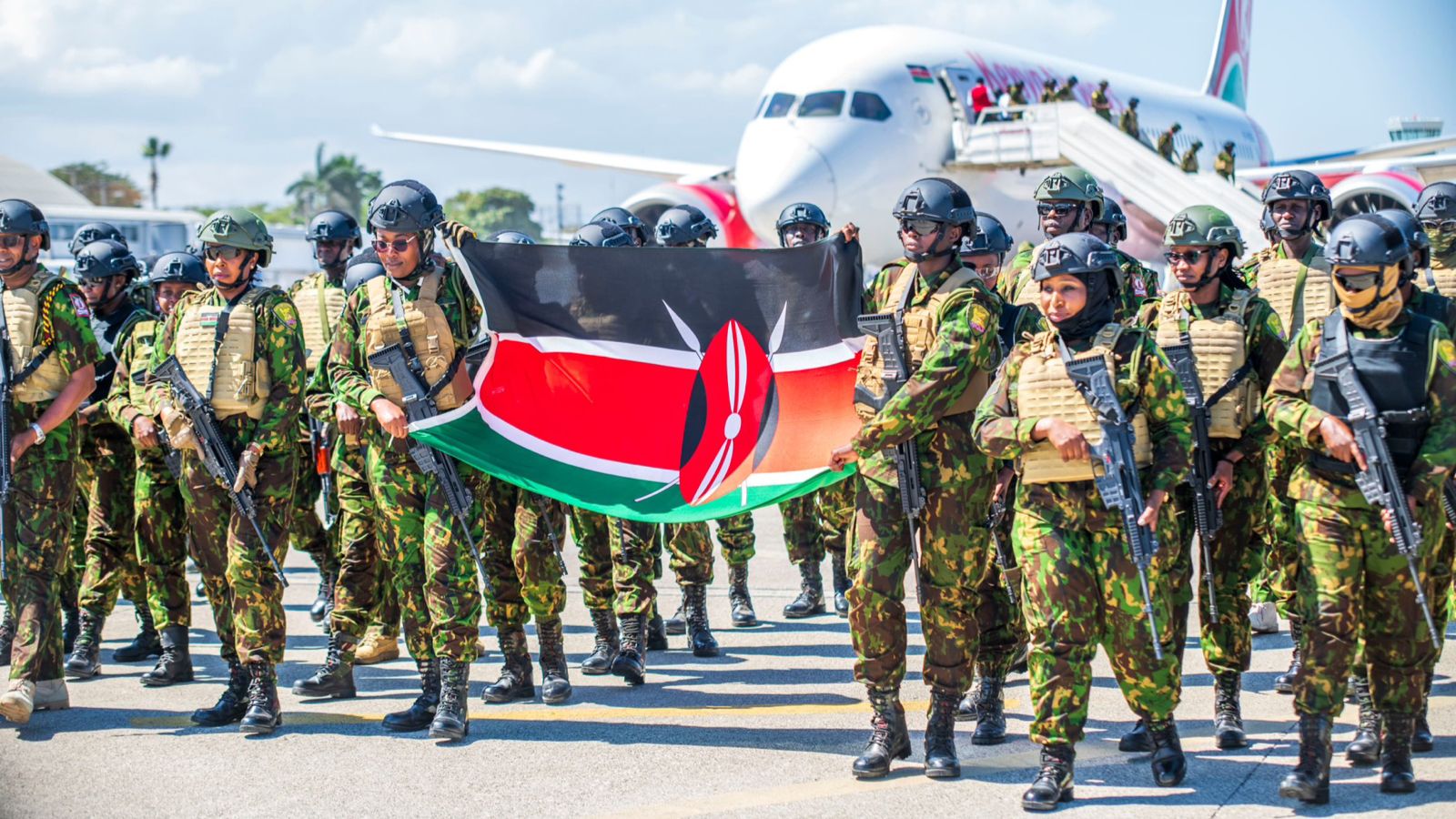
Kenya said it welcomes the unanimous adoption of a Resolution by the UN Security Council to create a new unit to fight gangs in Haiti.
The Resolution transitions the Multinational Security Mission (MSS) authorized in resolution 2699 (2023) (as renewed in resolution 2751 (2024)) to the Gang Suppression Force (GSF) for an initial period of twelve months.
The GSF shall comprise a contingent of 5500 police and military officers bolstered by a UN Technical Office which will assume full responsibility for among others, the provision of logistical support for the GSF and resource mobilization.
The new Mission also has a robust mandate including conducting intelligence-led counter-gang operations to neutralize, isolate, and deter gangs.
Foreign affairs Principal Secretary Korir Singoei said this is a welcome development in the pursuit of a more peaceful and secure Haiti.
“Having led the MSS and cognizant of the challenges the Mission faced as recently articulated by President William Ruto at the 80th UNGA, and having co-sponsored Resolution 2798 in her capacity as a member of the Standing Group of Partners, Kenya certainly welcomes the transition of the MSS to the GSF,” said Singoei.
Kenya has been leading the MSS since June 2024 when they landed there.
GSF will be lethal and beefed up force, supported by both a newly created U.N. Support Office and the Organization of American States. U.S. officials argued that a new, scaled-up and more lethal effort was needed.
Also, the new mission needed to be able to work independently of the Haitian police, something the MSS’ mandate did not allow, which meant that security forces struggled to reduced gangs’ territorial controls as gunmen coordinated and simultaneously launched attacks in different corners of the country.
Among the changes that were pushed was stronger language to ensure children and women are safe, by stressing their recruitment and rape by gangs, and for Haiti to do more to address the root causes of instability and carry out reforms in its governance system. The push was made by Denmark.
Ultimately, the goal of the new suppression force is to support the Haitian police and the Haitian armed forces, and national institutions to ensure security conditions are conducive to holding free and fair elections, and that humanitarian aid can be accessed safely and in a timely manner.
What’s in resolution authorizing ‘Gang Suppression Force’ Like the MSS, the new force will still have a force commander in charge. But now, it will be overseen by a group of countries representing the coalition of the willing, troop contributing countries.
How often will they meet, how will they settle differences, is one of the glaring issues with the proposal say experts on peacekeeping missions when you consider that soldiers and police who’ve never trained or work together are being asked to fight together without a clear support.
Also, the new force will be reporting up through a special representative, a civilian who will provide oversight and political direction.
It will still rely on voluntary contributions to fund its personnel, however, its operations and logistics, including the current U.S.-constructed base in Port-au-Prince, will be overseen by the new U.N. Support Office. In the resolution, the U.N. is asked to provide technical support to the Organization of American States, which is also tasked with providing assistance to both the GSF and Haiti National Police in the form of provisions of food and water, fuel, transport, tents, defense stores and appropriate communication equipment. The resolution also makes specific reference to the Haitian armed forces, a sign of the increasingly important role they must play in the fight.
The newly named special representative will also be responsible for coordinating with the U.N., and the OAS on the deployment of such a package to ensure it strengthens joint operations between the GSF and the Haitian police, including through the construction of operational facilities and security infrastructure supporting joint planning and oversight of operations by both forces. What remains unclear is the cost of the new mission, and where the funding for the logistics will come from.
The newly authorized Gang Suppression Force was approved for a period of 12 months in a vote of 12 in favor with three abstentions.
Russia and China, which hold veto power, abstained.
How the two would vote was the biggest uncertainty going into Tuesday’s meeting, with discussions circulating that Beijing and Russia would try to prolong the expiring mandate of the Kenyan mission by a few months but face a veto from the U.S.
Ahead of the vote, the representatives of more than four dozen countries gathered at a media stake out to show support for both the Gang Suppression Force and the U.N. Support Office.
“The unity and collaboration demonstrated by member states, including the Standing Group of Partners for Haiti and the United Nations, underscore our shared objective: Put an end to the violence and suffering so that Haiti may restore security, rebuild strong institutions and lay the foundations for sustainable development,” Panama’s representative to the U.N. Eloy Alfaro de Alba read in English and Spanish.
“Any further delay of action by the Security Council could mean continued suffering of the Haitian people, with potential consequences for the stability of the region. We urge all council members to act now and pass the resolution before them so that Haiti may have a chance at a better future.”
Both Russia and China during negotiations, which were ramped up last week by Washington, had expressed concerns about the new force’s financing, chain of command and other technical and political questions like the future role of Kenya’s police forces in the new makeup.
Many of those questions persisted, but last week during an address to the U.N. General Assembly, the head of Haiti’s Transitional Presidential Council, Laurent Saint-Cyr, pleaded with the international community for help against the merciless violence.
Haiti has not held elections since 2016, and last had an elected president in 2021 when its head of state, Jovenel Moïse, was assassinated in July 2021 inside his bedroom.
Kenyan mission’s failure to stop gangs In the 15 months since the first contingent of Kenyan police officers arrived in Haiti, more than a dozen neighborhoods have fallen to armed groups that now control up to 90% of Port-au-Prince, and are rapidly expanding north to other regions of the country.
Ruto last week said the mission had “achieved” a lot in Haiti and acknowledged that its lack of equipment, personnel and resources hampered its ability to take control of gangs.
Email your news TIPS to Editor@Kahawatungu.com — this is our only official communication channel
