

KHRC reveals only 13 of 33 bodies exhumed from Kericho mass grave had court approval for burial

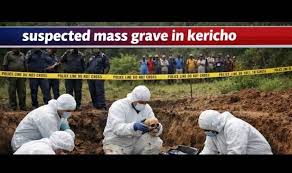
DCI says mass grave bodies in Kericho originated Nyamira
A chilling discovery in Kericho has sparked national outrage after authorities exhumed 33 bodies—most believed to be children—from a mass grave, despite a court order authorizing the burial of only 13.
The discrepancy has raised serious questions about procedural violations, possible criminal liability, and the specter of a wider cover-up involving public institutions.
Documents obtained by the Kenya Human Rights Commission (KHRC) indicate that only 13 bodies had been legally cleared for burial.
These included eight adults, one child, three foetuses, and a set of stillborn twins, as confirmed in official correspondence from Nyamira County Referral Hospital to the Chief Magistrate’s Court in Nyamira.
However, the remaining 20 bodies—undocumented and unexplained—were buried without any court authorization, igniting concerns over how such a breach could occur without detection.
According to KHRC, the burial process appears to have been conducted without proper documentation, coordination, or oversight from county health authorities. This has cast a spotlight on the roles of hospital officials, cemetery management, and law enforcement agencies.
So far, neither hospital authorities nor police have provided a credible account for the additional bodies.
KHRC has warned that the incident may point to a deliberate attempt to conceal unlawful deaths, citing Kenya’s troubling history of enforced disappearances and extrajudicial killings.
The Kericho case bears unsettling similarities to previous incidents that shook the country.
In 2024, bodies of murdered women were discovered in a quarry in Embakasi, in what became known as the Embakasi quarry killings.
Witnesses reported disturbing details, including victims with toothpaste smeared around their eyes—a method used by protesters to counter teargas during anti-Finance Bill demonstrations.
The latest discovery also revives memories of the mass deaths in Shakahola Forest, where at least 429 bodies were recovered in a cult-linked tragedy marked by delayed and opaque investigations.
Terming the Kericho incident a grave violation of constitutional rights to life and human dignity, KHRC has called for an urgent, independent, and transparent investigation.
The rights group is demanding establishment of individual and institutional responsibility, including any involvement of police officers and public officials and determination of whether the unidentified bodies are linked to enforced disappearances or extrajudicial killings.
It also wanted comprehensive forensic identification, including DNA testing, to restore the victims’ identities and full public disclosure of findings, alongside prosecution of those found culpable.
As pressure mounts, the Kericho mass grave scandal is rapidly evolving into a test of Kenya’s commitment to accountability, transparency, and justice in the face of recurring human rights concerns.

