


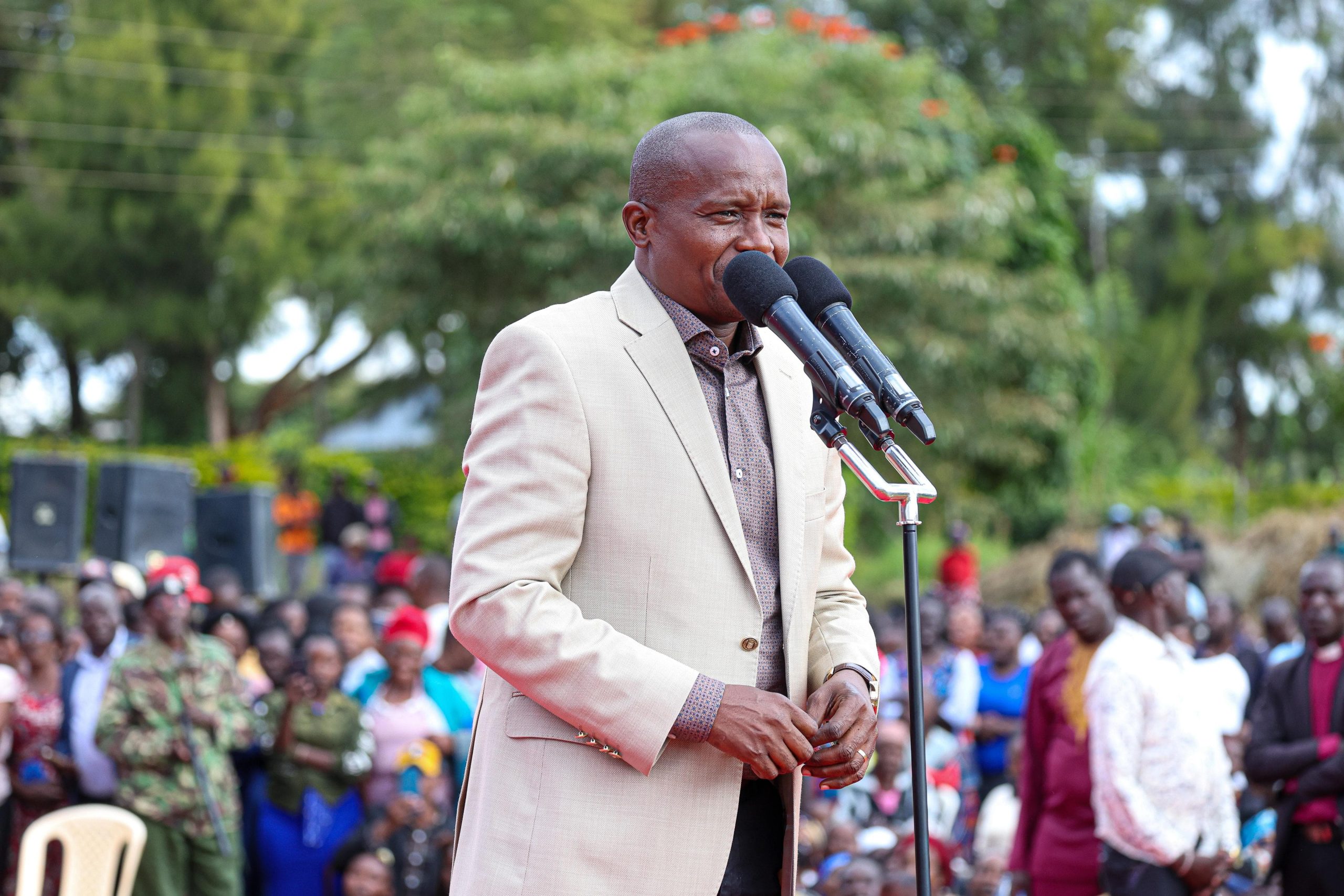
Deputy President Kithure Kindiki Sunday declared the government’s sweeping education reforms irreversible.
He cited recent policy shifts, infrastructure investments, and staffing increases as having reshaped Kenya’s learning ecosystem.
He said the education sector’s transformation over the last 22 years has reached a tipping point, with reforms implemented in just the last two years anchoring long-term change.
“These milestones are not cosmetic. They are foundational, permanent shifts that will define the future of education in Kenya,” Kindiki said in a statement released Sunday.
Among the reforms, he stated that the resolution of early challenges associated with the Competency-Based Curriculum (CBC).
CBC has evolved into a more comprehensive Competency-Based Education and Training (CBET) model.
Kindiki confirmed that a seamless national transition into senior school under CBET is scheduled for January 2026.He also revealed that 23,000 classrooms have been constructed nationwide in the last two years—16,000 through the Ministry of Education and another 7,000 through the National Government-Constituency Development Fund (NG-CDF).
Kindiki described the infrastructure rollout as “unprecedented in our history.”
The construction of 1,600 new science laboratories will soon begin to enhance learning in science and technology, with a focus on underserved regions and schools offering Science, Technology, Engineering and Mathematics (STEM) programs.
On staffing, the Deputy President described the recruitment of 76,000 teachers since 2022 as “the boldest move yet to fulfill the constitutional right to basic education.”
He noted that this number dwarfs the historical average of 5,000 teachers recruited annually.
An additional 24,000 teachers are expected to be hired in December, bringing the total to 100,000 within three years.
“That’s almost a third of all teachers employed between 1963 and 2022,” Kindiki said.
The TVET sector has also undergone major expansion, he said.
Kindiki said enrollment has increased from 297, 000 in 2022 to 700, 000 today.
He attributed the growth to government investment in the sector through equipment, recruitment of tutors, introduction of flexible modularised curriculum, the Dual Training Policy and the system for recognition of prior learning.
“The Dual Training Policy is a game-changer,” he said.
“We are now producing skilled graduates who are not just certified, but actually employable.”
To complement this, the Recognition of Prior Learning (RPL) certification system is being rolled out to recognize and validate skills acquired through informal or on-the-job experience.
“It’s time we acknowledged real-world knowledge, not just classroom credentials,” Kindiki added.
He announced that a new university funding model is already being refined to ensure no student is denied access due to lack of fees. He also noted that the model is intended to prevent financial collapse in several struggling public universities.
“Access to university education should not be a privilege. It must be a right for every deserving Kenyan,” said Kindiki.
He also highlighted the establishment of the Open University of Kenya, calling it “a revolutionary step” toward democratizing higher education through digital, distance-based learning.
“These are not isolated wins—they represent a complete re-engineering of Kenya’s education system to meet the demands of the 21st century,” the Deputy President emphasized.
Kindiki maintained that the reforms are “firmly on track” and assured Kenyans that the government will stay the course to ensure education remains a central pillar of national development.
His statement comes at a time the government is under criticism for reducing capitation fees by almost Sh6,000.
Email your news TIPS to Editor@Kahawatungu.com — this is our only official communication channel
