

LSK threatens court action over election results livestreaming, police reforms

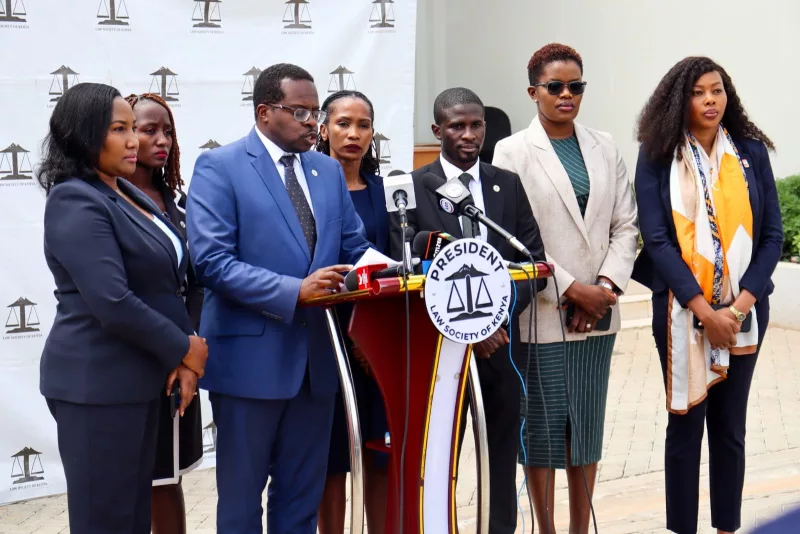
LSK threatens court action over election results livestreaming, police reforms
The Law Society of Kenya (LSK) has threatened legal action against Parliament over proposed changes to election laws that could weaken public scrutiny and verification of results ahead of the 2027 General Election.
LSK President Charles Kanjama said the society would move to court to challenge any legislation that undermines transparency in the management and declaration of election results, insisting that Kenyans must be able to independently scrutinise results transmitted by the Independent Electoral and Boundaries Commission (IEBC).
In a wide-ranging statement on Friday, Kanjama called on Parliament to publish the approved text of the Elections (Amendment) (No. 2) Bill, 2024, together with the record of amendments, following conflicting accounts over what the National Assembly passed.
He said electronic transmission of results and livestreaming served different purposes, arguing that transmission sends results to IEBC systems while livestreaming allows the public to follow the results as they are received.
Kanjama said publication of polling station results forms would provide an additional mechanism for verifying figures and identifying discrepancies.
“The safeguards work together,” he said, calling on Parliament to expressly protect livestreaming of polling station results through a publicly accessible platform.
The LSK president cited previous court decisions, including Katiba Institute & 3 Others v Attorney General & 2 Others (2018) and a subsequent Court of Appeal decision in 2023, which found Section 39(1G) of the Elections Act unconstitutional.
The provision had required livestreaming of polling station results but restricted their use to public information, excluding them as a basis for the Commission’s declaration.
Kanjama maintained that the decisions did not prohibit livestreaming, arguing that Parliament should enact provisions that give the public meaningful opportunities to scrutinise and verify election results.
The statement comes amid a public dispute over the National Assembly’s consideration of the amendment Bill. Government and parliamentary officials have maintained that MPs deleted the contentious Clause 22, retaining the existing livestreaming requirement under Section 39 of the Elections Act. The Bill was referred back to the Senate for consideration of the amendments.
Beyond the election laws, LSK announced plans to challenge a Court of Appeal decision that stripped the National Police Service Commission (NPSC) of powers over the recruitment and management of uniformed police officers.
The judgment, delivered on October 16 in consolidated appeals involving the commission, LSK and lawyer Harun Mwau, upheld a previous ruling that placed the recruitment of uniformed officers under the National Police Service and the Inspector-General’s independent command.
The court held that the commission’s constitutional mandate over recruitment, appointments, promotions and transfers applied to civilian employees within the service rather than uniformed officers.
Kanjama, however, argued that the decision had weakened the constitutional safeguards established to promote police accountability and professional independence.
He said the commission was established to provide independent oversight of personnel decisions, including recruitment, promotions, transfers and disciplinary control, while the Inspector-General remained responsible for operational command.
LSK has lodged a notice of appeal and intends to move to the Supreme Court to challenge the interpretation of Article 246 of the Constitution.
The society also questioned the continued tenure of President William Ruto’s Cabinet following the expiry of a court-granted period to comply with the two-thirds gender principle.
Kanjama said the four-month window granted by the High Court to allow the President to reconstitute the Cabinet had expired without compliance, leaving the Executive in violation of the Constitution.
The court had declared the Cabinet unconstitutional over its failure to meet the gender requirement and granted the President 120 days to address the composition.
The deadline expired on October 28, with the Cabinet still short of the constitutional threshold.
According to Kanjama, the continued failure to implement the court order exposed the President and Cabinet to constitutional consequences, including the possibility of their decisions being challenged.
He called on Attorney General Dorcas Oduor to advise the President to reconstitute the Cabinet without further delay, warning against continued non-compliance with court orders.
The LSK also demanded accountability over alleged political involvement by public officers, singling out Communications Authority of Kenya Chairperson Charles Karondo over claims that he participated in campaigns during the Ol Kalou by-election.
Kanjama said the society had called for Karondo’s suspension and an investigation into the allegations, arguing that public officers entrusted with politically neutral responsibilities should not use their positions, public resources or influence to benefit political parties or candidates.
He warned that the conclusion of the by-election should not be used as an excuse to abandon investigations into the allegations.
The lawyers also turned their attention to the abduction of Standard Group Associate Editor Alex Kiprotich, demanding that the Director of Criminal Investigations (DCI) publicly account for allegations linking officers attached to DCI headquarters to the incident.
Kiprotich was abducted near Gilgil weighbridge on September 1 before being released hours later.
LSK expressed concern over what it termed a lack of substantial action two months after the incident, giving the DCI seven days to identify, arrest and charge suspects allegedly involved.
Kanjama warned that failure to act within the stipulated period would force the society to institute legal proceedings to pursue command responsibility and accountability.
The incident had attracted attention from media organisations and press freedom advocates, with questions raised over the circumstances surrounding the abduction and the progress of police investigations.
On professional conduct, the LSK president said the society was pursuing internal disciplinary processes involving legislators Peter Kaluma and John Kaguchia, both advocates, over remarks attributed to them.
He maintained that election to Parliament did not exempt advocates from their professional obligations, warning that political engagement should not become an excuse for threats, incitement or conduct amounting to professional misconduct.
Kanjama said both members would be accorded an opportunity to respond before the disciplinary processes were concluded.
The society also raised concerns over restrictions on public institutions engaging external advocates, arguing that the limitations could undermine the delivery of legal services by government agencies.
It cited a ruling delivered on January 30, 2026, in Gikenyi B & 6 Others v Council of Governors & 68 Others, which retained restrictions on fresh engagements of external lawyers by public institutions, subject to specified conditions.
LSK argued that external advocates complement the work of State Counsel, county attorneys and in-house legal departments, particularly where additional capacity or specialised independent advice is required.
While supporting scrutiny of public expenditure on legal services, Kanjama opposed restrictions that, in his view, unjustifiably limit the autonomy of public institutions to procure legal services in accordance with procurement laws.
He said the society would continue defending the lawful engagement of private practitioners by public agencies.
In his closing remarks, Kanjama said the society would remain engaged in defending constitutional safeguards, professional standards and accountability in public institutions as the country prepares for the 2027 General Election.
“Kenyans need an election they can verify, a police service subject to effective constitutional safeguards and public officers who understand the obligations of their positions,” he said.
He added that LSK would pursue legal action where necessary to protect constitutionalism and the rule of law.

