

Former IPOA boss Makori pledges to follow law if selected as apex judge

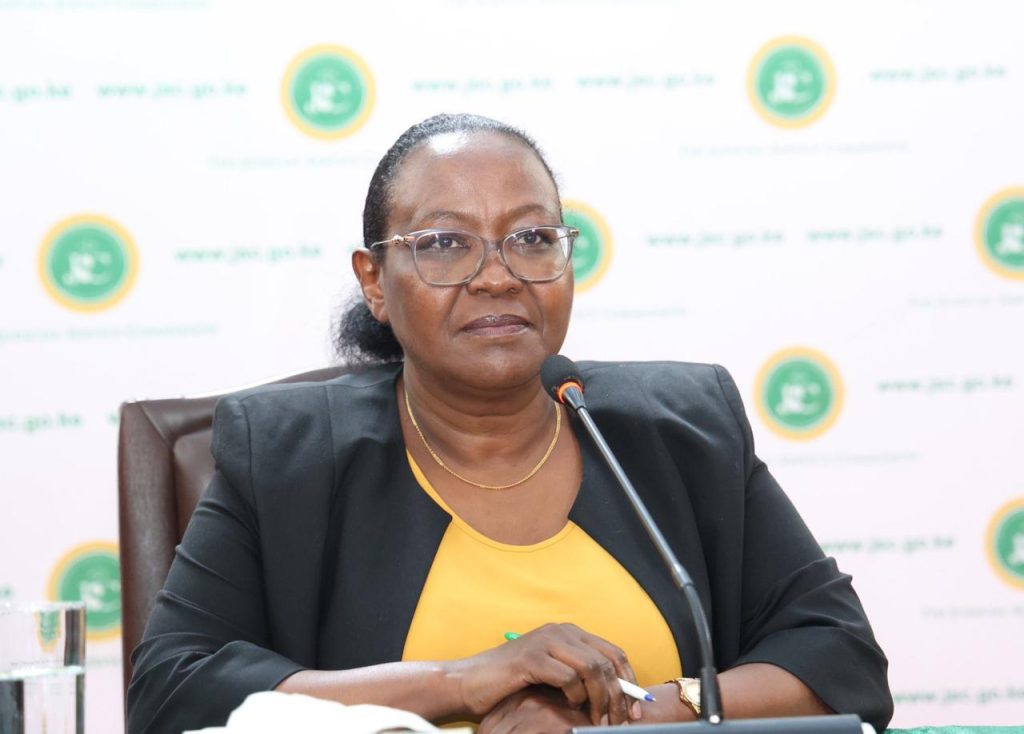
Former Independent Policing Oversight Authority (IPOA) Chairperson Anne Waceke Kiratu Makori told the Judicial Service Commission (JSC) that if selected as a Supreme Court judge, she will be firmly guided by the Constitution and the law in executing her duties.
Appearing before the commission, Makori said judicial decision-making must remain anchored in constitutional principles, adding that she would uphold integrity, independence, and accountability on the bench.
“Whatever I do must be supported by the Constitution and the law,” she said. “If I encounter a conflict, I will disclose it to my colleagues and we will determine the best approach.”
Makori reiterated that her experience across public service, corporate governance, private practice, and human rights makes her a strong candidate for the position.
“I am the person with the experience for this high position. My background spans several sectors, and I have had the opportunity to lead a national institution,” she said.
She acknowledged that while she has appeared before the High Court in appellate matters, she has not practiced before the Court of Appeal or the Supreme Court, but emphasized that judicial work is collaborative.
“We are all lawyers with different exposures and capabilities. I will not be sitting alone,I will be part of a collegial bench. Where I have gaps, I will learn,” she said.
Makori noted that her legal experience is mainly in civil litigation and commercial law, and stressed that continuous engagement is key to mastering the law.
“The best way to learn the law is through experience and exposure. If you only study and do not engage, you risk becoming rusty,” she said.
During the interview, she also addressed her tenure at IPOA, saying it provided her with critical experience in governance, accountability, and decision-making under pressure.
She recounted a challenging moment when she opposed efforts by commissioners to remove the CEO, arguing that the move lacked substantive justification.
“It was not just about procedure, it was also about the substance of the decision. I felt termination would have been a mistake,” she said, adding that the matter was later resolved after seeking the Attorney General’s opinion.
Makori dismissed claims that she was domineering in her leadership style, describing herself instead as firm.
“In leadership, especially in public institutions, there are areas where you do not seek consensus particularly on accountability and prudent use of resources,” she said.
She also denied allegations of irregularities in recruitment at IPOA, insisting that all processes were transparent and open to audit.
“There were no irregularities. If there were concerns, they would have been formally raised and audited,” she said.
On judicial priorities, Makori said she would support efforts to reduce case backlog through strict case management and limiting unnecessary adjournments.
“If a matter must be adjourned, there must be proper justification so that timelines are respected,” she said.
She further highlighted the importance of stakeholder engagement through frameworks such as the National Council on the Administration of Justice (NCAJ), saying it enables collaboration across the justice sector.
Makori also emphasized the judiciary’s role in community development, saying that access to justice is critical for economic growth and social stability.
“Timely and accessible justice builds public confidence and supports business and social development,” she said.
The interview ended on a tense note after Chief Justice Martha Koome raised concerns over Makori’s failure to submit required wealth declaration documents.
Makori said she believed she had uploaded the documents online and had physical copies at home, maintaining that she is fully compliant as a public officer.
“I honestly thought the uploaded documents came through. I am compliant,” she said.
In her closing remarks, she thanked the commission for the opportunity and expressed hope that the omission would not affect her chances.
“I hope I have persuaded the panel and will still be considered the right candidate,” she said.

