

Man in court over appointment of Kindiki as Deputy President

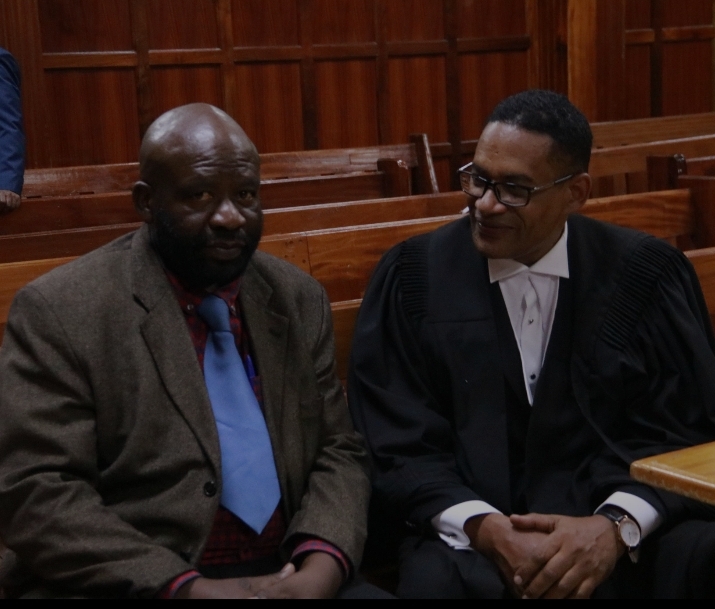
Businessman Joseph Enock Aura with his lawyer Harrison Kinyanjui
Businessman Joseph Enock Aura has asked the High Court to nullify the appointment of Deputy President Kithure Kindiki, describing him as an “imposter” and arguing that he was never lawfully nominated, elected or sworn into office.
Through his lawyer Harrison Kinyanjui, Aura has challenged the constitutionality of the entire process that led to Kindiki’s elevation following the impeachment of former Deputy President Rigathi Gachagua in October 2024.
During oral submissions before a three-judge bench comprising Justices Eric Ogolla, Winfrida Mugambi and Anthony Mwita, Kinyanjui argued that Kindiki’s nomination, parliamentary approval and subsequent swearing-in were riddled with constitutional and procedural violations.
In written submissions, the petitioner accused the National Assembly and the Senate of violating the Constitution, their respective Standing Orders and the Public Appointments (Parliamentary Approval) Act, describing the process as a “sham” conducted with “unseemly haste.”
According to Aura, Kindiki was ineligible for nomination as Deputy President on October 18, 2024, because he was still serving as Cabinet Secretary for Interior and National Administration.
The petitioner relies on Article 137(2)(b) of the Constitution, which disqualifies a person who “is a public officer, or is acting in any State or other public office” from being nominated as a presidential or deputy presidential candidate.
“The 10th Respondent has never formally resigned as Cabinet Secretary, and no Gazette Notice has ever been published to signify the cessation of his occupancy of that office,” the written submissions state.
Aura further argues that no legally constituted Independent Electoral and Boundaries Commission (IEBC) was in place at the time to declare a vacancy in the office of Deputy President and verify the nominee’s qualifications.
“The Speaker of the National Assembly and the National Assembly have no lawful power to declare the position of the Deputy President vacant,” the submissions assert.
During the oral arguments, Kinyanjui also challenged the legality of Kindiki’s swearing-in on November 1, 2024, arguing that the date had not been lawfully declared a public holiday.
He maintained that President William Ruto could not have lawfully appointed Prime Cabinet Secretary Musalia Mudavadi as Acting Cabinet Secretary for Interior on October 31, 2024, because he was in Burundi attending a COMESA Heads of State meeting.
“Kindiki was sworn in as an imposter. He became an imposter because Ruto was in Burundi on 31st October, 2024 and he could not have lawfully appointed Hon. Musalia Mudavadi to declare 1st November 2024 as a public holiday for Kindiki’s swearing in.
Section 3 of the Public Holidays Act was violated; therefore, there was no public holiday on the 1st November for the swearing-in of Honourable Kindiki. He was never sworn in; he’s an imposter. He never took the oath according to law and, as I’ve shown you, he was never elected,” Kinyanjui stated.
The lawyer further insisted that Mudavadi never took the oath of office as Acting Cabinet Secretary for Interior, arguing that Article 74 of the Constitution requires State officers to take an oath before assuming office.
“The Deputy President was still in acting position as CS interior. Wetangula found himself in a connudrum. Ruto while in Burindi on a COMESA Heads of State meeting decided to take Musalia in acting position CS Interior, when Article 74 of the Constitution forbids him from taking any position in acting capacity without taking an oath of office. When did Musalia get sworn in as CS?” he posed.
The written submissions also challenge the Gazette Notice declaring November 1, 2024, a public holiday, arguing that it was issued by Mercy Wanjau, who allegedly lacked statutory authority to make such a declaration.
“The 14th Respondent was, and is unconstitutionally and unlawfully arrogating to herself the powers conferred on, and delegated by law to the Cabinet Secretary of Interior… to declare holidays in Kenya,” the submissions state.
The petitioner also questions the appointment of Mudavadi as acting Interior Cabinet Secretary, arguing that Executive Order No. 5 of 2024, cited in the appointment, had already been used on July 5, 2024, to establish a taskforce on human resources for health.
“NO 2 Executive Orders by the President of Kenya can bear the same number in the same year, directing themselves to diverse subjects,” the submissions argue.
Aura has also challenged the National Assembly’s approval of Kindiki’s nomination, arguing that MPs endorsed his appointment within hours of receiving the President’s message on October 18, 2024, without following the prescribed vetting procedures.
According to Hansard extracts cited in the written submissions, Speaker Moses Wetangula guided the House that “no debate arises on a matter that the House is required to take a vote,” effectively locking out scrutiny of the nominee.
The petitioner argues that the Public Appointments (Parliamentary Approval) Act requires a vetting committee to examine a nominee’s suitability, prepare a report and table it before the House for debate.
“No hearing of, or report generated on the purported nomination of Prof. Abraham Kithure Kindiki… exists,” the submissions state.
“The nominee never appeared before the National Assembly at any time for the purported approval hearing.”
The petitioner further claims that the electronic voting system malfunctioned during the proceedings, forcing a roll-call vote, while approximately 36 MPs did not have their voting cards.
“Was this consent of the governed to be secured AFTER the vote?” the petitioner asks.
During the oral submissions, Kinyanjui also accused Wetangula of losing control of the House, arguing that the voting process was unconstitutional.
“The Speaker lost control of the House; the Speaker could not conduct a proper vote. Speaker Wetangula vote of the nomination of Kindiki Kithure to the office of the Deputy President defies article 145(1) of the Constitution delegated to the kenyan people each to cast a vote via their elected representatives. I ask you to declare that as an unconstitutional voting, null and void,” he submitted.
The lawyer also questioned how Kikuyu MP Kimani Ichung’wah cast his vote, claiming that the proceedings lacked transparency and order.
He argued that Standing Order 70(3) of the National Assembly Standing Orders required MPs to expressly state either “I vote Yes” or “I vote No” when called upon to vote, rather than simply responding with an affirmation.
“We dont know how Ichung’wa voted. It was like a market place. Kimani only announced an affirmation “yes” to his name; he did not vote.
They are chaos in the National Assembly yet there was supposed to be order,” he stated.
The petition also seeks to overturn Gachagua’s impeachment, with Aura arguing that the process was fundamentally defective from the outset.
He challenges the Special Notice of Motion dated September 26, 2024, which initiated the impeachment proceedings, claiming it violated Standing Order 64(5) of the National Assembly Standing Orders.
The petitioner alleges that several MPs who had initially signed in support of the motion subsequently withdrew their support, voted against it, or stayed away from the proceedings, but were still listed as supporters in parliamentary records.
“Hon. Charles Nguna had cancelled and withdrawn his name… yet he was mysteriously listed as Member number 103 in the subject National Assembly’s Order Paper of October 8th, 2024 as allegedly supporting the impeachment Motion,” the submissions state.
Aura argues that the motion was therefore “dead on arrival” and could not form the basis of a valid resolution to impeach the former Deputy President.
He further contends that the National Assembly lacked jurisdiction to entertain some of the allegations against Gachagua because they involved matters that were sub judice and issues falling within the mandate of the Ethics and Anti-Corruption Commission (EACC).
“The National Assembly unconstitutionally arrogated to itself the role of the EACC conferred Constitutionally on the EACC under Article 79 of the Constitution,” the submissions state.
The petitioner also faults the Senate for proceeding with the impeachment trial without first determining whether the National Assembly’s resolution had been validly passed.
“The Senate received from the National Assembly not merely a legally unsound impeachment Resolution… but the embodiment of an unconstitutional and illegal act,” the submissions say.
Aura further argues that the impeachment proceedings violated the constitutional rights of residents of four constituencies that allegedly had no representatives in the National Assembly at the time.
The constituencies are Banissa, Gwassi (Suba South), Magarini and Ugunja.
“The constituents of Magarini, Ugunja, Banisa, and Gwassi had NO representative in the National Assembly, and were hence unrepresented in all aspects relating to the said decision,” the submissions state.
He argues that the alleged lack of representation amounted to discrimination contrary to Article 27(4) of the Constitution.
The petitioner has also faulted the Senate for allegedly failing to facilitate public participation during Gachagua’s impeachment trial.
“The 4th Respondent herein (Senate of Kenya) through Jeremiah Nyegenye expressly admits in its Replying Affidavit that there was NO public participation in the entire span of the TRIAL of the purported impeachment allegations,” the submissions state.
Aura further argues that the Senate violated Gachagua’s right to a fair hearing when it declined to adjourn proceedings after the former Deputy President fell ill on the afternoon of October 17, 2024.
“By a Resolution of the Senate voting on the night of 17th October 2024… the purported impeachment of H.E. Hon. Rigathi Gachagua was Gazetted,” the submissions note.
The respondents had argued that the issues raised in the petition were political questions beyond the jurisdiction of the courts.
However, Aura maintains that the High Court has constitutional authority to examine the legality of actions undertaken by Parliament and other State institutions.
He relies on Article 165(3)(d)(ii) of the Constitution, which empowers the High Court to determine whether anything done under the authority of the Constitution or any law is inconsistent with or in contravention of the Constitution.
“The Political Question Doctrine stands ousted by dint of Article 165(3)(d)(ii) of the Constitution,” the submissions state.
Citing previous court decisions, including the Supreme Court’s decision in Speaker of the National Assembly v Attorney General, the petitioner argues that accepting the political question doctrine would shield Parliament from constitutional scrutiny.
“Were it to be accepted, the doctrine of Political Question to oust the Court’s jurisdiction… would effectively elevate Parliament above the Constitution of Kenya,” said Aura.
“Its unfair for the Respondents to claim impeachment is a political question. Impeachment is a legal and constitutional through and through,” he submitted.
He warned that upholding Kindiki’s appointment despite the alleged violations would undermine constitutional accountability.
“That is not the jurisprudence we want to carry forward. We must reprimand it. And then, my Lords, we have not even come to the point of saying, what is a cost of these unconstutuonalities on us as a people? We have a Constitution, and Article 3 demands that it be respected,” said Kinyanjui.
He further urged the judges to uphold their constitutional obligations.
“And Article 3 is binding on all of us. When do we allow such an egregious sort of violation of the Constitution and still blink at it and say that it can be allowed; what is the cost to us? We come across as dishonest, and unfaithful to the Constitution. If we’re judicial officers sworn to uphold the Constitution, why would we defend an indefensible position as I’ve shown you?”
In his petition, Aura wants the court to declare that no vacancy in the office of Deputy President was declared by the IEBC and that Kindiki was ineligible for nomination to the position.
He is also seeking a declaration that the National Assembly’s approval of Kindiki’s nomination was unconstitutional, illegal and procedurally flawed, alongside an order quashing the Gazette Notice that confirmed the appointment.
The businessman further wants the court to overturn the Senate’s decision to impeach Gachagua and issue an order barring Kindiki from exercising the powers and functions of Deputy President.
He is also asking the court to invalidate Executive Order No. 5 of 2024 and Gazette Notice No. 14101, which he challenges in connection with the appointment of Mudavadi as acting Interior Cabinet Secretary and the declaration of the swearing-in date as a public holiday.
The National Assembly, the Senate and the Attorney General contested the petition through grounds of objection and replying affidavits.
The petitioner, however, alleges that the Attorney General’s affidavit was sworn in opposition only to his conservatory-orders motion and not to the petition itself, and that several respondents including Prof. Kindiki, the Chief Justice, Musalia Mudavadi, Mercy Wanjau, Head of Public Service Felix Koskei and the EACC filed no response at all and did not rebut the factual claims in his depositions, despite being served.
“The 10th Respondent… has not opposed the Amended Petition herein in any manner,” the submissions state.
“He also did not respond to the FACTS of, and concerning him which the Petitioner set out in his depositions.”

