

Mysterious ‘Virgin Mary’ image draws thousands to Kisii village

Mysterious ‘Virgin Mary’ image draws thousands to Kisii village
It began with an ordinary wall.
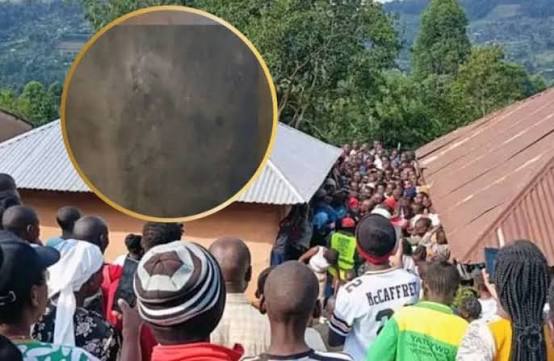
There was nothing remarkable about the wall at a modest home in Emenwa village, Nyamache, Bobasi, Kisii County—until villagers began claiming they could see the unmistakable outline of a woman on it.
Then came the whispers.
“It looks like Mary.”
Within hours, word had spread from one homestead to another, carried along village paths and amplified by mobile phones and social media.
The quiet rural village was suddenly at the centre of an unusual mystery.
Hundreds of curious residents began streaming to the homestead, with some travelling from neighbouring areas to see the image for themselves.
They stood before the wall, stared at the markings, moved closer and viewed them from different angles, trying to establish whether the pattern resembled the Virgin Mary.
Days later, the home had become an unexpected attraction, drawing thousands of people, many of them Catholic believers.
For some visitors, the resemblance was striking.
Joseph Motume was among those who said the image bore similarities to traditional depictions of the Virgin Mary.
Others remained unconvinced, describing it as nothing more than an unusual pattern on a clay wall.
But uncertainty has done little to dampen the excitement.
Visitors have been taking photographs of the image on their phones, while groups of believers debate its possible religious significance.
For three consecutive days, what started as a village rumour has spread across the internet, attracting the attention of believers from different Christian denominations as well as agnostics and sceptics.
Lydia Nyaboke, a lifelong Catholic, travelled to Emenwa on Saturday to see the image.
“I have seen Virgin Mary, no doubt about it,” she said.
Nyaboke’s phone captured what appeared to be a faint, scrubby image on the clay wall.
“The image appears to you as Mary if you believe,” she said.
She said she intended to return after the crowds had subsided.
Mary Mokandu, another believer who visited the homestead, also vowed to make another trip.
“It was not easy taking in everything before a surging crowd,” she said.
The phenomenon has revived an age-old question about faith and the possibility of extraordinary experiences occurring in ordinary surroundings.
For devout Christians, the Virgin Mary occupies a revered place in the story of Jesus Christ. Reports of perceived images of Mary have emerged in different parts of the world, with believers claiming to have seen her likeness in clouds, trees, walls and other everyday objects.
But such claims are often difficult to verify.
Scientists point to a phenomenon known as pareidolia, in which the human brain recognises familiar shapes—particularly faces—in random or ambiguous patterns.
A stain can appear to have eyes. A crack can resemble a nose and mouth. Shadows and markings can combine to create what looks like a familiar figure.
The explanation offers a possible reason why different people can look at an indistinct pattern and independently perceive a recognisable face.
Yet in Emenwa, scientific explanations have done little to diminish the sense of wonder among visitors.
The attraction lies precisely in the unresolved tension between faith and evidence, coincidence and belief.
There has been no declaration by an established religious authority that the image is miraculous, while no scientific evidence has established that it represents a supernatural manifestation.
For now, the image remains what it was when the first villager noticed it—a mysterious pattern on a wall that has captured the imagination of an entire community.
The sudden influx of visitors has transformed Emenwa from a quiet rural village into an unlikely destination for the curious and the faithful.
As evening falls and visitors begin leaving, the wall remains silent and unexplained.
Yet the question continues to circulate among those who have seen it:
Is it really the face of the Virgin Mary—or simply a face that exists because people believe they can see it?
For now, nobody has the final answer.
But the rumour has already achieved something extraordinary.
It has brought a sleepy village to life.
As journalists prepared to leave the scene, police officers arrived amid concerns over the growing crowds and the possibility of a stampede.

